
5 23.873s 115 57.082w
Leaving Panama, we had not intended to stop in the Galapagos. It is expensive and, after living through the paperwork and endless nose-swab tests relating to quarantines and COVID, the red tape for entry to the Galapagos was more than we wanted to tackle.
But, after weeks of sailing, we spotted land. An island appeared before us, looking like a Martian landscape. The urge to visit the Galapagos was irresistible. We headed back out to sea to clean our boat bottom.


We knew that Ecuador, much like New Zealand, is protective of its ecosystems and does not want to introduce invasive species by way of algae or other marine growth. We had heard that, as part of the entrance procedure, port authorities would put a camera under a boat and look for signs of growth. Rumor had it that a single barnacle was enough for the authorities to send you back out to sea to do a proper cleaning. Divers are available to do the work at your expense.
Bottom Cleaning in an Anchorage vs. in Deep Water
Cleaning the bottom of our catamaran is usually one of my favorite boat jobs. In addition to being able to visit restricted environments, a clean bottom eliminates drag in the water, meaning we can go faster under sail.
Using a large drywall scraper, scrub brush and screwdriver, I enjoy removing the barnacles and watching the fish that my efforts attract. I do this job about twice a month.
The downsides are that it can be time-consuming, my children sometimes ask me to resolve disputes while I am in the water, and I often leave the water with sea lice — thousands of flailing bodies — clinging to my wetsuit. Sea lice look like tiny shrimp but they are actually the larvae of jellyfish. They can cause a stinging sensation on exposed skin, which is why I cover up as much as possible. (The good news is that they die when you spray them with fresh water.)
Scraping a Boat Bottom in Martinique
The video below shows what bottom cleaning looked like in Martinique, in about 20 feet of water, which is where we spent COVID.
Bottom Cleaning in Sainte-Anne, Martinique
Scraping a Boat Bottom in Deep Water as We Approached the Galapagos
Swimming in rough, cold water with the Galapagos islands on the horizon was not something I was looking forward to.
Day 1: Along the Waterline with Help from Above
The waves were lifting the bow of our boat out of the water. At the back, the underside of our boat was clearly visible with each passing wave. The area between our hulls offered very little air space as the waves slapped and sloshed at the sides.
Tools, Conditions and Creatures of the Deep
The boat bottom cleaning took about 8 hours total and was done over 2 days in rough water, 2,000 meters deep. I used a mask, snorkel, fins and a 3mm wetsuit. Our boat is only 4’3” below the water so there is no need for dive equipment. The water was a beautiful painter’s tape blue, absolutely clear. Karen says that, at sea, the water is “so clear you could track a single hair in it”.
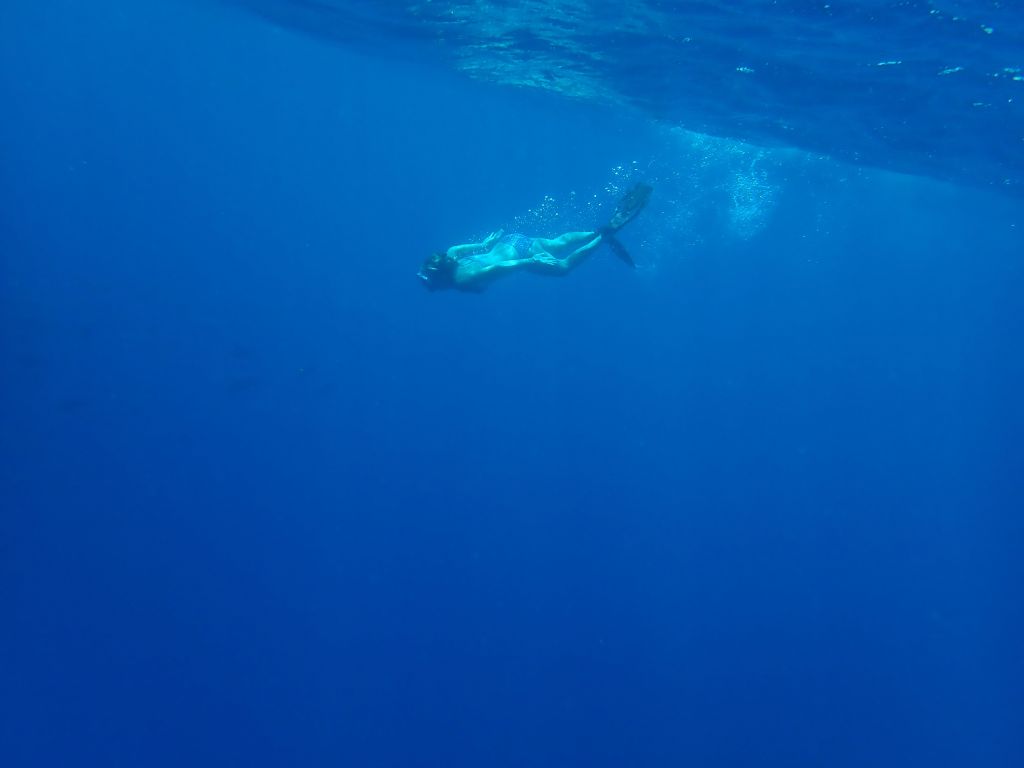
Checking for Large Sea Creatures
Waves, cold water and other factors aside, my number one fear was sharks. As I gathered my cleaning tools I summoned courage to get in the water.
When I saw small birds swimming behind our boat. I reasoned that if they could be in the water without losing a leg, perhaps I would be okay too.
I put on my wetsuit, and jumped in. I felt the cold water creep around my outline. Despite being at the equator, the water was only 24 degrees Celsius. This was a marked difference to the water during our family swim at the equator, where the water was 31 degrees Celsius.
Opening my eyes, I went to work. I saw about 6 small fish with bright yellow lips. They followed me about as I swam. As long as the fish didn’t get progressively bigger I was happy.
Ever watchful for sharks, whales, molas, dolphins, and giant squid — I was, instead, enchanted by small jellyfish with long tentacles. The clarity of the water made them appear like they were part of an exhibit at a major aquarium.
Breathing in Time with the Waves
With only a snorkel and no dive equipment, breathing can be exhausting. A large part of the physical activity is timing my breathing to ensure I can come up for air without getting hit in the head with the boat.
As I worked below, Paul and Henry jumped in and scrubbed the algae at the waterline. The barnacles on our boat were surprisingly large, purple, and abundant. (I would have liked to have been more thorough when we left Panama, but there were crocodiles in the water.)
The boys’ boisterous shouts were distracting; when I surfaced, my ears were on high alert in a way that any parent will recognize. I was constantly scanning to detect whether I was hearing screams of delight or pain and injury.
I continued to scrape the boat bottom. Rick rigged lines around the outsides of the boat. He watched from above to make sure someone didn’t accidentally get sent out to sea. And, then he started the generator.
With my breathing already compromised by big waves, the generator exhaust was annoying. And so I avoided cleaning that area until the second day. Leg cramps signaled to me that it was time to get out of the water.
Slightly grumpy about the diesel fumes, I missed Rick’s kind intentions. He had run the generator to make water (using our reverse osmosis machine) and heat it for me to have a shower. This was a real treat as most of our showers are cold and infrequent.
Day 2: Big Waves Continue
On the second day, a wave caused my head to hit the underside of the boat. That was enough for me to call it a job done. I was pretty much ready to come in at that point anyway. I had been thorough and, despite conditions, I was not seasick.
No sharks spotted
At this point, we had been sailing for seven years, and there were still no in-the-water shark sightings for me. But that soon changed when we went on a tour in the Galapagos.
When we arrived in the Galapagos, I expected someone to run a camera along our boat bottom. But, that did not happen.
Pin it
I’m now on Pinterest. If you enjoyed this story, you can save it to your own Pinterest board using the image below. Thanks for reading and following our journey.
Next post in the Galapagos series: Jumping into The Water of the Galapagos Was Like The Best Exhibits in the Zoo had Thrown the Doors Wide Open
 Becoming a Sailor