
Today, a single breadfruit tree outside my bus window flashed within the foliage of a moist tropical forest in Fiji. For the remainder of my trip, I watched the array of green before me. Our travels have provided a front-row seat to subtle shifts in ecosystems, and historical controversies. The sight of a single green, globular fruit hanging from a branch seemed, to me, to be very curious.

Ecosystem appreciation begins early
As a kid, I liked when the landscape would change as my family drove 500 kms from our home in the dry, subarctic climate of Whitehorse, Yukon to go camping in the temperate rainforest of Juneau, Alaska. I appreciated that Alaska was lush and smelled like cedar, not pine. Canada has 20 different ecosystems. It boggles my mind that a breadfruit might grow in Fiji, and also be found Caribbean, which is about 7500 nautical miles away.
Breadfruit: Passengers of Captain Bligh?
I wondered, could this breadfruit tree be related to the mission of Captain William Bligh? Borrowing from my experience in the Galapagos, perhaps the breadfruit seeds travelled by sea? Surely, the presence of the breadfruit tree couldn’t be explained just by its ability to grow in warm climates.
The Pacific Islands and the Diaspora of People and Plants
Tracing Breadfruit’s Ancient Voyage from Taiwan to Fiji
After a bit of research, it turns out the breadfruit arrived in Fiji with Polynesian explorers about 3,000 years ago, likely by canoe. Some sources put this date to be even earlier. The early explorers are sometimes called the Lapita people. Scholars speculate that the Lapita people originated from Taiwan and East Asia.
As it turns out, when we were in French Polynesia, we met archeologist, Barry Rolett fom the University of Hawai’i who has spent his career studying the Polynesian people. Barry told us that, even after about 20 years of study in Taiwan, he was unable to find the definitive link that clearly showed the origins of the Polynesians. He found lots of artifacts but there was not one piece of physical evidence that gave him an “aha” moment that linked the Polynesians to Taiwan. I admired his tenacity.
From Polynesia to Colonialism: The Global Journey of Breadfruit
Elizabeth DeLoughrey and the “Diaspora of Plants”
My curiosity about breadfruit led me to something that UCLA Professor, Elizabeth DeLoughrey, calls the “diaspora of plants.” DeLoughrey’s article, Globalizing the Routes of Breadfruit and Other Bounties,” is rather meaty but very interesting. It explains how the breadfruit was used as a tool of colonialism in the Caribbean. Her article is what prompted me to explore the origins of the breadfruit that I saw in Fiji. All sources follow at the end of this blog post.
There are many plants that have travelled. The breadfruit is just one of them. Colonizers are often credited for spreading seeds, but African slaves also stowed seeds and plants to grow in the Caribbean, including the colorful Ackee tree. We saw the Ackee tree in Grenada. The breadfruit, however, sparked my curiosity partly because I know it has a central role in Captain William’s story of Mutiny on the Bounty.
Mutiny, Botany, and the Bounty
In 1789, Bligh proposed to bring breadfruit from Tahiti to the Caribbean. On the first trip, his crew seized control of the ship (HMS Bounty), and Bligh and 18 other men were pitched out to sea in an open boat. They floated for 3500 nautical miles before he reached what is now called Indonesia.
Bligh’s Mission to Feed the Caribbean
In 1791, Bligh made anouther sailing trip and successfully brought breadfruit from Tahiti to the Caribbean. On the surface, it appeared he was trying to help feed the slaves. However, the slaves refused to eat the breadfruit. In fact, breadfruit was not a part of their diet until 40 years after emancipation. The Caribbean didn’t need more starchy vegetables.
Put in the harshest of terms, the slave population had to be maintained to survival standards. Otherwise, there would be no one to provide the British citizens, who relied on the Caribbean slave trade, with their rum and sugar.
Breadfruit and the Illusion of Benevolence
The slaves were encouraged to eat the breadfruit. They were told it would whiten their skin. Like bread, it was meant to be seen as friendly sort of food to be shared amongst friends. The breadfruit was said to have caused people to have noxious farts and the joke (that DeLoughrey describes) is that a slave could be tracked by the smell. That is, I suppose, if the other plant, the mimosa, didn’t betray their escape.
The Colonial Landscape and the Psychology of Power
The Mimosa Plant once used as a Tracking Aid
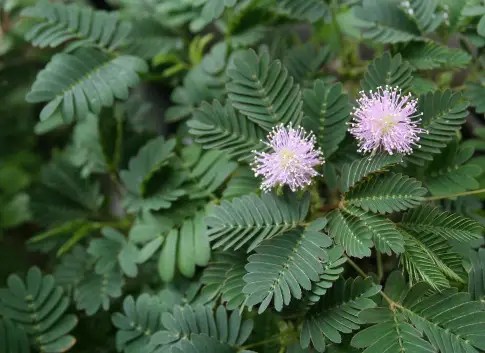
The mimosa is sometimes called the “sensitive plant”. Its leaves fold flat when they are agitated, revealing a path of someone who has disturbed the plants. A tour guide in Grenada told us that slave owners used to use the plants to track slaves who had escaped. I’ve seen material suggesting that some people in Africa used the mimosa plant to track the presence of the slave hunters.
Inciting Control by Changing the Landscape
In Bligh’s day, breadfruit was changing the landscape of the Caribbean nations. I can’t imagine the psychological impact on the indigenous people and the slaves who worked the land. The colonizers were asserting their dominance by literally changing the scenery.
Bligh began in Tahiti with over 2000 breadfruit seedlings. By the time he reached Jamaica, only 678 plants had survived the sea air and fly infestations. Of those surviving plants, 66 breadfruits were brought back to England as trophies of colonialism.
Back in England: Breadfruit was a Trophy of Empire
Bligh had removed plants from Tahiti, planted breadfruit in the Caribbean, and delivered plants for prized collections. British “progress” could be observed in the name of science. “While most specimens gathered by British collectors were destined for the Royal Botanical Gardens at Kew, outside London, some went to satellite stations at Calcutta, Sydney, St. Vincent and to Bath (in Jamaica)”.
The breadfruit is an unassuming, humble vegetable with a very sneaky past. It made its way into Fiji on a 5000 mile canoe voyage from Taiwan. However, Bligh brought it in o the guise of sustenance, looking like a botanist hero to collectors in Britain. Meanwhile, his efforts helped to launch a psychological assault on the slaves in the Caribbean.
Modern Science Revisits Bligh’s Breadfruit
Following the trade routes myself, I find the history to the breadfruit to be interesting. It is now part of mainstream Caribbean cooking. And, there seems to be renewed excitement about better understanding the original cultivars that were brought by Bligh to the Caribbean. As Amanda Morris writes, ” a plant biology team led by Northwestern University, the Chicago Botanic Garden and the St. Vincent Botanical Gardens” is trying to get a better sense of the history and origins of the breadfruit brought by Bligh. Tahiti has long been the accepted story, however, this team notes that Bligh did not keep very accurate records,
Nyree Zerega points out that just as apple variants can taste very different (“When you bite into a Honey Crisp apple, you expect a different taste and texture than a McIntosh,”) the same follows suit for a breadfruit. “Three generations of women scientists were able to provide answers to a centuries-old mystery: ‘Which varieties of breadfruit did Captain Bligh introduce into the Caribbean?’”
To find out how many breadfruit cultivars Bligh may have brought, you will have to get on board and read the article written in January 2023 by Amanda Morris.
Sources
- Alexander, Caroline. Smithsonian Magazine. “Captain Bligh’s Cursed Breadfruit”
- DeLoughrey, Elizabeth. UCLA. “Globalizing the Routes of Breadfruit and Other Bounties
- Gurdeep Pandher of Yukon. A Preview Of Whitehorse Ecology and Climate
- Jean-Michel Cousteau Resort, Fiji. Breadfruit (Fijian: Buco ni viti, Uto buco)
- McDermott, Sandy. Juneau, Alaska, Part 2: Climate and Habitats of the Pacific Rainforest
- Mensah, Kent. Face2FaceAfrica. Mimosa, the sensitive plant that spied on slave hunters for Africans
- Morris, Amanda. Northwestern Now. “Caribbean breadfruit traced back to Capt. Bligh’s 1791-93 journey”
- Rupp, Rebecca. National Geographic. Breadfruit and ‘The Bounty’ That Brought It Across the Ocean
- The St. Lauretia Project, Enslaved People’s Lives. “Food”
- Wikipedia. Ecozones of Canada
- Wikipeda. Lapita Culture
Pin it
I’m now on Pinterest. If you enjoyed this story, you can save it to your own Pinterest board using the image below. Thanks for reading and following our journey.
Related posts
 Becoming a Sailor
Hello Lorraine.I have read the whole of this so well researched article. It is very impressive I had never heard of the breadfruit before. I might never get the chance to taste it but now thanks to you I have seen the nice picture and followed its introduction into différent parts of the world. Marthe
LikeLike