
Mantus Anchor
Our 105-pound Mantus Anchor is worth its weight in gold. It provides a sense of safety and security that cannot be measured. Sometimes called “ground tackle,” our anchor rests into the sand and digs in with every tug and pull. We like our anchor so much that we own a smaller version of the same brand for our dinghy. The Mantus Anchor falls into the category of a “spade-type” anchor.
Here is a video with some interesting underwater footage. Like a time traveler, I introduce the anchor from Chaguaramas, Trinidad and then set it with the help of our friend Darryl – a Canadian sailor (and former lifeguard) from Victoria, Canada –in Grand Anse, St. George’s, Grenada.
Anchor Chain matters
But, not to be overshadowed, the anchor chain plays an important role as well. Its weight lies on the sea bottom. If the weather is calm, the links tighten and strain well before the anchor is called on to engage.
Dinghy anchoring: smaller-scale scenario
Earlier this year, we visited Ko Racha Noi – a small island to the south of Phuket, Thailand. We snorkeled at many sites, but were struck by the solitude of the northwestern side.
With our catamaran safely anchored, we took our dinghy close to shore to snorkel. Jumping in, we found ourselves snorkeling over top of some very unusual rocks. They were massive. Think Stonehenge-sized rocks.
It drifted through my mind that the bottom of this anchorage was going to be a problem, but the thought left as soon as it came. Turns out, our dinghy anchor would become the canary in the coal mine.
The dive site was like watching a snowfall with fish flickering and flashing all around us. The visibility was not great. But, when the sunlight dappled through the water, bright streaks illuminated the sides of the rocks as multitudes of fish picked at the coral and mossy seagrass. The sound of parrot fish popped around us.
After we were done swimming, Henry began to pull up the dinghy anchor. It snagged, and someone had to jump in to retrieve it. “I hope this isn’t a sign of things to come with our big boat,” I said.
Of course, it was.
Leaving the anchorage later in the day, I began to reel in the anchor. You might imagine that this would be sweaty work and that, after circumnavigating for ten years, my arms would be like ropey snakes. Not so. I simply press a button and make sure the chain doesn’t fall off the specialized winch called the windlass.
I am quite good at this, actually. There are situations where the chain used to confound us.

Using the chain hook for security
I should mention that we have a chain hook. It’s the sort of hook you would see at the end of a crane, though sized to suit our situation. We use the chain hook to hold the chain when we are sailing or at anchor, and anytime we don’t want the chain to move out of the windlass. Basically, it takes the strain off the windlass winch.
As the anchor chain struggled and strained, it was a bit like catching a big fish. The chain would tighten and move out a few feet, and I would pull it back.
“How are things going?”, Rick asked from the helm.
“Not so good,” I replied.
“Perhaps we should wait for the tide to come in and it will help to lift the chain a bit.”
I looked at the sky. The sun was still bright but we needed the time to return to Chalong Bay, Phuket. Our plans did not include fighting with an anchor. But, we had done it before, and we would do it again.
That anchor chain was not going to get the better of us. I put the chain hook on to prevent the anchor chain from slipping out of the windlass. I told that chain who was boss. And, Rick very slowly let the boat drift back, and the chain tightened but then we stopped. There was no give.
“Maybe try another angle, I called back. The sound idea of waiting for high tide was far from our minds. In two hours, we would be back in civilization.
And so we pulled, and the chain pulled back.
If you read my last blog post, you will recall that we were not using our chain. We left Pangkor Marina knowing that we had the wrong anchor chain. Yet, Pangkor Marine washed its hands of our situation. This issue was not going to go away. The links were slightly too small for our windlass cogs. It was a recipe for disaster from the start.
It broke.
Aww. Snap!
I didn’t notice it at first as the windlass purred away, the chain was coming up. Later, Henry would say, “I knew straight away. When the chain was coming up and it was just flowing in so easily like that. I knew it had broken.” I reached that realization myself when I saw a stumpy piece of metal chain roll up to our bow.
We took the news pretty well, considering we had just lost our 105-pound Mantus Anchor, something we were sure that we would not be able to replace in a hurry. But, we had to keep it together. We had visiting family onboard.
The cruising community in Phuket steps up
The impact of our loss was felt that very evening as we trolled about the expansive Chalong Bay seeking a mooring. That is when we met Brent McInnes of the Phuket Cruising Yacht Club (PCYC). He was in a hurry and as he ripped over the waves in his dinghy, our catamaran could scarcely keep pace.
From a distance, dinghies started to look the same. We began by following Brent, but then we found we were following another person in their dinghy. Finally, we arrived at the mooring (which we later learned was a bit of a contentious spot, as someone else really wanted the mooring to be closer to their friend), Brent had us tie up to his lines. “Put this loop right on the cleat, please,” he said. “Right. There you go.”
Rick had us put our spare Fortress anchor on as a safety measure. The Fortress anchor is called a fluke anchor because it has two ‘prongs’ that stick and drive into the seabed, as opposed to scoop into the seabed like our Mantus anchor.


We quickly made a friend in the anchorage who offered us a lift bag that divers could fill with air and bring the anchor up to the surface.

Enter Dave of Phuket – Just a Phone Call Away
Not wasting any time, Rick reached out to his long-time friend and colleague, Dave, who hails from Ottawa, Canada, but now lives in Phuket with his wife, Nonny. I had never met Nonny. They were one of the reasons we wanted to visit Phuket.
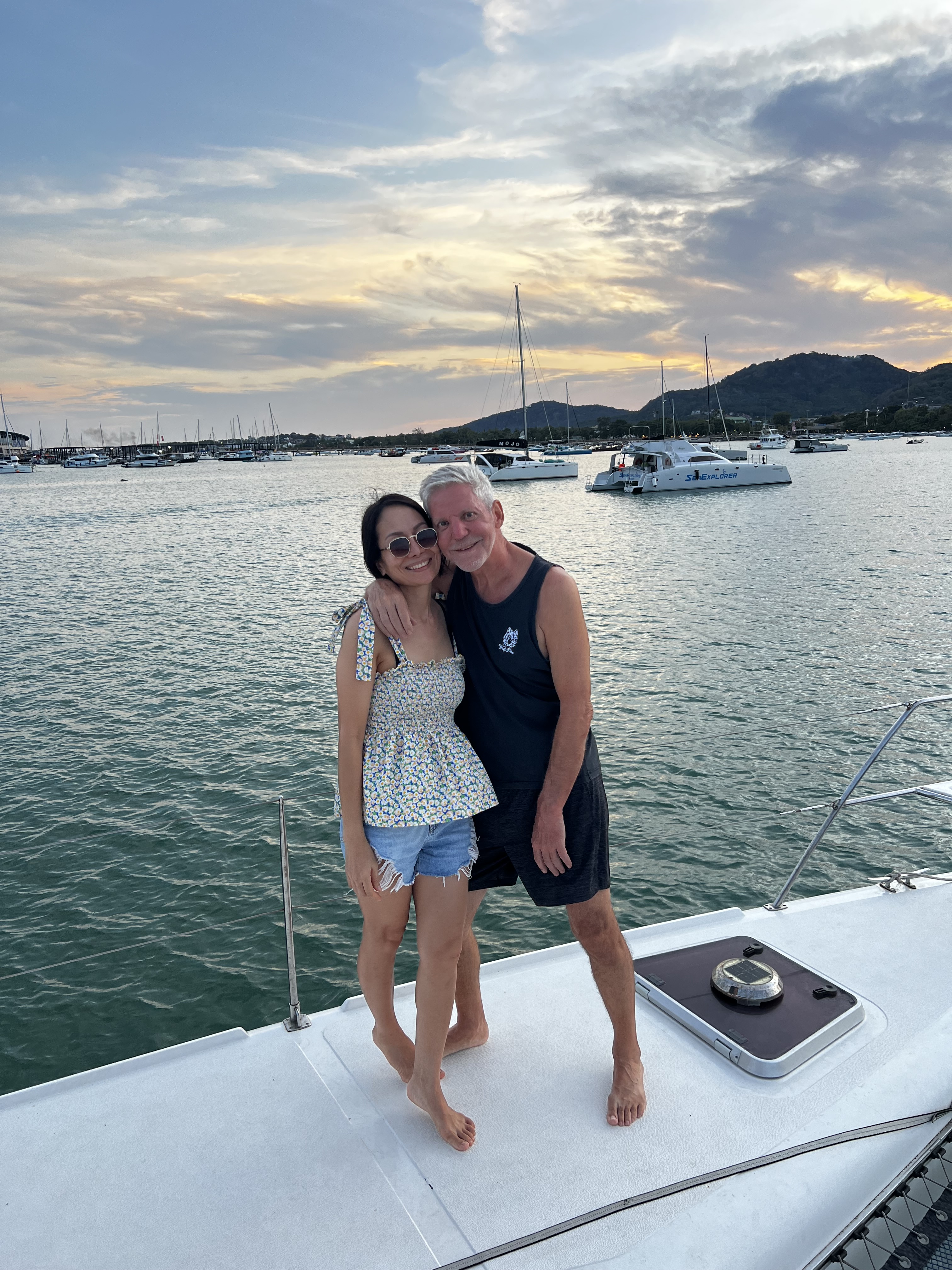
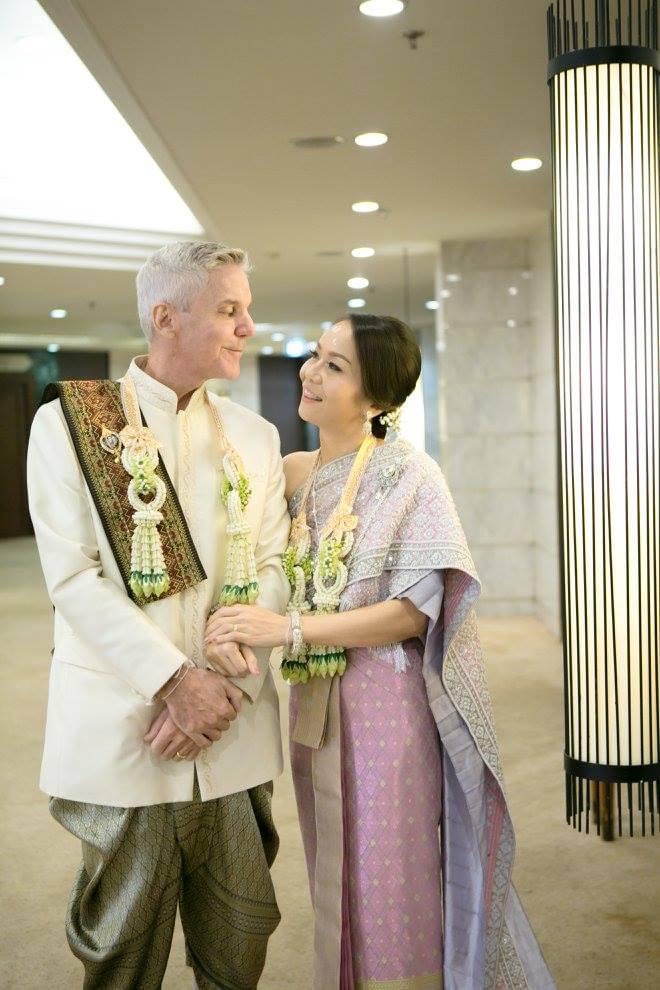
Dave is a diver and the only person that I’ve met who has been injured by a fish. Years ago, he arrived to a business meeting with a nasty bump on his head. The bump was delivered by a territorial Queen Triggerfish.
Dave talks about Nitrox and has seen the skeletons in Chuuk Lagoon – sailors left behind in sunken warships from WWII. If you are able to get to those depths, you must know what you’re doing; your survival depends on it. Dave refers to these diving days as being in his past.
We found Dave a reputable and friendly dive buddy — a German dive master based in Phuket called Michael. They shared notes, and plans, and determined that they were on the same page.
We made plans for anchor retrieval.
To me, things were looking up. But, Dave and Michael were not so sure. Our anchor was placed unusually deep; sixty-five feet was not a casual dive. When the sea played rough, we were about to learn a lesson about priorities and keeping people safe.
To be continued…
Pin it
If you enjoyed this story, you can save it to your own Pinterest board by clicking here. Thanks for reading and following our journey.
Next Post in the Anchor Chain Series: Part 3: Diving for a Lost Anchor: A Salty Ballad from Phuket
 Becoming a Sailor