
Sat Jun 04 2022 16:36:00 GMT+0800 (Singapore Standard Time)
All of the fish that I saw today were dead.
There are few birds. We’re too far offshore for most of them to reach us – though I did see an Albatross out my galley window as we approached the Galapagos. There are only two types of fish: those I can see and the monsters of the deep that I imagine.
At least twenty flying fish and squid lay on the deck today. Paul received two dead fish through his bedroom hatch. Sometimes I hear them arrive (alive) with waves that break across our decks. I saved one fish. But, generally, it’s either too dark or the waves have been too rough to venture out on deck to save them.
Our route to the Galapagos, on the other hand, had us ferrying birds on our deck. One bird had an injured foot. I was glad to have given it safe harbour, even if its compatriots chased it off eventually. I put painter’s tape on the rails so the birds could get a better grip.

When I told Paul about my excitement seeing the birds in French Polynesia he replied with standard teenage enthusiasm. “No, I think they’ll look exactly the same.” To a point – wings and legs – sure.
For all his swagger, Paul was the first on deck with a camera and tripod to capture the wild Scarlet Macaws we saw in Costa Rica.
The Galapagos was teeming with life of all kinds. And, just a day later the emptiness of seeing endless blue waves could not be more extreme. There were no other ships seen or sighted on our radar all day. And, then a little blip appeared. All I could see was the name “Guillemot, sailing vessel” and, for me, it was as though a light went on.
A race with SV Guillemot
I picked up our VHF radio.
“SV Guillemow. SV Gweeliomott. This is Sailing Vessel Aphrodite. I see you on my radar. With two boats on the water, I’d say that makes it a race.”
Silence.
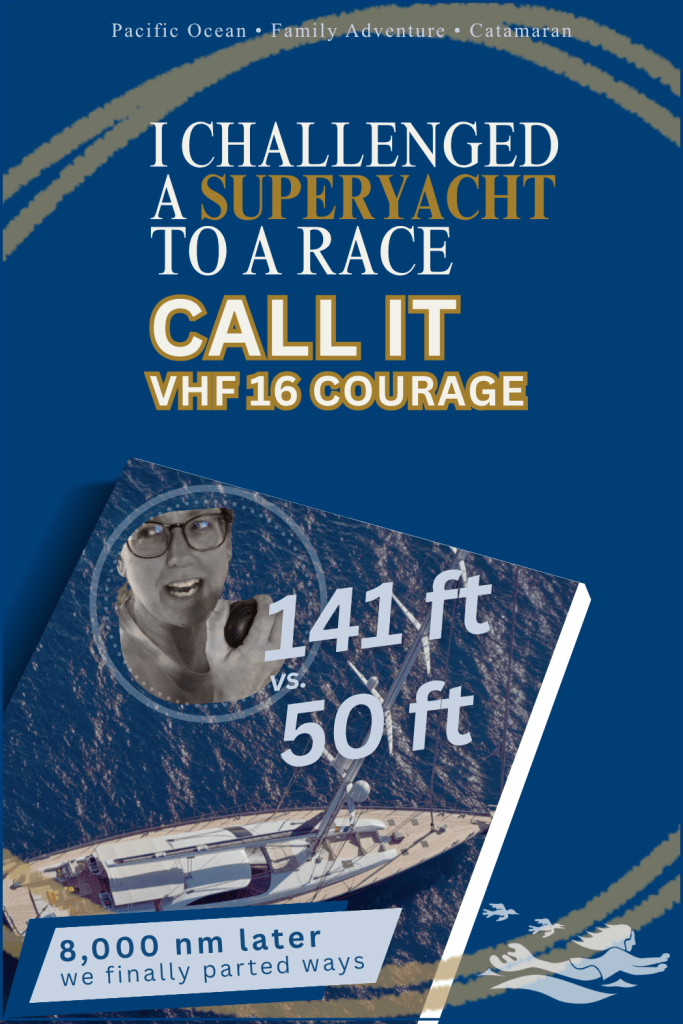
On our chartplotter, I could see that our boats were getting closer together, but SV Guillemot was too far away to see. Our chartplotter soon provided greater detail. The boat I called was 141 feet – a super yacht, more than twice our size, and probably about twice as fast.
I challenged a boat you might see in a Rolex commercial to a race.
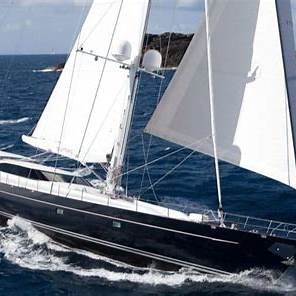

Later they called us on the radio and wished us a safe journey. But, at that point, I had gone to bed.
Our story with SV Guillemot was not over.
Seeing SV Guillemot again…
We saw this boat at a marina in Tahiti, as we schlepped our groceries past them in our dinghy.
…and again
We saw them again in Auckland, New Zealand when they were at West Haven Marina. And, then a full year after our first encounter we saw them in Luganville, Vanuatu. At that point, I paddled up to them with my kayak.
The crew were new, and leaving the next day. They were on a tight schedule to sail their boat for charter season in the Mediterranean. In low season, a week’s charter will set you back €120,000 per week + expenses (such as food, drinks, fuel, trips to shore, and tips for the captain and crew).
Because we are all being pushed by the same east to west tradewinds, it is not uncommon for us to see the same boats over and over, sometimes thousands of miles apart.
At night: an Intergalactic glow of Fishing boats
As Guillemot sailed on, there appeared a glow from a never-ending stream of 20-30 industrial 160’ fishing boats (Zhou You 930, Yong Xiang 9, and the Fu Yuan YU7670 to name a few) harvesting the ocean.

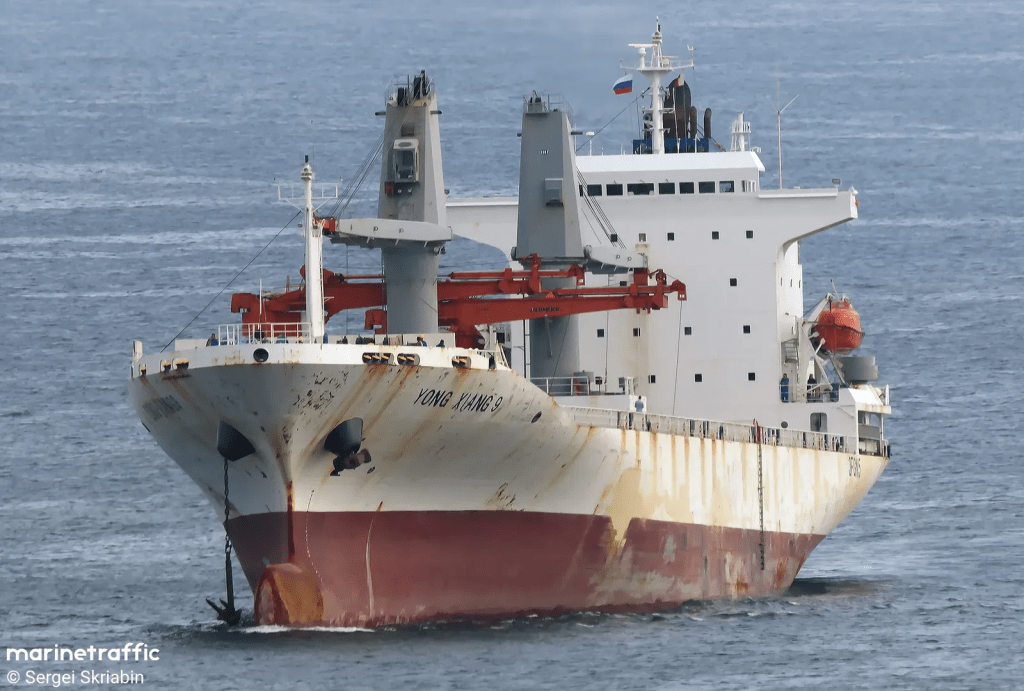

We saw these huge fishing boats two nights in a row. The glow of their work lights lit up the entire horizon from east to west – each spaced 5-10 degrees apart; like a string of white pearls.
They were located about 200 and 400 miles off the coast of Galapagos. Their bright lights loomed for 50 miles.
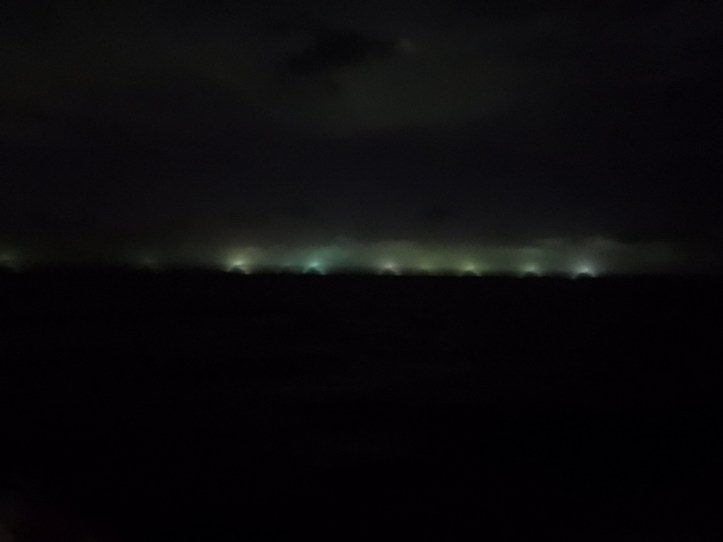
We kept well away from these ships, not wanting to become tangled in a net, or cross a fishing line. However, later on in Fatu Hiva, French Polynesia we met a couple who sailed very close to the fishing boats. They said the fishermen looked emaciated and they speculated that they were Chinese prisoners in fishing labour camps, where they are permanently at sea and food is brought in to them by ship or helicopter.
They were not wrong.
Forced labour at sea: modern-day slavery
“The Outlaw Ocean Project produced a four-year investigation of forced labour
and other crimes tied to the Chinese fleet and the world’s seafood supply.” You can read about their findings in a 2023 report published in the New York Times and Canada’s Globe and Mail article, “‘They treat us like dogs’: Inside the deadly world of Chinese squid ships.”
Shark finning
The movie “Shark Water” shows industrial fishing boats around the Galapagos performing shark finning and using drift nets. Shark finning is the practice of slicing off the fins of the shark, and casting the rest of the shark back in the water to die. Drift nets are nets miles long that basically removed every living thing from the water. Only what’s wanted are kept; everything else is discarded dead. Even if they were fishing for mullet.
I am looking forward to seeing signs of life again. I think we have seen the last of the sea birds for a while. We are sailing a distance of 3100 nautical miles. Our kids are finishing their school year at the American School of Correspondence and will send in their completed exams as soon as we have Internet again.
(The original blog post – written at sea – predated Starlink.)
5º 25.472 S 101º 03.608 W
On Pinterest
Next post in the Galapagos series: Four Methods We Tried to Manage Sleep Deprivation While Sailing
Related post: Oil Spill in Trinidad
 Becoming a Sailor