
Sailing has its own unique language. This makes it unapproachable in ways that differ from other expensive sports. As with most cultures and sub cultures, without a basic understanding of the language you are an outsider.
I learned that first hand in 2014 when I was a complete noobs at the US Sail Boat Show in Annapolis. If you are brand new to sailing and feel limited to very basic conversations, this is fine. Worst case, you buy a nice coffee somewhere and fill your day with eye candy and people watching.
What to expect at an Annapolis Boat Show
First Rule: Wear Slip-on Shoes
Wear shoes that you can take off easily. You are expected to take off your shoes at every boat you visit. It is not cool to walk on a boat deck with your regular street shoes. Bare feet or sock feet keep the decks clean. You can be assured that people have worked long hours to make their decks shine for the Annapolis Boat Show.

Wear shoes that you can take off easily. You are expected to take off your shoes at every boat you visit.
It is not cool to walk on a boat deck with your regular street shoes. Bare feet or sock feet keep the decks clean.
You can be assured that people have worked long hours to make their decks shine for the Annapolis Boat Show.
I wore running shoes (shown in the foreground) because I didn’t know better. For the Annapolis Boat Show, wear slip-on shoes.
Expect some Show Boats (in more ways than one)
You will see beautiful sail boats. And, you will also hear boasts of long passages, near-misses, and glamourous budgets. Those people are not easy to miss as they tend to talk loudly. These people sprinkle themselves throughout all sorts of subcultures.
In the sailing sphere, you might hear people say things like “Yes, it’s a shame. I seldom see a carbon fiber family boat like ours. It’s like people aren’t willing to commit to speed and function anymore.” (Carbon fiber is lightweight and can cost as much as ten times more than a fiberglass boat.)
I recall a woman loudly discussing her “first circumnavigation” and felt like a gooseberry.
Seasickness on the docks, maybe
I was so new to sailing that, after the boat show, I felt seasick after a day on the docks. I didn’t realize until after we bought a boat and set off “to sail around that world” that I was prone to seasickness. Ten years later I still take seasickness medication if I know we are anticipating a rough passage.
If you feel seasick at the Annapolis Boat Show take a break from the docks for an hour or two. If you want to sail, don’t let seasickness prevent you from doing just that.
Just be yourself
Every broker will ask what you are looking for. Are you looking to buy new? A monohull? A catamaran? What size? There will be people trying to sell you everything from a magazine subscription to a charter vacation, electric toilets and everything in between.
If you don’t know your budget just say that. Your experience as a person is just as important as the person who is trying to sell you a sailboat. It’s their job to hustle. Think about your objectives at the boat show in advance, maybe sit in on one of the sailing lectures — there’s bound to be one for someone who is new to sailing — and just go on and enjoy your day.
The language of sailing
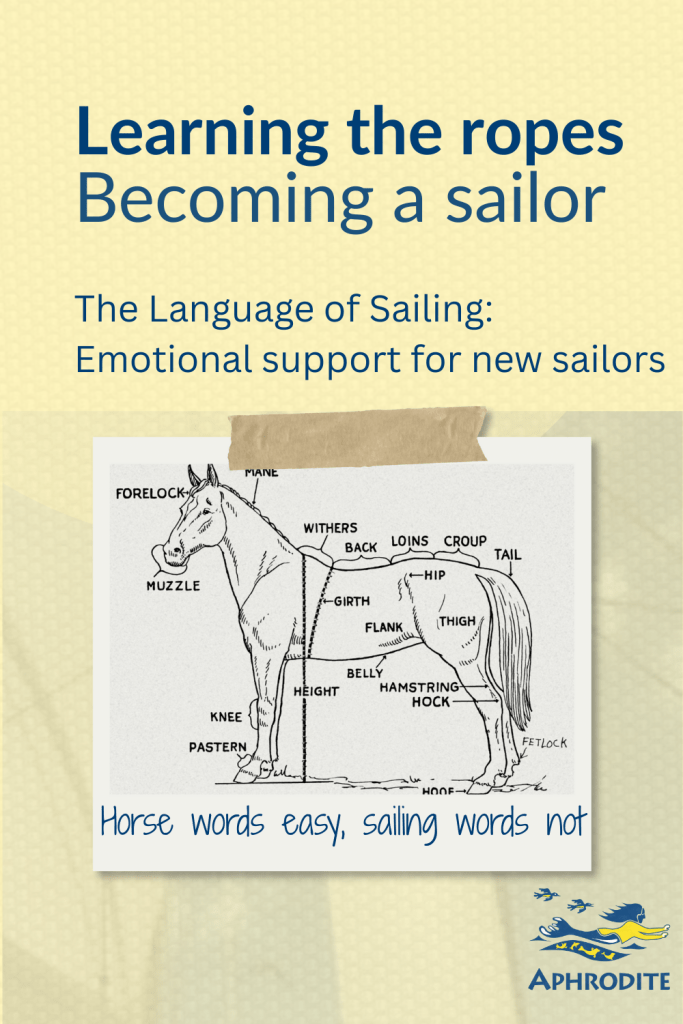
Compared to sailing, horseback riding is another expensive sport. But, I think riding would be much more approachable because everyone can identify the basic parts of a horse. Parts like legs, head, nose, rump, hooves and so on provide beginners with immediate entry points to conversation. In the diagram below, some of the terms are unfamiliar to me, but not beyond the realm of comprehension. In sailing this is not the case. A bathroom is a head, and I’m still sorting out my lefts (port) and rights (starboard). My conversations with sailors and brokers are limited and can end rather awkwardly.

Sail training, yes, but maybe not start with Antigua Sailing Week
Learning the language of sailing is essential to me, and it seems to me that the best entry point is formal training. To this end, I will be in Antigua in April 2015, leaving my family without me for 3 weeks, to attend practical training around the Antigua Sailing Week. By that time, I will have completed the RYA on-line Day Skipper program and a radio course.
Thoughts from 2025: Antigua Sailing Week tends to be rather competitive.
To give you a sense of where I am now I thought I’d end this post with an excerpt from the book: Chapman Piloting Seamanship and Small Boat Handling, 63rd edition, 1999, page 230. This text requires great effort for me to read. I have deliberately mangled a passage of text from this book as it provides a window into what it’s like to be complete sailing rookie. The text is about reaching, which – I gather is about “Catching the wind with your sail”. So here goes my interpretation of reaching.
Catching the wind with your sail (My interpretive text)
Most boats are on their fastest point of sail when the sail billows out very far, and the mast is turned perpendicular to the boat to catch the wind. But, caution must be taken: Continued care is required to maintain the boat’s balance. The tendency of the boat to follow the direction of the wind is usually strongest when the sail and the mast basically follow the same direction as the length of the boat. A main sail that is too tight will tend to do very little to combat the tendency of the boat to follow the direction of the wind, and to luff.
The original text is as follows:
Reaching technique (Original text)
Bearing a way from a close-hauled course onto a reach is a technique that puts most boats onto their fastest point of sail. But caution must be taken whenever this maneuver is put into practice: Continued care is required in order to maintain the boat’s balance. Weather helm, as the boat tries to round up into the wind, is usually strongest on a close reach because an over-trimmed main will tend to keep the center of effort back and to twist the boat into the wind.
Except for the term “Weather helm” in the original text, I didn’t use any outside research as I read the text. I knew the term “luffing” so I thought I’d add luff into a sentence.
Someday soon I will look back at my interpretive text and laugh, I think.
In 2025, I have learned there is still lots to learn. For example, the mast does not move, at least not to the extent of any sort of swivel, unless you are sailing the Maltese Falcon.
Thanks for reading.
Pin it
I’m now on Pinterest. If you enjoyed this story, you can save it to your own Pinterest board using the image below. Thanks for reading and following our journey.
 Becoming a Sailor
