
In short
Before we left in 2015, our doctors in Ottawa prescribed a year of medication and advised us on emergencies, including anaphylaxis, since an ambulance may not be available. Our pharmacist packed capsules in small sealed bottles against humidity. Our 2026 update explains how we have restocked in more than 40 countries: request quotes, compare prices, order ahead, and visit a local clinic when a prescription is needed.
We leave for Florida in one week. The entire family has seen doctors and specialists for checkups, immunizations, and advice.
Initially, most doctors reacted with some concern, and one with visible shock. But once the surprise of our news wore off and they could see that we were thinking this through, our trip seemed to provide an interesting challenge.
Because we are going to be travelling on a boat for an extended period of time, our doctors in Ottawa took special care to explain how to manage pre-existing medical conditions and how to respond to some emergencies.
Food allergies, for example, affect our family and prompted our allergist to discuss how to respond to anaphylaxis. Our allergist’s explanation went well beyond the norm as we could not assume an ambulance would be available, even in a busy anchorage.
Our family doctor was very supportive. Along with prescribing medication for a full year, she recommended that we have our kids’ eyes examined before we leave.
Specifically, she wanted an optometrist to look for convergence insufficiency (CI).
This condition can cause double vision and difficulties with reading. Fortunately, if diagnosed in childhood, the condition can often be treated with regular eye exercises.
Our doctors in Canada considered the sort of medications that might be readily available in other countries. In one case, we were prescribed capsules instead of tablets only because they would be easier to obtain elsewhere.
Pharmacies we contacted suggested we give them a week’s lead time to prepare our medications. The independent pharmacy we chose could provide our medications within a single day.
The pharmacy staff carefully packed the bottles in bubble wrap and provided our capsules in small quantities. The pharmacist was concerned that the capsules might degrade in the humidity on our boat. So instead of giving us 400 capsules in one bottle, she gave us multiple sealed bottles that contained 30 capsules each.
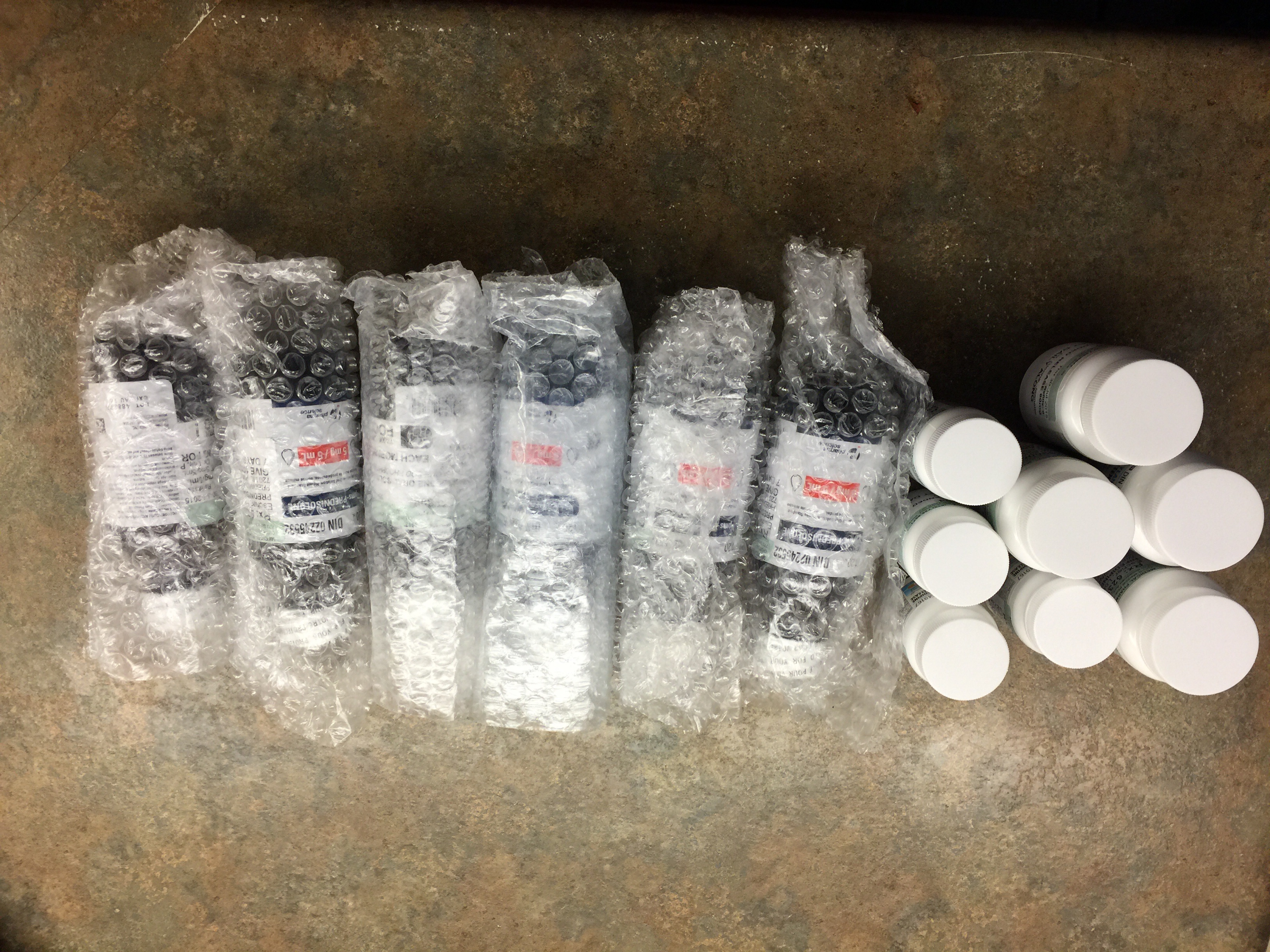
How will we restock our medications when they run out?
We’ve heard that medication is available over the counter in many countries. We’ve also heard that it can be substantially cheaper.
Out of curiosity, I called a couple of pharmacies in Antigua yesterday to see if they could fill a Canadian prescription. Filling an out-of-country prescription was not a problem. However, they were limited in terms of brands and doses.
When pressed, the pharmacist said they could obtain a medication — by sourcing it elsewhere on the island — but they would need some time. Hearing this information, I imagined someone would make some phone calls and then drive over to another pharmacy.
“So, about a week?” I asked.
“No,” the pharmacist replied. “About a month or two.”
Oh.
I guess we will have a year to figure out how to restock before our medications run out.
2026 Update: How We Restocked Our Medications While Circumnavigating
In the past 11 years, we have visited more than 40 countries. Many of the pharamacies in these countries do not seem to require a prescription at all, though there can be tighter rules when buying controlled medicines or antibiotics.
If pharmacies receive an order to fill, we have found that they will do everything they can to help and are unlikely to decline your business based on a technicality.
I usually provide pharmacies with a list of medications and quantities, ask about expiry dates and availability, and request quotes. Prices often vary between pharmacies. Once I choose a supplier, I pay a deposit and place the order.
In Trinidad, we purchased medication from a pharmaceutical wholesaler as it was cheaper than buying from a retail pharmacy.
A prescription requirement is not a major obstacle. Sometimes a prescription simply means visiting a local clinic. The cost of a doctor’s visit can vary. I’ve seen a doctor for less than $10 U.S. in an office the size of a closet in Panama. In New Zealand, however, medical care was off-the-charts expensive, and obtaining medication involved considerable red tape.
In New Zealand, when I asked to stock up on what I thought were over-the-counter treatments for yeast infections, the pharmacist said she was required to ask about my symptoms. I didn’t have any symptoms because the medicine was intended for our ship’s medical chest. Finally, I told her, “I am so itchy.” This information fulfilled the requirement she needed to sell me the medication.
Pin it
If you enjoyed this story, you can save it to your own Pinterest board using the image below. Thanks for reading and following our journey.

Hi Lorraine! You are good to get all your meds in order just before leaving, this will ensure that they won’t expire too quickly. My son has a peanut allergy and it seems like his Epipen or his Benadryl always needs to be replaced, even though we’ve never used them. I’m very envious of you taking on this trip with your kids and wish I had done it with mine when they were younger. Now that they are 12 and 14, they are very set in their routines and wouldn’t want to rock their world too much, being teenagers and all the stress and pressures that go with that. I hope to be able to follow your blog and keep up on your adventures! Do you have a Facebook page or will I be able to follow through e-mails only? Best of luck with everything and please know that you are in my thoughts. I followed the Stuemer family through every blog that was written in the Citizen, was at Petry Island when they arrived home and got Diane’s signature at their book launch! Take care! Kat.
Kat – thank you for your nice note. I enjoyed Diane Stuemer’s book very much, and was fortunate to have spent and afternoon with Herbert Stuemer a couple of months ago.
I am on Facebook though somewhat Facebook illiterate. I never login so I always forget my password.
Thanks for following our travels. If all goes according to plan we will be back in the water on Monday afternoon.