
In short
This long read follows us south of George Town, Bahamas, beyond the Exumas. With my sister Collette and niece Emily aboard, we buddy-boated with Dave and Nathalie through shallow Hog Cay Cut to the remote Jumentos, which have no services or cell coverage, and spotted a nurse shark. At Ragged Island we met Edward, sole resident of Buenavista Cay, and in Abraham's Bay, Mayaguana, everyone we met had something to give.

In this Long Read | Off the Beaten Track Bahamas
Jumentos, Bahamas — Leaving Chicken Habour
Originally posted April 1, 2016
My sister, Collette, and her daughter, Emily, have been visiting us this week. They began by meeting us in George Town. They are both new to sailing. In just a few days, our lifestyle of cruising left its mark.
A Cautious Start
Collette remains vigilant about safety, but she no longer wears her life jacket in our galley.
Emily has sat at the bow of our catamaran and felt the spray of six-foot waves. She has used a bathyscope to observe a nurse shark. The word “remora” is now in her vocabulary.

Our visit to the Jumentos took my sister well outside her comfort zone. This is one of the reasons we sail. I like to push the boundaries of my own experience. As waves have hammered our bow, I have been known to ask my husband, Rick, “Are we sailing beyond our abilities?” His answer is always the same. “No.”
My husband was taught from an early age that there is no such thing as “can’t.” It’s a point of view we try to impress on our children. Rick and I enjoy finding solutions to remove the obstacles that stand in our way.
Sometimes the answers can be found by reading a good book and applying what we’ve learned. In truth, I would prefer that Rick didn’t read Wallace Ross’s book, Sail Power: The Complete Guide to Sails and Sail Handling, while we are sailing in 25 knots of wind. But it doesn’t always work that way. We are parents to young children. Time management is a challenge.
We were thrilled to have Collette and Emily join us aboard. We wanted to show them some of the splendor of the Bahamas — the rugged landscapes, and the crystal-clear waters. In many places, you can see the ripples in the sand at the bottom, even when the water is 20 feet deep or more.
Buddy Boating to the Remote Islands
When our friends Dave and Nathalie suggested we visit the Jumentos with them, we couldn’t pass up the opportunity.
Collette took some convincing that our trip to the Jumentos would be a success. She had trepidations relating to safety. She worried that our boat might tip, or that we might hit a reef and take on water. George Town is a pretty comfortable place for cruisers. It has a grocery store, dinghy dock and hardware shop. Many people never wish to go further south. Hence, the nickname “Chicken Harbour”.
To be fair, Collette and Emily had a rude introduction to our cruising lifestyle. They arrived in rough weather and had an awful dinghy ride to our boat. With choppy waves, it was as if they were being beaten with a paddle while riding a bucking bronco. Emily was in tears. Collette told me that she wanted to open her mouth and scream. We had considered sending a water taxi to fetch them. But I’m not sure that they would have fared much better.
Given that disastrous beginning, we are glad that Collette agreed to try sailing. The Jumentos are remote with no services or cellphone coverage. You must be self-sufficient. Collette told me later that she felt like she was on the “Voyage of the Beagle” as we sailed with no land in sight. She was a bit on edge and although she sat on our bow, she silently wondered if a helicopter might be involved as part of an emergency rescue plan.
Hog Cay Cut to Water Cay
You reach the Jumentos from George Town by passing through Hog Cay Cut at your own risk. The cut is very shallow and, if you draw more than a couple of feet, you must wait for high tide to pass through. Our draft (or draught if you prefer) is 4 feet 3 inches.
We stayed close to Dave and Nathalie’s boat. While it was nerve-wracking to see so much exposed rock and reefs, we had no trouble passing through Hog Cay Cut.
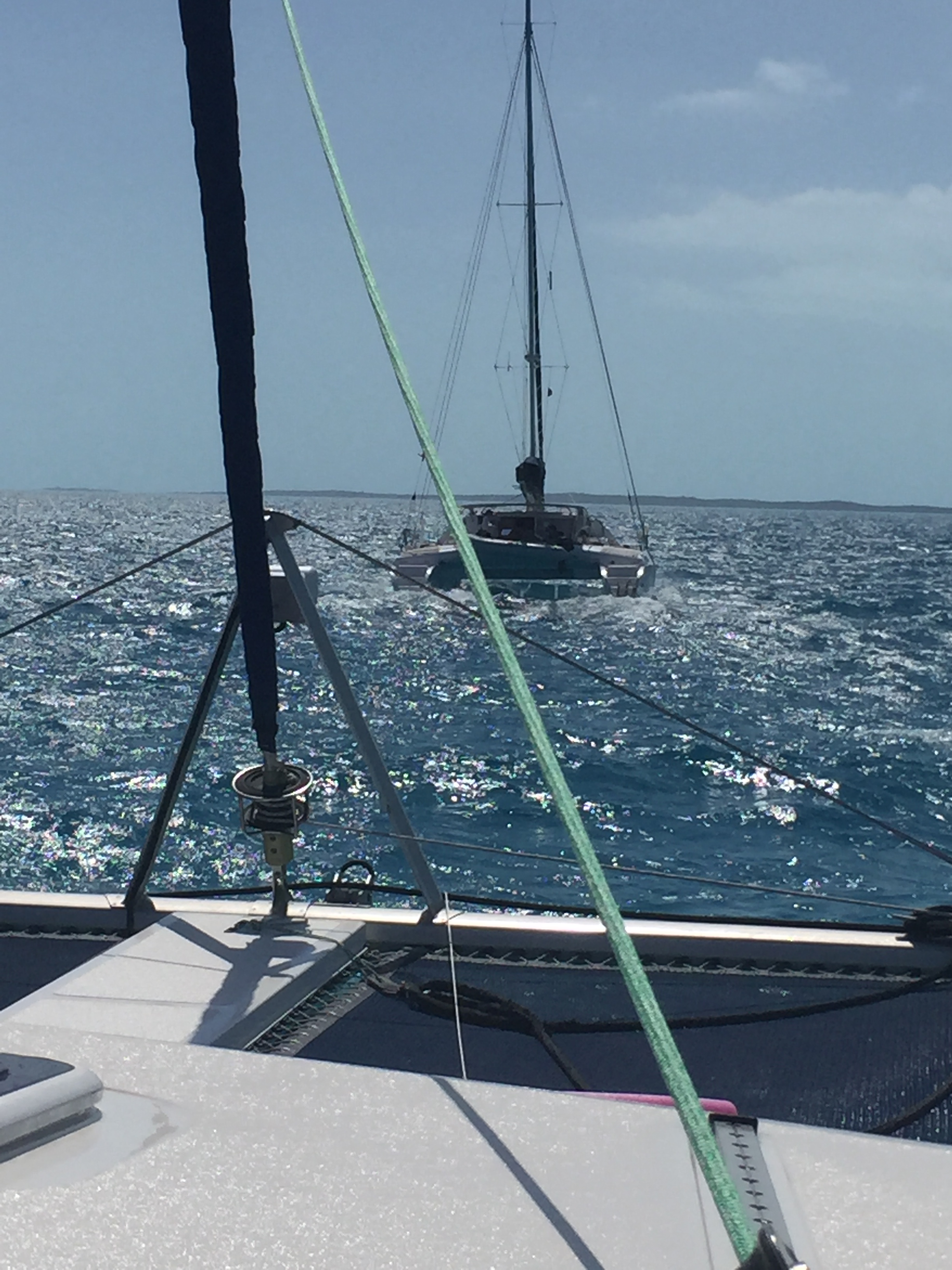
After passing through Hog Cay Cut, our destination was Water Cay. When we arrived in Water Cay, Dave told us that the reef and the nearby fishermen’s anchorage were home to sharks.
Dave knows what he is talking about. He is an adept fisherman. He uses a Hawaiian sling to catch groupers, snappers, lobster, and queen triggerfish. Dave told us that he was putting his fish guts near the reef so we wouldn’t be bothered by the sharks.
Our anchorage was quiet with about six boats at anchor. This is a sharp contrast to the anchorage at George Town, which attracts more than 300 cruising boats in a single day.
Shark Sighting
On our first morning, we were faced with a boatload of five energetic young children. Swimming seemed like a good idea. Three of my children — Betty, Paul and Karen — went swimming in the water. But the splashing was short-lived. Collette was the first to observe a black shape shifting and swivelling by our boat.
Although we couldn’t be sure that there was a shark, we were cautious and had the kids leave the water. The next day, however, it was sunny and Rick suggested the kids go swimming. It was only later, after everyone was out of the water, that we observed a nurse shark near our swimming area.
Nurse sharks are pretty harmless, or at least that’s what I’m told. In a 2013 story for the International Business Times (IBT), Rebecca Schumann writes:
The website HowStuffWorks provides an entertaining view of the nurse shark, and also cites 52 attacks with no recorded fatalities.
We were excited to view the nurse shark and some remoras (also known as shark suckers) with a bathyscope from the safety of our boat. It might sound very civilized. There was much clamouring to see inside the bathyscope.
As we left the Jumentos, a sailboat in front of us got stuck on a reef going through Hog Cay Cut. Another sailboat assisted by attempting to tip the sailboat using a dinghy to loosen their keel. Fortunately, the stranded sailboat was successfully dislodged.
We are now back in George Town and anchored close to the dinghy dock. Collette and Emily left us this morning.
As Collette stood on land, she said the solid earth felt strange. Collette will be back at work on Monday in Victoria, B.C. She is already talking about her next visit, and has her sights on owning a bathyscope.
Ragged Island, Bahamas — Where Goats Cross the Street
Originally posted May 12, 2016
I’m writing this blog from Duncan Town, Ragged Island. Here, goats cross the street, and cars are few and far between. Local resident Maxine Wallace tells me that the town population is 70 people.
Internet access is available at the local clinic. We rely on Wi-Fi. We have no internet access on the boat otherwise. The clinic waiting room is outdoors. You can sit in the chairs and use the internet for free. Here is a picture of my family outside the clinic.

Here, abandoned houses cozy up to well-inhabited structures. We saw a laundry machine on the front porch of one house along with some rusty bicycles. But the local grocery store is impeccable, save for a few ants that danced about the sugar. I bought two bags and then put them in the freezer.
Maxine showed me her dried conchs yesterday.
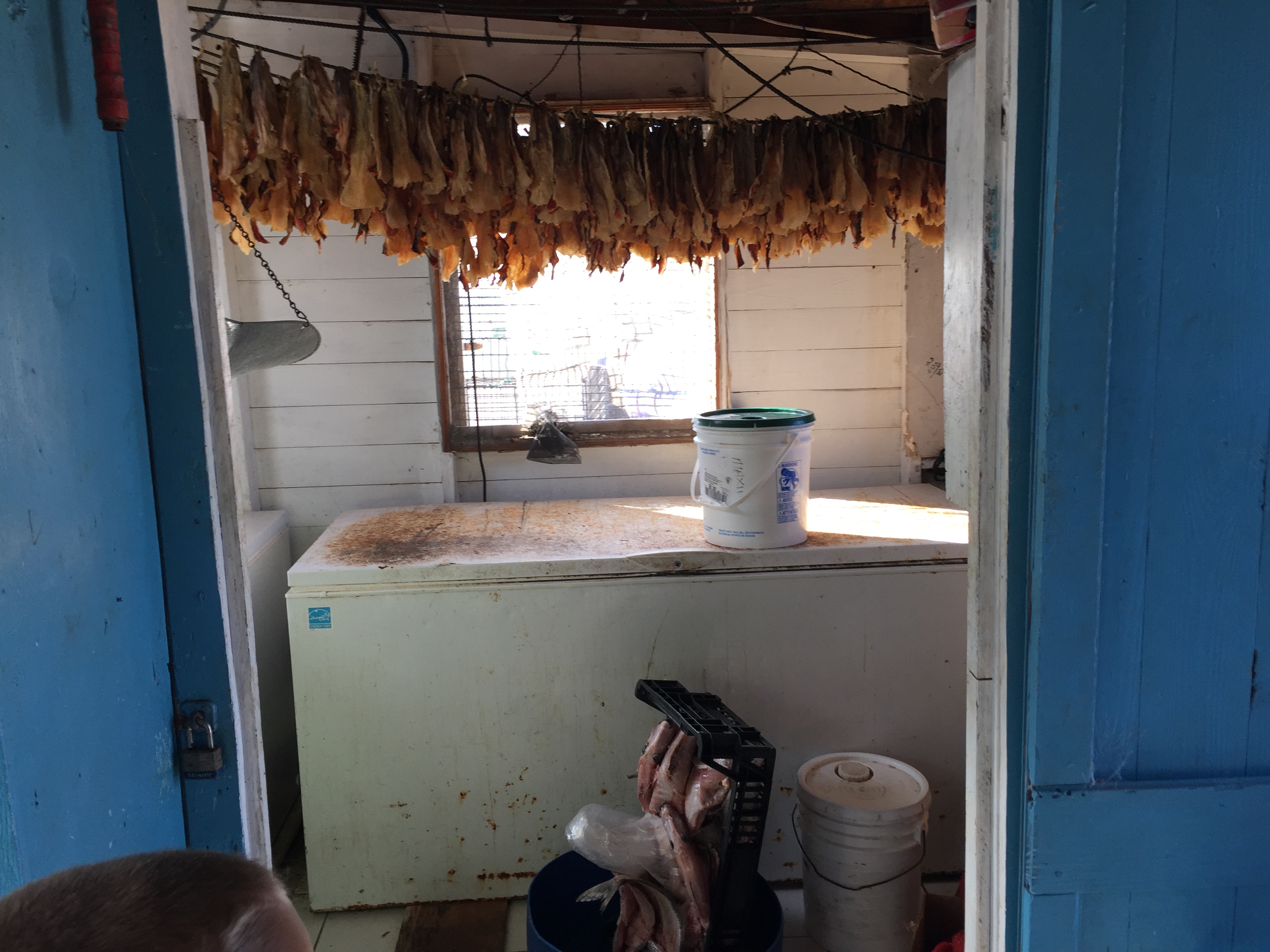
The conchs are sent by mail boat to be sold in Nassau.
Maxine, by the way, is the cousin of Edward, who you would know if I could post blogs more frequently.
We met Edward a few days ago on Buenavista Cay. He is the sole resident of the island and is very friendly. Edward has no motorized method of transport. He has no generator, which means he has no refrigeration, and appears to sleep in a hammock on the main level of his dwelling. Here is a picture taken in Edward’s yard.

Edward showed us his chickens, peacocks, dogs, and garden. He grows papayas, peanuts, corn, and sweet potatoes. All of his water is supplied by rain.
Here is a picture of Edward with our son, Paul.

Edward was our first human contact since we left George Town a few days ago. Before that, we were exploring a cave at Flamingo Cay and viewing sharks from our dinghy. Here is a picture taken from inside the cave.

Natural light shines through holes in the ceiling of the cave. We went at low tide and saw sharks swimming close to shore.

Thanks to everyone who sent birthday wishes to our twins. It was their birthday yesterday. They are now five years old.
We are spending one more night in Duncan Town before working our way southeast. We hope to see more reefs and perhaps some flamingos before we leave the Bahamas.
The Lasting Impact of Hurricane Irma
In 2017, Edward of Buenavista Cay made the news as he survived Hurricane Irma alone, underneath a tree.
We returned to Duncan Town in 2019 and saw the aftermath of the hurricane. The pink clinic was heavily damaged. Yet, as of May 2026, it is being rebuilt as a full-service clinic that resembles a small hospital.
Abraham’s Bay, Mayaguana — Everyone Had Something to Give
Originally posted May 22, 2016
We have been in the Bahamas for almost four months. Yet Abraham’s Bay, Mayaguana has been one of my favourite places to visit. Everyone we met had something to give. The culture of generosity and community was infectious. It extended from the dinghy dock and onwards into town. Each act of generosity could be expanded upon.
But here is the short story.
The story of giving started with a woman who had lovely shoes. She helped us get oriented on our first visit into the settlement of Abraham’s Bay. Treading on a rocky path, this woman left her air-conditioned office to point us in the direction of the grocery store. I was glad to have had her help. The grocery store was in a large shed with no signage. It turns out her daughter was the proprietor of the grocery store.
On our second visit into town, we met LeRoy at the dinghy dock. LeRoy drove a shiny Kia cube car and worked for the government. His wife worked in the customs office. LeRoy offered us a drive to the play park. The play park was a bit dilapidated but the kids had a marvellous time. We did some grocery shopping.
Later, stemming from an earlier conversation, LeRoy stopped by to say that he had found us a bag of carrots, and that they were in stock in the only other grocery shop, which was called “Lorraine’s Convenience Store.”
After we bought the carrots, a woman offered us a drive back to the dinghy dock, which I gladly accepted. As she said, it was very hot. At the dinghy dock, we met a fisherman. It seemed that he was also caught by the community spirit and had something to give. He offered us fresh conch.
On the third day, before we got to town, a different fisherman suggested that he collect some conch slop for us. He said it was excellent bait and that we had to have some for fishing. By slop, he meant the parts of the conch that the fishermen cut off and usually go to waste. He, too, had something to give. He left the conch slop in a container in our dinghy while we were at the play park.
After leaving the fisherman, we headed to the play park. Now it was our turn to give.
Using a rope from our boat and a thick piece of pipe that we found, we fashioned a swing. Soon, some local kids joined us at the play park. Henry made a friend with a local boy called, Shawnny. Here is a picture of the swing in action.
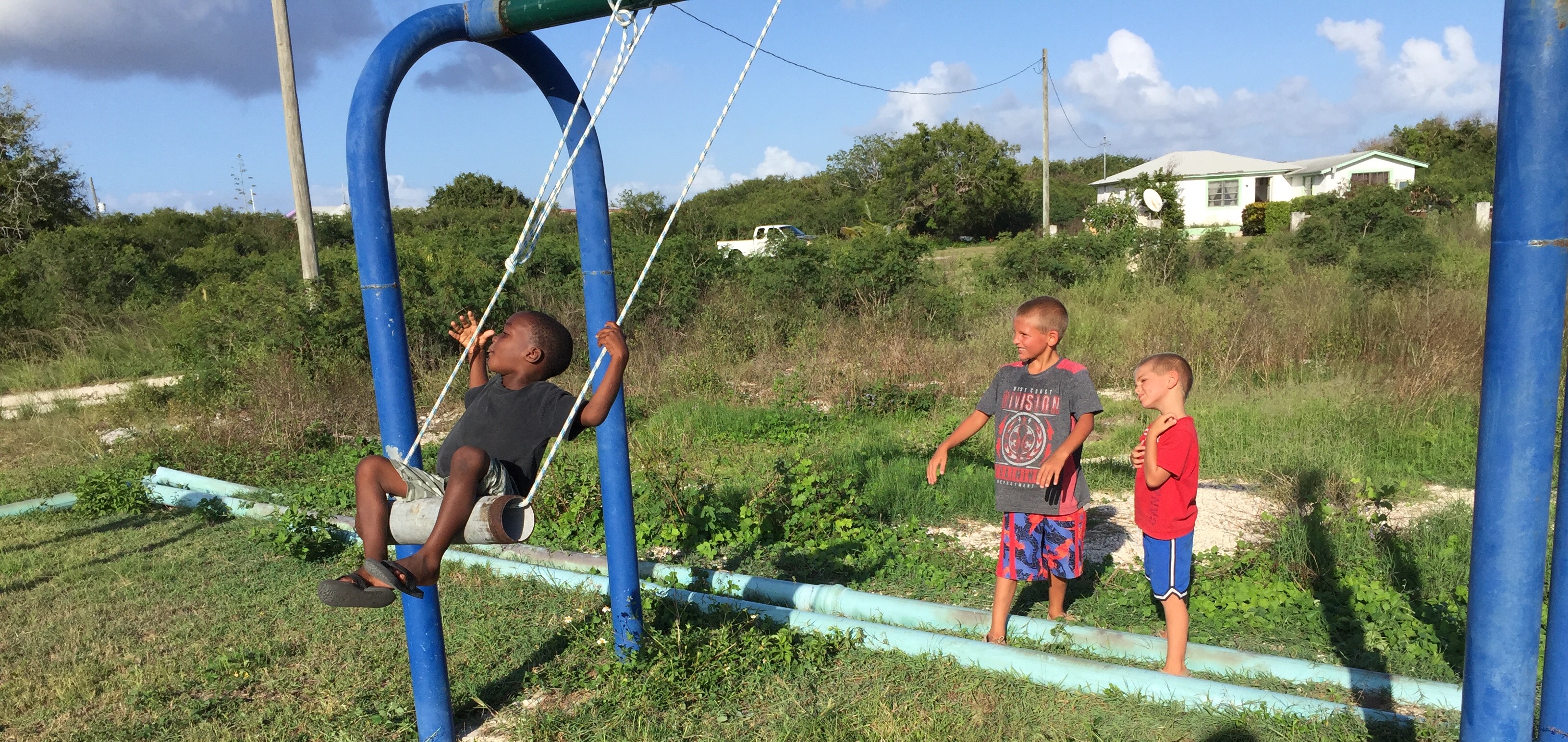
Eager to make friends, Henry asked me if we could bring a cake on our next visit to the play park.
Later, as we sat in the shade under a pavilion, LeRoy came by and brought us water and cold beer. He then offered to drive our entire family on a sightseeing trip to a former U.S. Army base. Here is a picture we took of a plaque at the base. Our trip was of particular interest to my husband who studied space physics. As a result of our visit, our daughter Betty is now interested in U-2 spy planes.

On the fourth day, the kids were excited to see their friends again. We brought a chocolate cake and iced it in a pavilion near the park. We waited for them to arrive and then finally visited their house to invite them to the park. They were already on their way to the park. Here is a picture of us enjoying cake with our new friends.

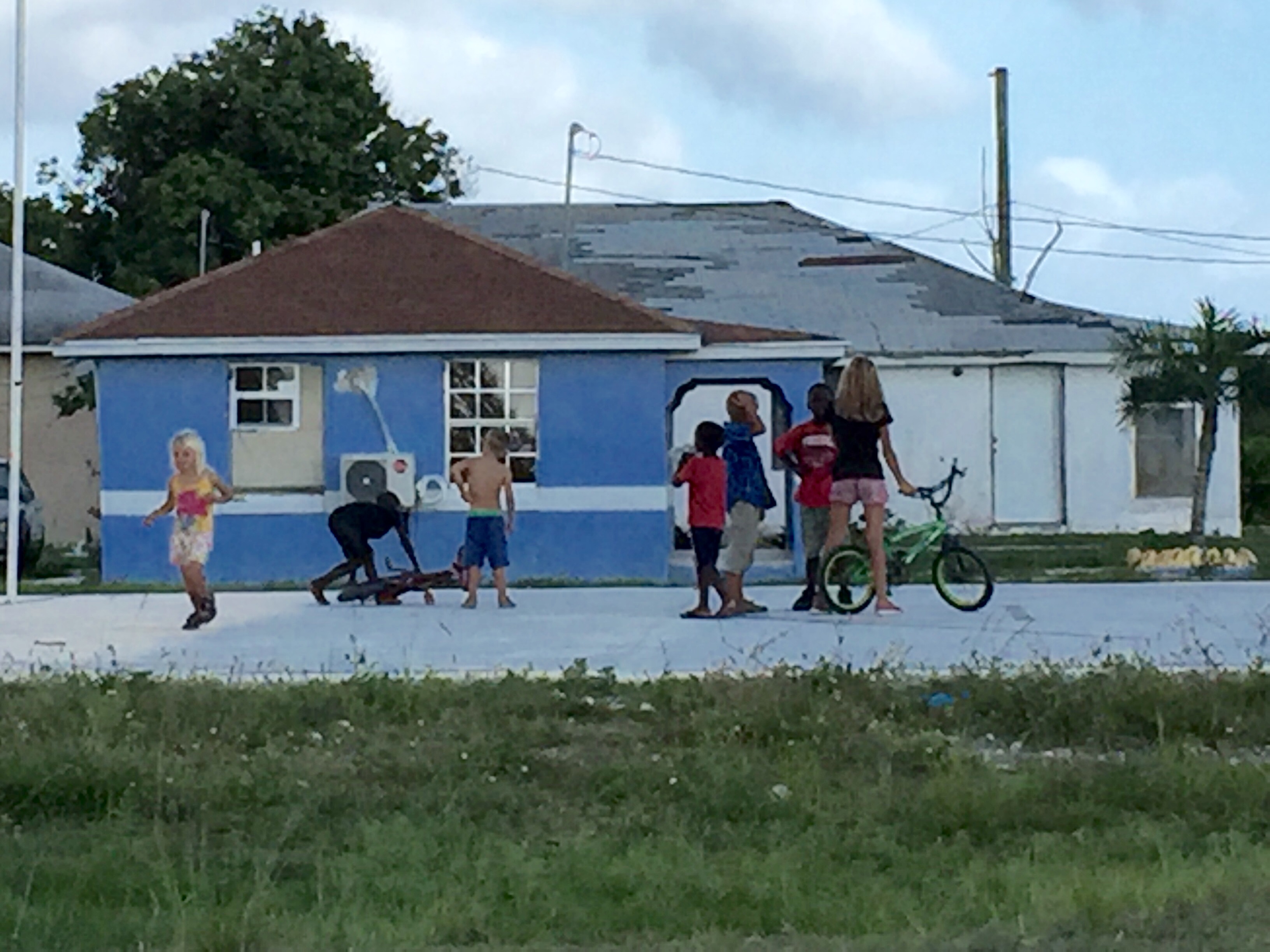
Later, the local kids shared their bikes with our children. Our kids were thrilled to be on bicycles again. A couple of local people helped Henry learn to pedal.
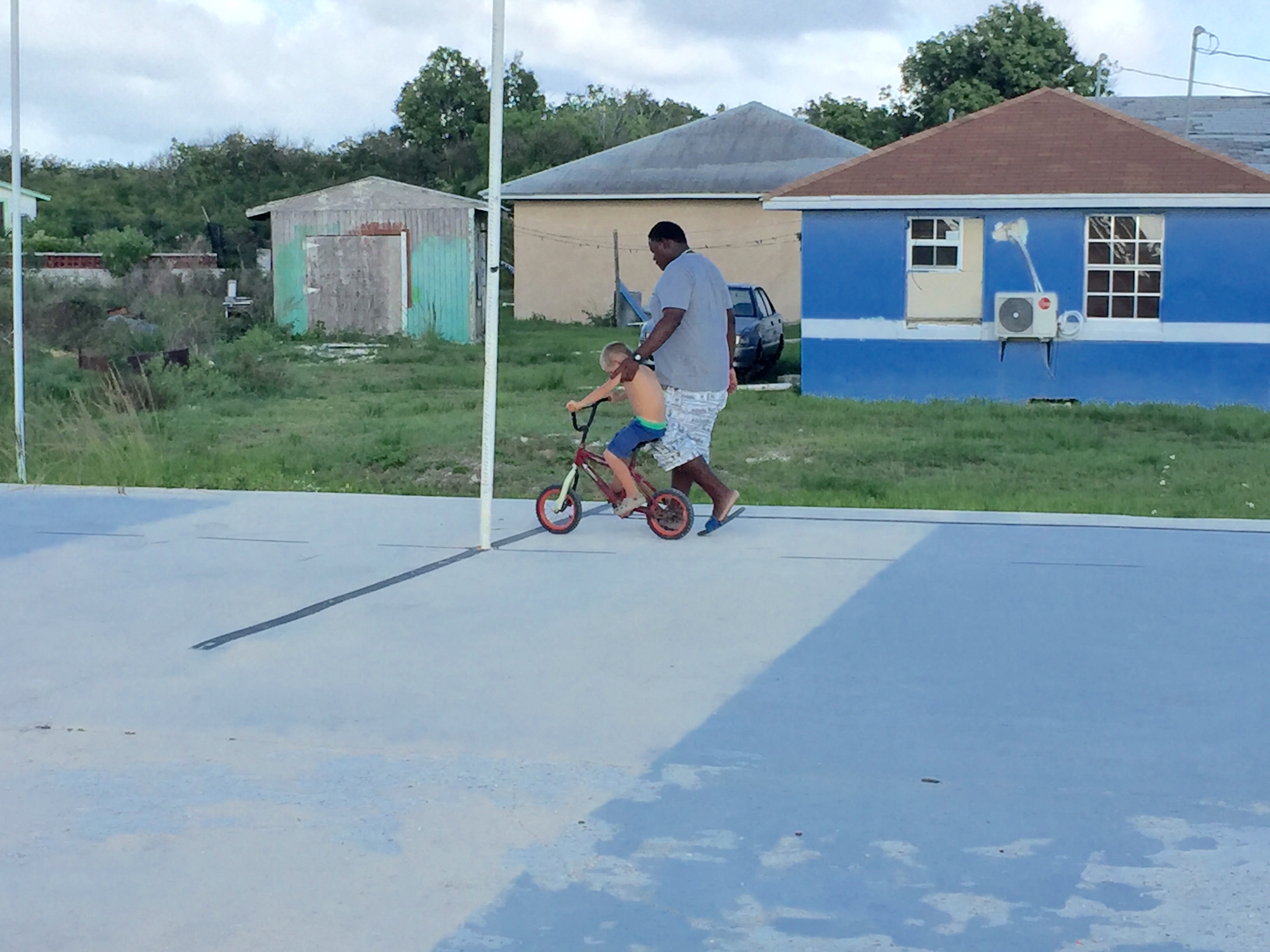
We also met Scully. Scully is a fishing guide. He rode over on his bike to chat and invited us to a community cookout on Saturday night.
Unfortunately, we could not attend because we had checked ourselves out of the country and would be flying our quarantine flag once we returned to Aphrodite. Once that yellow flag is up, you cannot return to land without checking back into the country with immigration.
On the fourth day, which was Friday, we checked out with Bahamas immigration.
It’s Saturday now. On Sunday we’re going to Southeast Point. We will leave the Bahamas on Monday morning at about 2 a.m. and will arrive in Provo in the Turks and Caicos by mid-morning.
Flamingos Spotted in the Harbour
The customs and immigration office is now closed, according to Noonsite, but for friendliness alone it is well worth the visit. Plus, the water is gin clear, and if you are lucky, you might see the wild flamingos in Abraham’s Bay.
Bonus Photo: A Throwback to Shark Sighting at Rum Cay, Bahamas
This is a picture of our niece, Elizabeth, with Paul. Just prior to this photo being taken, Elizabeth had jumped in for a swim and spotted a shark. She immediately got out of the water. Paul was keen to see the shark too. You can see in the photo, he is using our bathyscope.


Thanks for reading!