
Thu Jun 09 2022 21:20:00 GMT+0800 (Singapore Standard Time)
Leaving town in Isla Isabella
On an organized hiking tour on Isla Isabela, Galapagos, we got a ride from town to the trailhead of Sierra Negra, which is an active volcano.
We could have been in the English countryside on a damp and foggy morning, except this was the Galapagos. Situated at the equator, I would have expected the Galapagos to be hot. Yet, ocean currents from Antarctica and the Californian coast cool the temperature to the point that a species of penguins now call the Galapagos home.

A Militant Start to a 10-Mile Walk: It’s Go Time!
“We will split up,” said our guide. “English speakers follow me. Spanish speakers follow the other guide.” A crunch of feet followed with some random chatter. The noise died out and our guide continued.
“Due to the rain, there is not much to see this morning. We will be walking along the south side of the crater. We should be able to see into Sierra Negra when the sun comes out.”
Surveying the other members of our group, I began to wonder if this was such a good idea. A 10-mile hike on rocky terrain with limited views.
“The start of the hike is hard because it’s uphill. For the first hour and a half we won’t stop for breaks, except for water. It is important to stay hydrated. At the top of the hill, there is a hut. We will stop for snacks and then start our descent into the volcano where we will stop more often as I provide greater explanation.”
We Set Off in the Footsteps of Charles Darwin
There are 16 of us. At first, I am towards the beginning of the pack. I match my pace to the people ahead of me, keenly aware of the footsteps behind me.

Finch. Spotted.
This is the Galapagos. I spot three finches, and feel rewarded. Darwin studied the finches on the Galapagos. He was in the Galapagos for only five weeks. What a banger of a trip it must have been.
In just five weeks, Darwin observed the shape of finch beaks, posited that the same species morphed depending on need, and developed the theory of evolution.
Why finches?
With all the interesting plants and animals in the Galapagos – giant tortoises, huge sea turtles, blue-footed boobies, dandelion plants that grew to be trees, cacti growing in wetlands, and penguins – the world was his oyster. I have to wonder, why finches? How did Darwin come to realize he could prove his theory of evolution by studying the finch, such a basic-looking bird?
I had wondered if Darwin might have been a bird-watcher with blinkers on. Rick, my husband and scientist, has this to say:
“It’s because their beaks rapidly evolved to meet their needs on each of the very of the different islands. It’s amazing that Darwin was able to see past the staggering diversity of life here and identify the importance of the lowly finch’s beak. All in only five weeks. Unbelievable.”

The March Continues
Soon, I am overtaken by a couple of people and then some more. I can feel a metallic taste in my mouth. I continue to work hard and focus on the feet of the people ahead of me.


“Really? Congratulations!” I hear one couple from Missouri say to a lone German man. The German is strikingly tall. His pants and mid-layer jacket must have been purchased at the same time because the color match is spot on. I missed the reason that he is being congratulated. I imagine he has just graduated from University or just got married. I catch myself as I concoct stories as to why his wife is not on this trip.
I am in the Galapagos. The flora and fauna are unique in the Galapagos. Constructing possible dramatic situations in the lives of strangers is not where I want my mind to wander.
I focus on the people ahead. One woman has a bum that looks solid and bally. In her performance-based, teal wicking pants, she affects the confident stride of two chicken drumsticks. She is chatting to the woman next to her whose legs are coated in sunscreen.
Still we plod along a muddy, rutted road. I see finches, I hear cows (imported), and my feet dodge horse droppings. I can see where the huge volcano crater might be if we had a view. The crater is so large there are clouds and fog inside, below our elevation.


Reaching the Crater of the Sierra Negra Volcano, Galapagos
By mid-morning it feels like midday. We are at the top and the edge of the crater. The view is great, the sun is getting hotter and we can see the nearer parts of the crater a long way below. We can see where fresh lava recently flowed by following the black rivers cutting through the lush, green floor of the crater.
Stopping for lunch, chit-chatting and gaining new perspectives
We spend about 45 minutes eating and chatting with a couple of men who we met the day before on a snorkeling tour. They are Wayne and Todd (aka Blowfish Todd) who we see again in French Polynesia.
Earlier in the day, Todd greeted us by doing a blowfish on our truck window. Karen (sitting on my lap in the front) thought this was fantastic. More than once, she traced his mouth print with her hand as we travelled by convoy to the trailhead of the volcano.
The Spanish guide and group joined us at the hut. Betty met a couple of young women who were first-year medical students. They were on a foreign exchange to learn Spanish. I think they said they were from the University of Iowa.
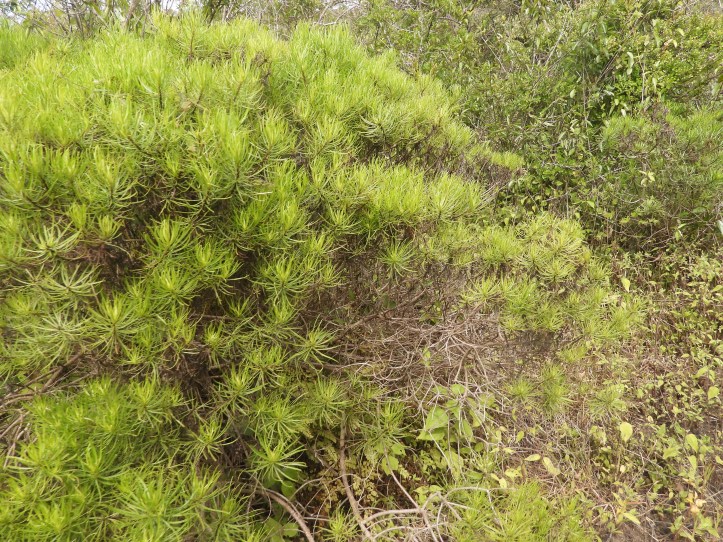
“Have you taken many pictures?” I asked Paul. “There’s nothing to see,” he replied cheerfully, taking a bite of his sandwich. “Well, I saw ferns that looked a bit like pine trees,” I said but he did not seem convinced. Later, our guide mentioned the ferns are endemic to the Galapagos and I feel intelligent and vindicated.
At the hut, I ate a wonderful tuna sandwich, cookies and had a drink box. The lunch was arranged by the Tortuga touring company. I had no reason to pick this company other than I was walking by the shop and caught the eye of a pleasant-looking woman in reception (Edith). I sensed she was the right person for my family.
Edith of the Tortuga Touring Company, Isabela Island
Edith wore her thick hair in a simple fashion. She wore a pale pink shirt that said, “Follow Your Fucking Dreams Not Me.”
Free of frills, Edith did her best to explain the tour until she was helped by someone who looked exactly like her, only younger.

Admission prices
At first, Rick wasn’t sure that he wanted to spend the money on the hike. But, over the years, Rick and I have honed a system: sometimes we alternate who gets to be budget-minded. When the cheaper person relents, we can buy things that we might not usually afford. A five-hour hike with a packed lunch, guide and transportation cost $40 per person plus a $60 tip. There are six members of my family so the price of admission quickly adds up.
That is how I found myself about to proceed into the most otherworldly landscape I could have imagined.
A Walk in a Moonscape on Earth
The south side of the Sierra Negra volcano is lush and green. The crater, however, is a hard, dry, sharp-lava moonscape.


On our visit, we saw fissures and put our hands inside fumaroles to feel the heat.
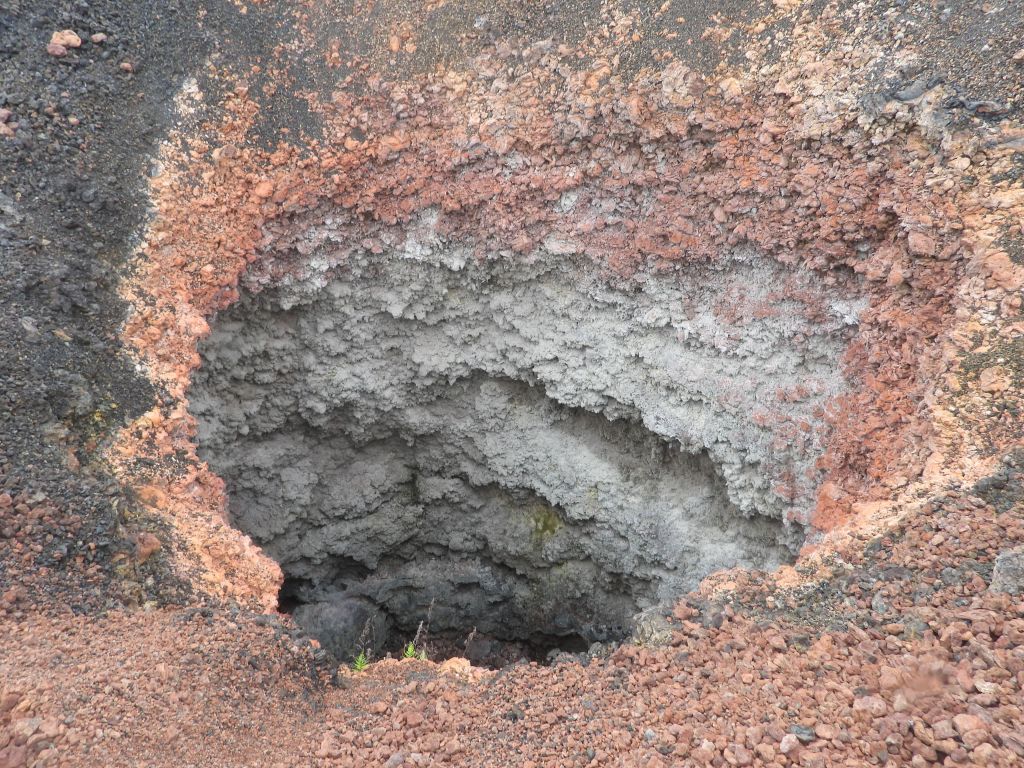


Some of the rocks were shiny. Our guide explained that they had solidified quickly. He showed us colorful mineral deposits, and tiny shards of rock that were evidence of the volcano’s splatter.

We saw lava scars embedded in cactus plants that grow only one centimeter a year. Some of the cactus plants appeared to be a couple of meters high and the scars were evidence of prior eruptions.


As we descended further into the volcano, we could smell sulfur, and the rocks were tinged with yellow.
The Galapagos has about seven different larger islands and many more smaller ones. Isla Isabella was not often visited until about 2005, when the tourist industry began to grow. And, few people have visited the volcano because a 10-mile (relatively strenuous) hike is not on everyone’s bucket list.
Our group sat on a craggy viewpoint and took some photos. I realized how special it was to be. Right here, in 2022. Not many people have seen Sierra Negra.

While the rest of the trip was overcast, I cannot complain. The temperature was just right for hiking.
Isla Isabela: Six Volcanoes
There are six volcanoes on Isla Isabela. If we had had more time, I might have liked to have camped at an area that is more remote, and less frequently traveled. Our guide told me that he had been there to camp for a weekend with his wife just two weeks prior. They had checked in with a Galapagos park ranger and had the area to themselves. Camping gear (tents and sleeping bags) are available to rent on the island, as are bicycles.
Adult Vacation Alert: Not so Many Kids in the Galapagos
We didn’t see a lot of tourists with young children in the Galapagos. The sights are highly regulated, and must be visited with a guide. Air travel aside, I think the cost per day in the Galapagos would be comparable to visiting Disneyland and staying in the Magic Kingdom.
Last year, we investigated going on an in-depth, one-week educational cruise in the Galapagos. It would have cost $5,000 each for the six of us with no discount for kids. A three-day stay on our own boat cost us a small fraction of that.
Pin it
If you enjoyed this story, you can save it to your own Pinterest board using the image below. Thanks for reading and following our journey.
Next post in the Galapagos series: After the Galapagos: The Sea is Alive with Extremes of Life, Luxury and Exploitation
 Becoming a Sailor
Lorraine,
I haven’t read your blog in so long but was just talking about you the other day about you and your Familly living life truly to the fullest.
how did your Family get to be 6? I thought you had Betty and then twins, seems I missed something
Donna Nash
thecoolredroom@gmail.com
LikeLike
We had a Paul between Betty and the twins!
LikeLike
It’s great to hear from you, Donna!
LikeLike