
This dictionary contains the language used by our family, and was inspired by Roy Peter Clark’s book The Glamour of Grammar.
The words are not necessarily unique to our family. However, as a whole, they capture terms from a family living on a boat and circumnavigating. Our dictionary describes language from a childhood spent at sea.


This dictionary was originally written as a 4-part series (A-C, D-K, L-R, and S-numerics). It was written as we sailed in Micronesia and then to the Philippines in January and February 2024.
Terms A-C were written sailing from Chuuk to Yap, Micronesia
GPS: 8 59′ .401 N, 142 29′ .627 E
a-lot-a-knot
A line tied in a haphazard way.
Alex Escher
A stray kitten we found in the PowerBoats boatyard in Chaguaramas, Trinidad in 2019. He was bumping into things and appeared to be blind and very hungry. We named him Alex and took him to a vet in Port of Spain.
Alex weighed 275 grams. He was treated for an eye infection and worms. Alex was boarded at the vet for several weeks before he was adopted.
Click for another picture of Alex.


Aphrodite
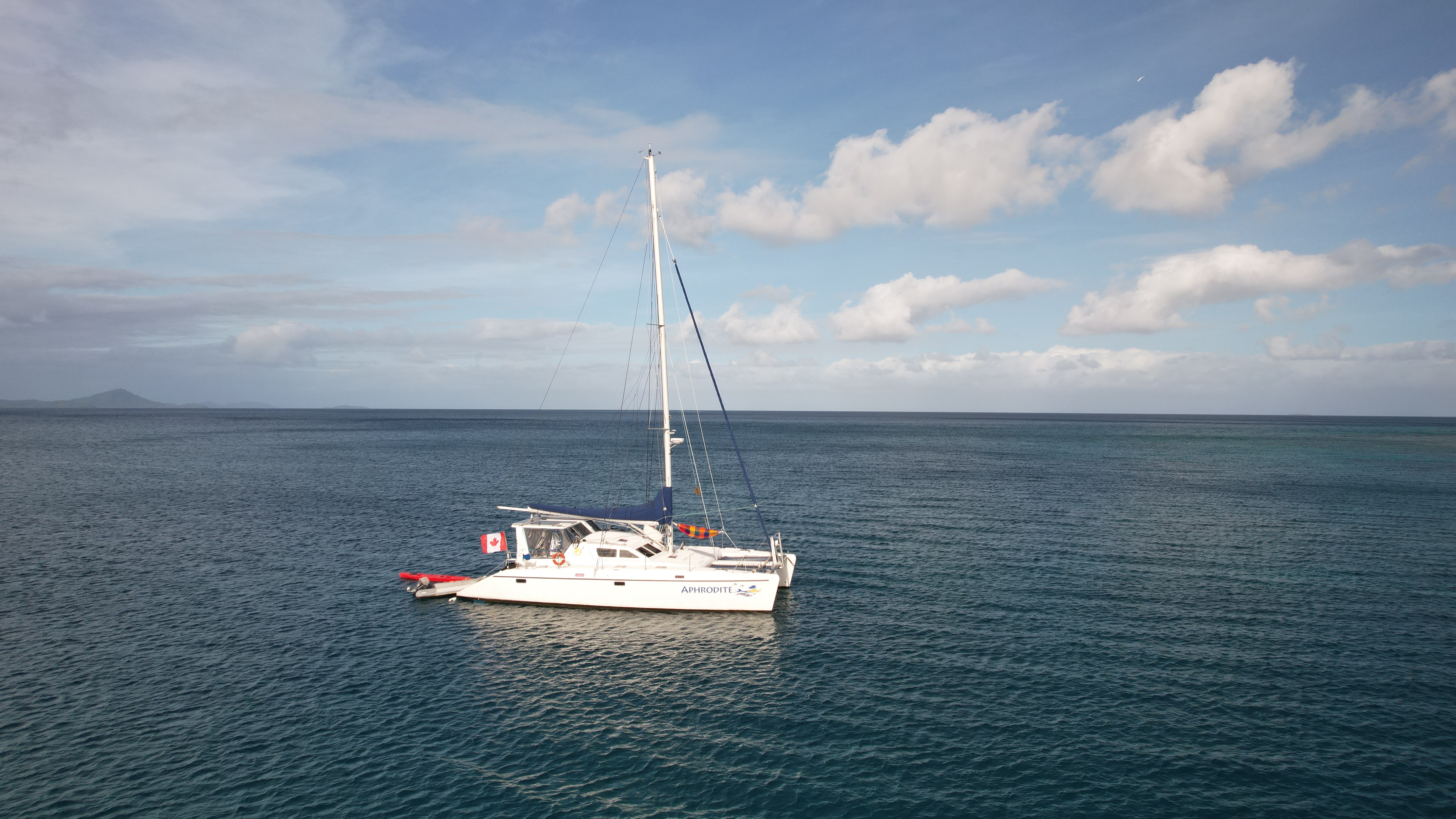
Refers to our boat as well as our family. In the cruising community, people are often known by their boat name, not necessarily by their first names.
Other sailors might say, “We are meeting Aphrodite for ice cream’” or “The Aphrodite mom has water.”

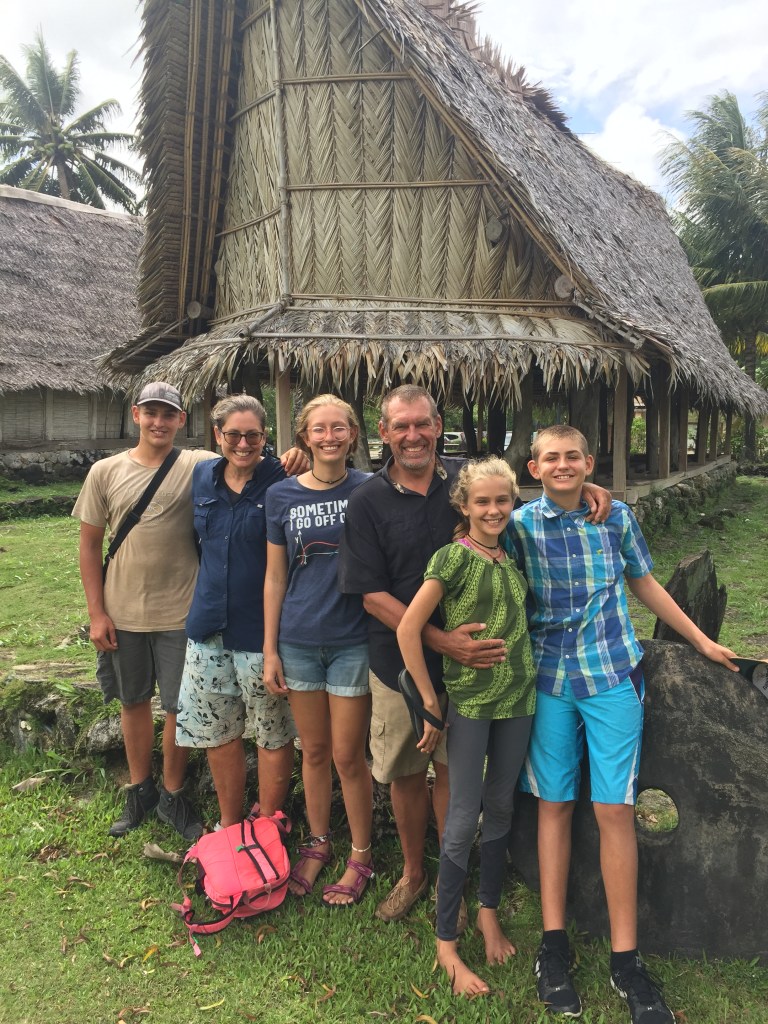
basketball
A term used to bolster confidence while poking fun at my performance on my high-school basketball team. In three years, I scored one basket — on the wrong team.
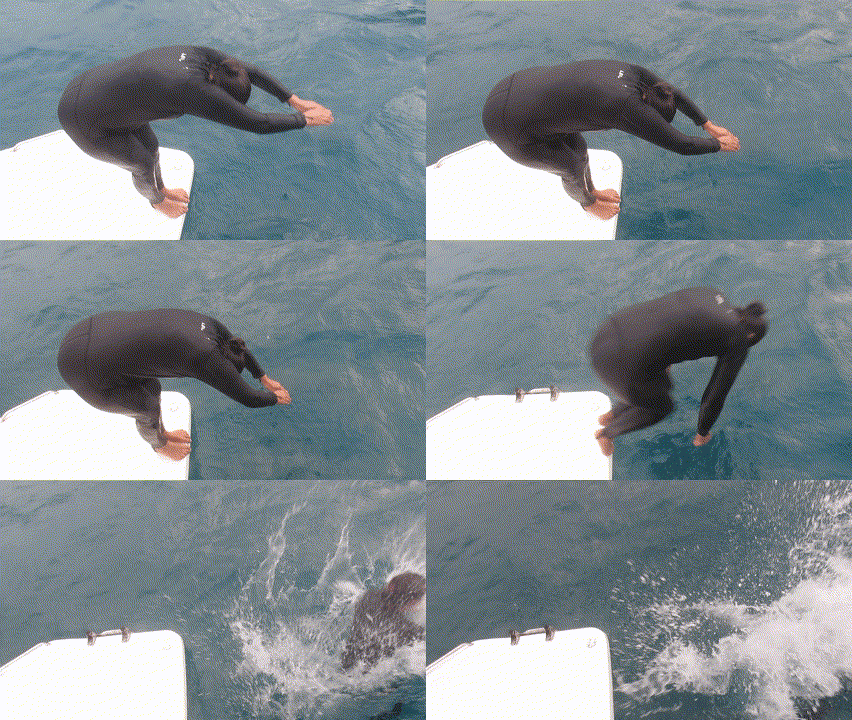
bathyscope
A low-tech underwater viewing device. A bathyscope works like a giant goggle. We put our bathyscope into the sea, hold it by the handles, and look underwater using its glass bottom.

big bum seat
A large corner seat in our saloon. This seat is comfortable because it allows the occupant to stretch out and lounge while watching movies.
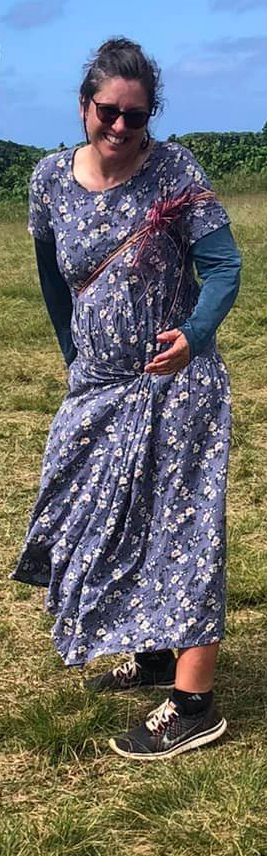
big dress
An ankle-length, short-sleeved, flowery dress I wear to indigenous villages or towns where modesty is important. In North America, this dress would suggest I belong to a religious sect. But, in Fiji, Vanuatu, Solomon Islands, Papua New Guinea and Micronesia, it works.
big house
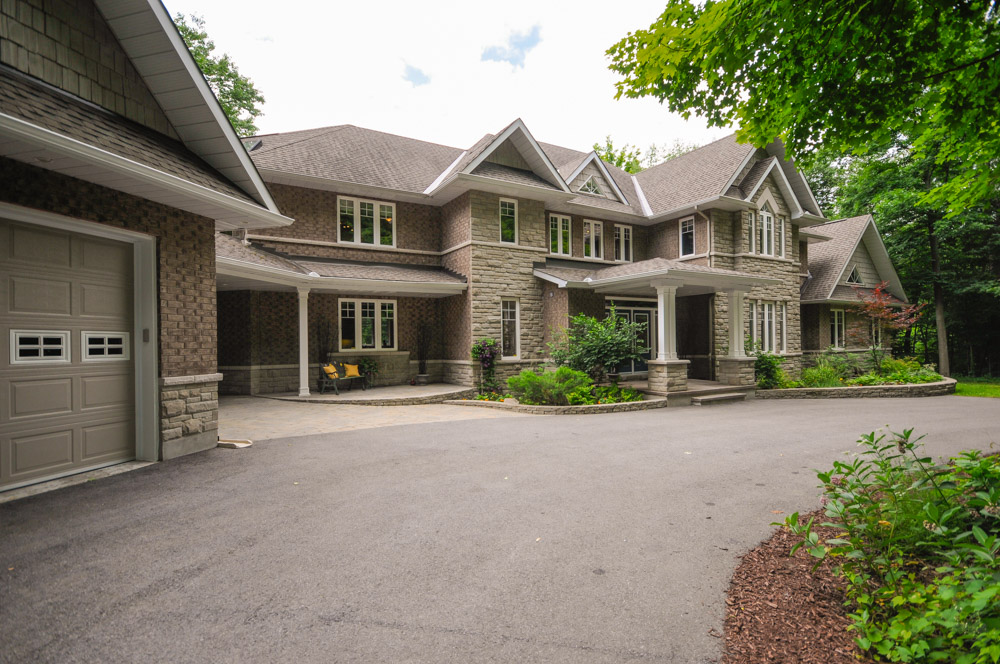
Our house in Ottawa before we moved to our catamaran, SV Aphrodite. Our kids lived in the “big house” after we moved from our smaller, and more centrally located, “yellow house“.
A cross-continent camping trip in 2014 caused us to rethink our priorities. Within six months of returning to Ottawa, we bought SV Aphrodite, and radically downsized by donating or giving most of our belongings away. My 2015 blog post, “Closing our house, room by room” describes how we packed up our “big house”.
black-handled knife
A dull knife with a pointy end, used to remove things, like dust, popcorn and hair that gathers in the crack of the teak transom.

Blowfish Todd
A man we met on Isabela Island in the Galapagos, and then again in the Marquesas, French Polynesia. Todd was crewing on his friend’s sail boat. My children know him as Todd or Blowfish Todd.
Todd got this nickname because of how he greeted us one morning before a tour of the Sierra Negro volcano on Isabela Island. He put his lips on the window of our tour guide’s car and made his cheeks and mouth expand (like a blowfish).
Photos supplied by Todd, with photo credit to Nelson Riollano. To preserve “Blowfish Todd” as a family term, Todd’s last name has been omitted intentionally. Todd is currently working on a boat for National Geographic.


boat clean
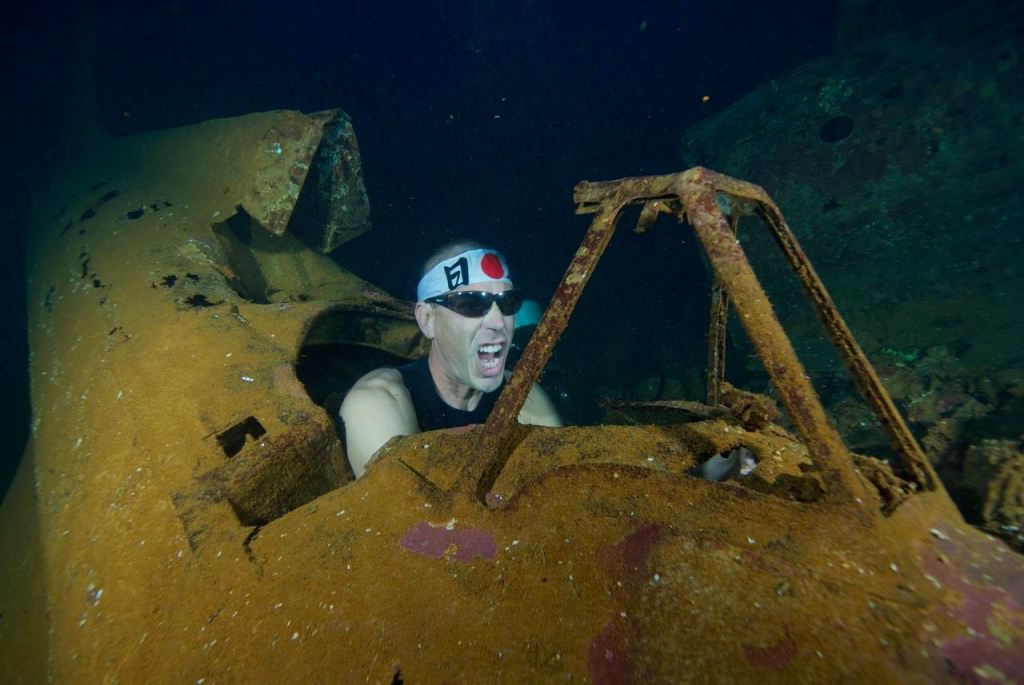
Stained clothing that is perfectly acceptable in our environment. We might change our standards to go to shore; we might not.
bulbous cup
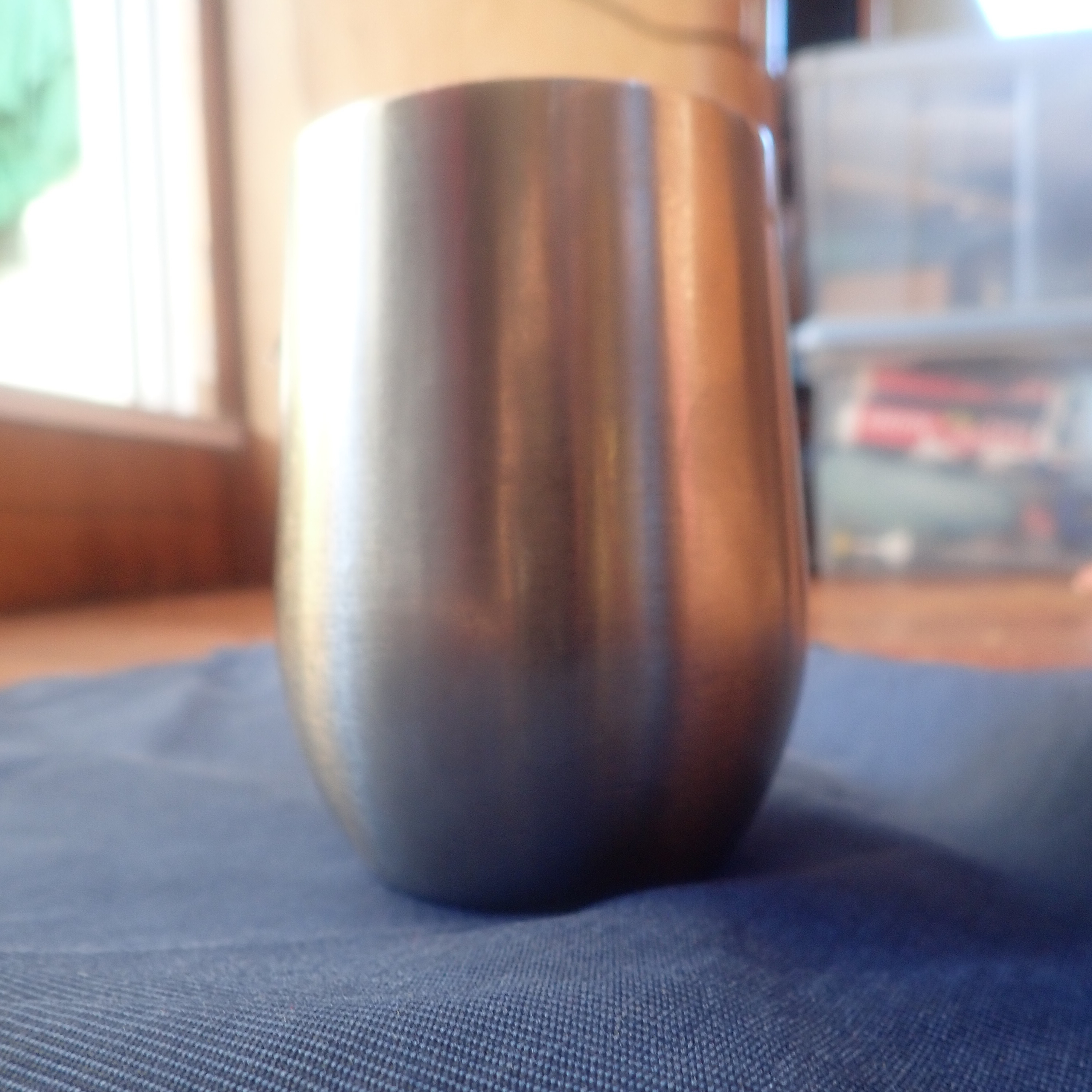
A double-walled, stainless-steel cup that narrows at the top.
“When Rick had dengue, he refused to drink out of any cup unless it was a bulbous cup.” Reason being, they’re the best insulated glasses on the boat.
cement bucket
A sturdy bucket designed to carry cement and strong enough to hoist seawater to clean the decks.
cheap water bottle
A recycled plastic water bottle. We refill these water bottles to use ourselves or give to local people. Cheap water bottles can be left in our dinghy or kayak without fear of theft.
child cage
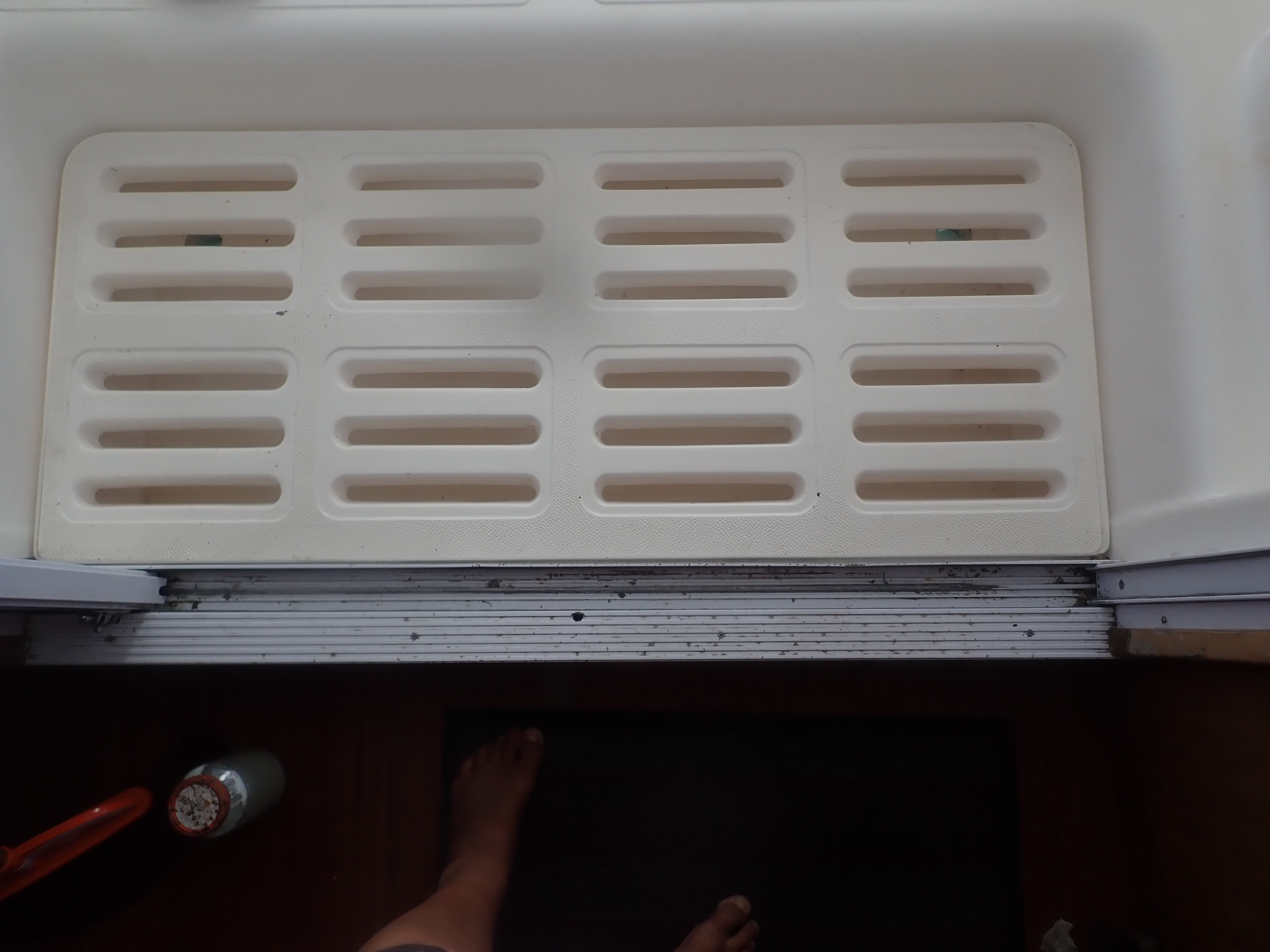
The child cage refers to the large, covered drain in our cockpit, just below the steering wheel. The name was perhaps inspired by watching the movie, “Chitty Chitty Bang Bang” with our kids. Who can forget the scene with the child catcher?
The “child cage” used to be called the “toy cage” because small objects like Lego or hair elastics would fall through the slots in the drain. The word “toy” and “child” had close association and over time the drain’s name morphed into the “child cage.”
clean the bottom
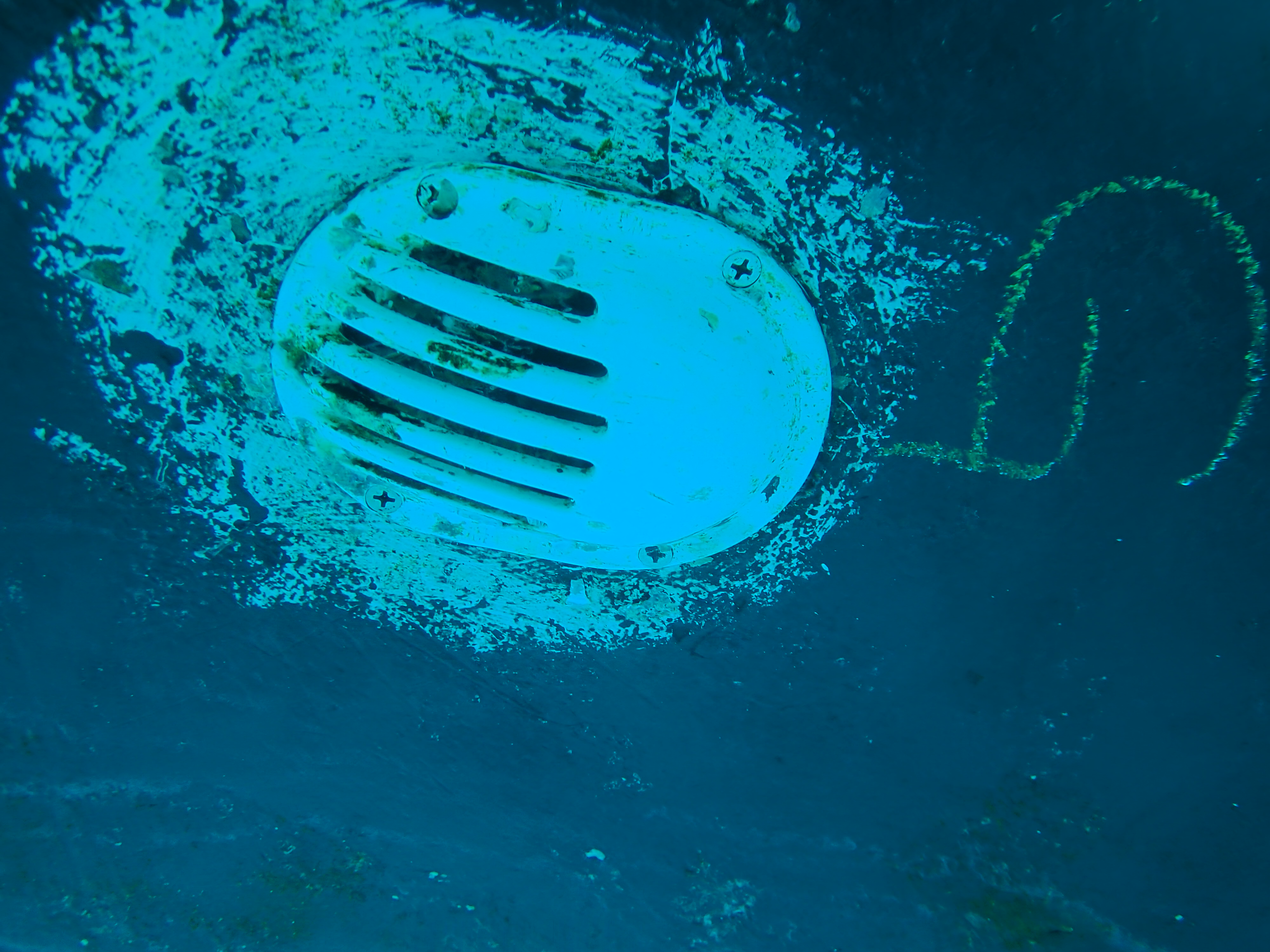
We use a paint scraper and green scrubby pads to remove barnacles and seaweed that collect on the bottom of our boat. A fouled bottom affects sailing performance. In some places, like the Galapagos, or New Zealand, a dirty bottom presents a biosecurity hazard.
New Zealand has very strict rules relating to boat bottoms at the national and municipal level. To enter New Zealand, we cleaned our boat bottom, and then documented our work with labels and underwater photos.

cleaning the engine
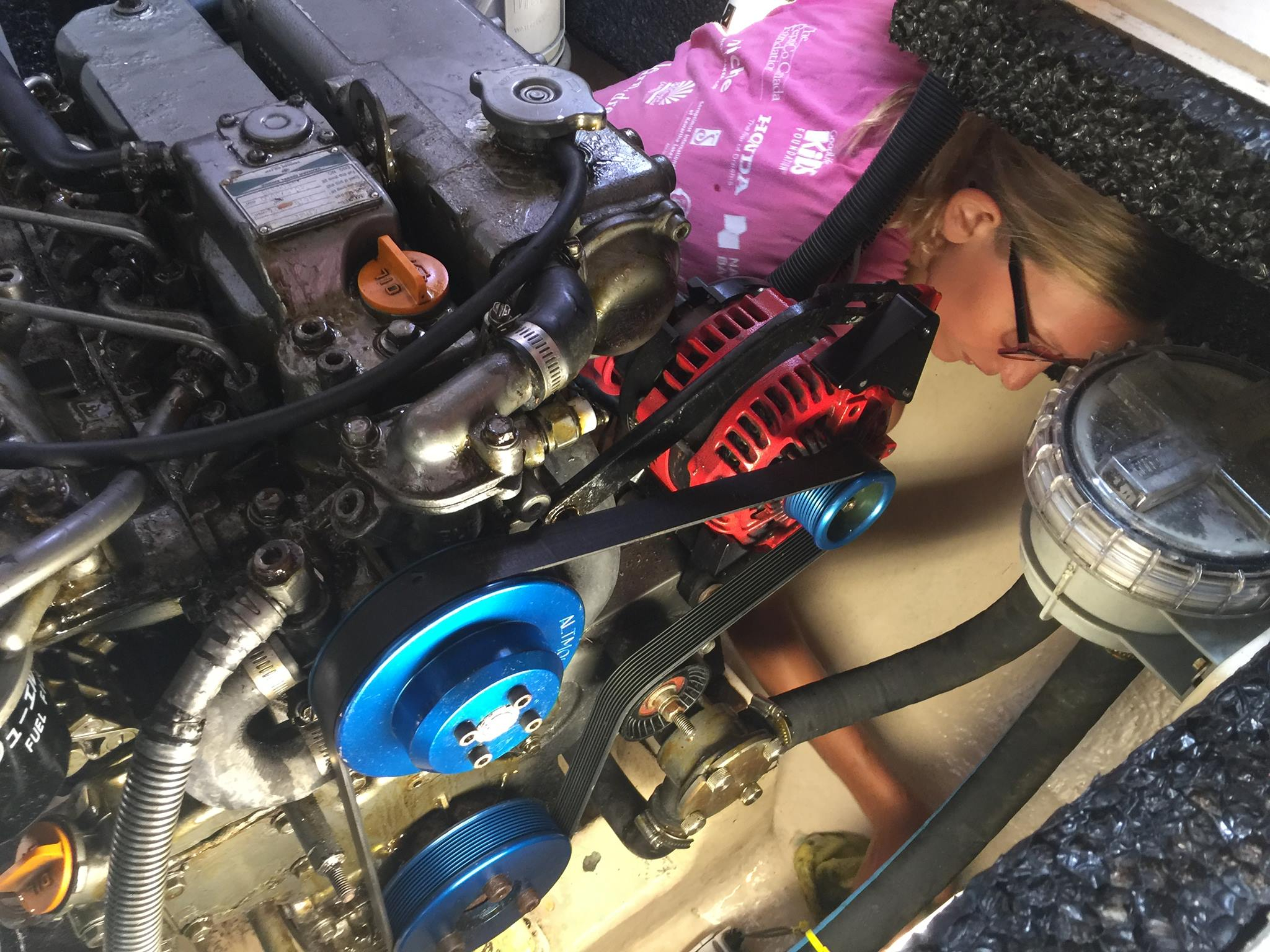
This is a regular job on SV Aphrodite. We have two engines. The engines are below the two aft beds. Cleaning involves crawling into tight spaces.
The job takes about an hour. We like to keep the engine clean because we can then easily see streaks of rust or oil. Issues are easier to detect when the engine is clean.
clip in
We “clip in” to our boat for safety in rough weather, at night, and when fishing at the back of the boat.
Example: We might ask “Is he clipped in?” when Paul is fishing to check he is attached to the boat, and not at risk for falling overboard.

coming from the US
The phrase “coming from the US” sparks excitement because it represents the possibility we might be able to order parts and have our things brought by airplane. Outside the US it is difficult to acquire engine and water maker parts, sail systems gear, plumbing supplies, and homeschooling materials.
Our environment wreaks havoc on our gear. The heat, humidity, and sea air damage cell phones, computers, Kindles and cameras.
You do not have to travel far before supplies become very limited. We carry a lot of spares. In Fiji, for example, we supplied a welder with good-quality stainless steel so that he could make us a new rudder.
In some cases, it is cheaper for someone to fly to the US than to have an item shipped. Presently, we are considering flying to Chicago to pick up schoolbooks for our kids because of the time, cost and the risks of trying to ship the books to Micronesia or the Philippines. Flying to Chicago also gives us a chance to pick up a much-needed Yanmar oil pan. The oil pan is integral to the function of the engine. At the moment, one of our Yanmar oil pans is limping along with three epoxy-puttied patches covering leaks.

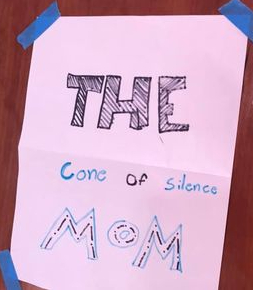
cone of silence
“Do not talk to me. I am in the cone of silence.”
A strategy I impose when my family talks at me through the bathroom door. A bathroom is called a ‘head’ on a boat.
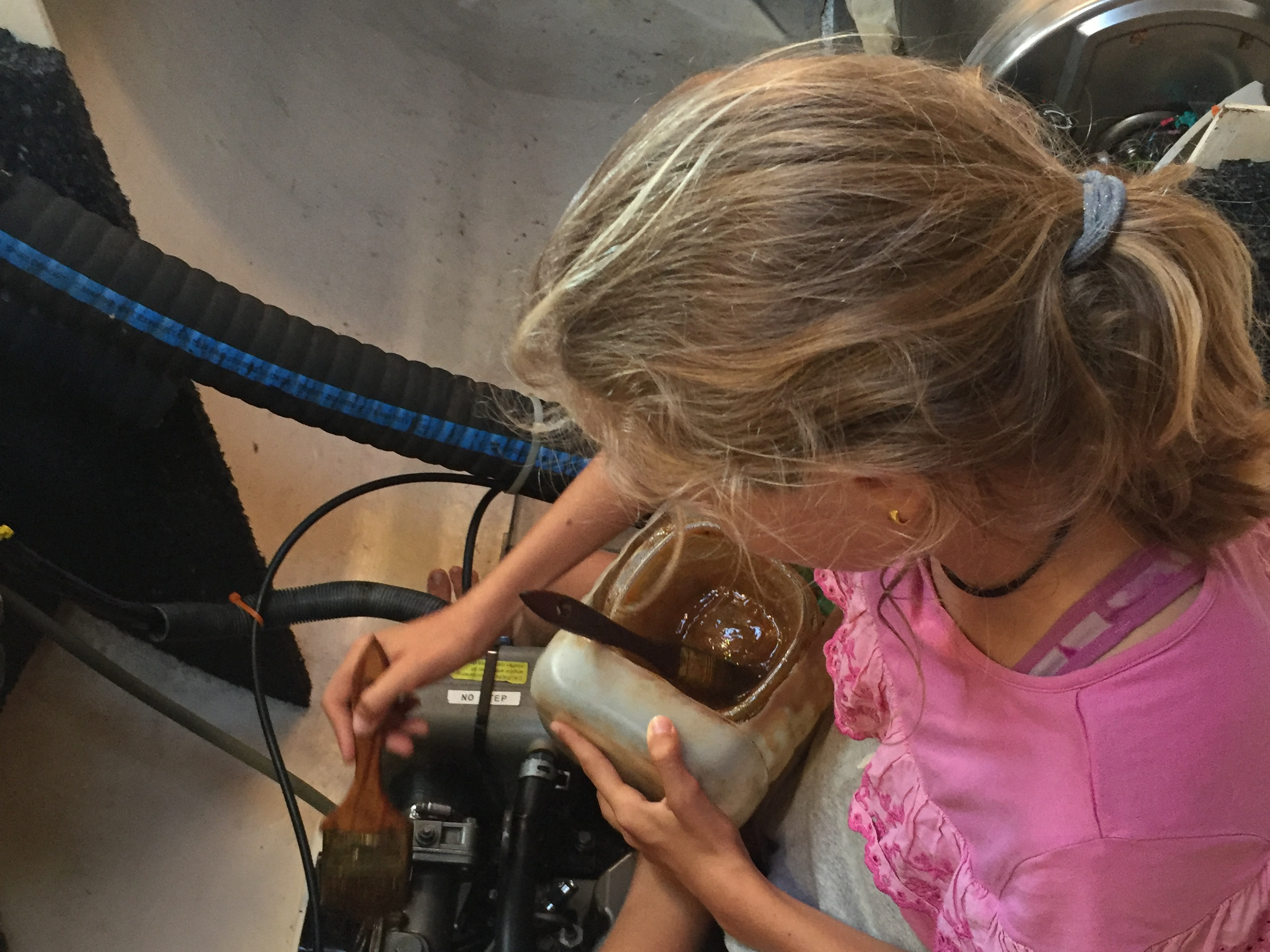
Corrosion-Xing-it
Corrosion-X is a miracle product that lubricates and revives rusty items. As we live in a salty environment, we coat our tools, and our engine with Corrosion-X.
Example:
“These scissors are seized.”
“Have you tried Corrosion-Xing-it?”
cough syrup
Said to someone if they cough or sneeze excessively. The phrase, “cough syrup” refers to an incident on a bus in Port of Spain, Trinidad, pre-COVID. Another passenger was coughing non-stop, and a stranger called out loudly, “cough syrup” on two occasions. The idea of struggling with a cough and being reprimanded by a stranger seemed rather funny. We have adopted the phrase, “cough syrup” ever since.
counting zip ties
This is a phrase used when we lower the anchor chain. We use zip ties to measure out the amount of chain we need. At one point, we painted the chain. However, the paint wore off quickly as it rubbed along the sea bottom. We put zip ties at 5-meter intervals along our anchor chain.
The amount of chain we put out varies depending on the depth of the anchorage area, and the swing room. We might put out more chain, and therefore count more zip ties, if we expect bad weather.
We will soon be installing a chain counter with a digital display. It works with a magnet and, in that regard, is similar to a bicycle computer. However, the device instead of measuring distance, the chain counter measures chain length.

cowboy shower
A short shower. On our boat, water is a scarce resource. A short shower means not wasting water: you get wet, then turn the tap off. Apply soap. Turn the tap on. Rinse off.
Recently, Karen complained that Betty was showering too often saying, “She has a shower every week!”
crap
Refers to any object that is taking up space on the boat.
cruise ship passenger
An insult. Someone who is expecting to be served; someone who is not pulling their own weight. This term replaces “human succubus”, which I recently learned means a demon who assumes the female form and has sex with someone while they sleep. Betty had suggested I did not know the meaning of the term “succubus”. Turns out, she was right.
Terms D-K were written sailing from Chuuk to Yap, Micronesia
GPS: 9 20′ .326′ N, 139 24′ .911 E
diamond cutters to knitter
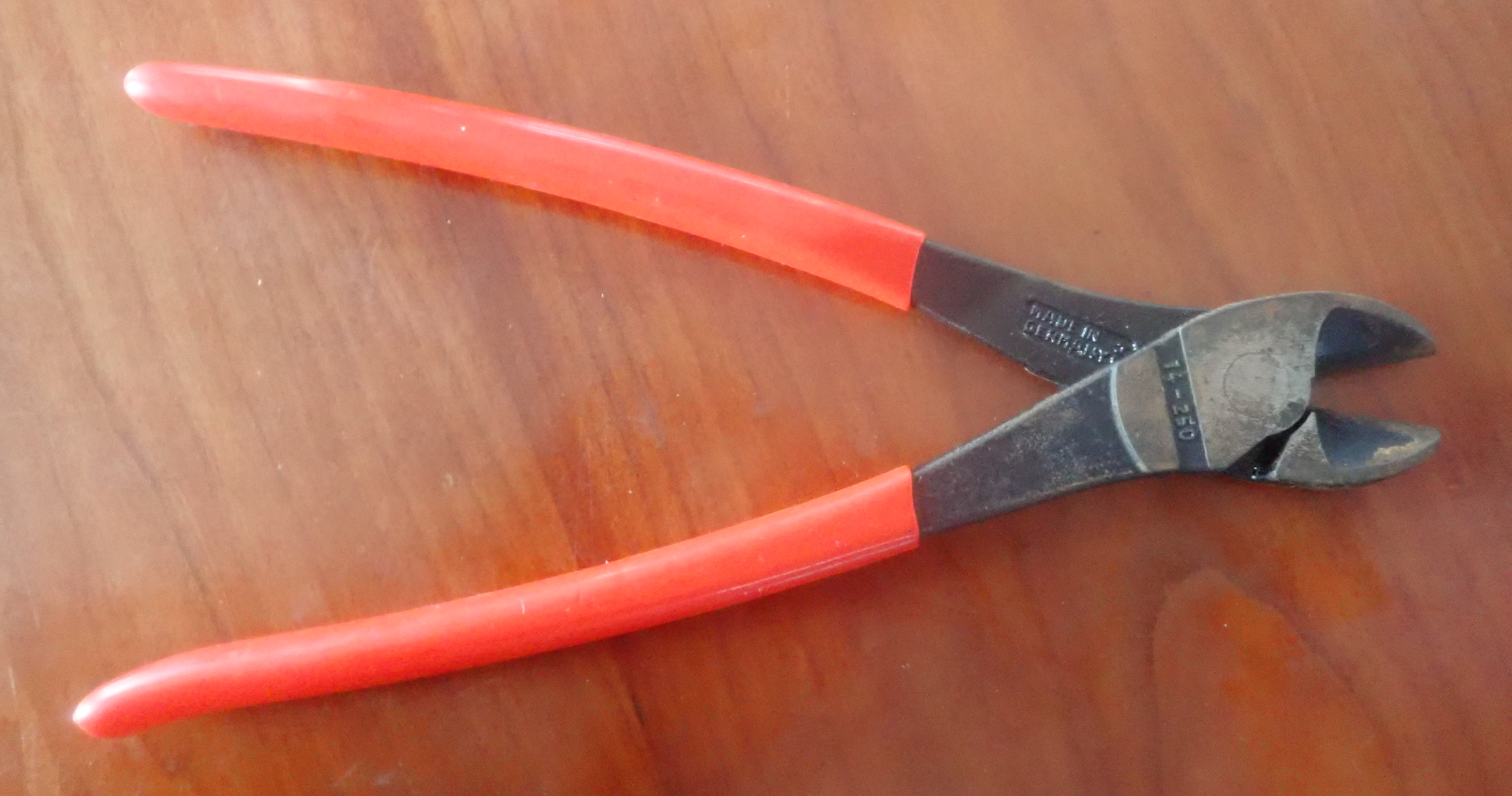
diamond cutters
Refers to diagonal cutters. Our family has interchanged the term diamond for diagonal for so long I didn’t realize that the term “diamond cutters” was unique to our family until I wrote this blog post.
diaper cream
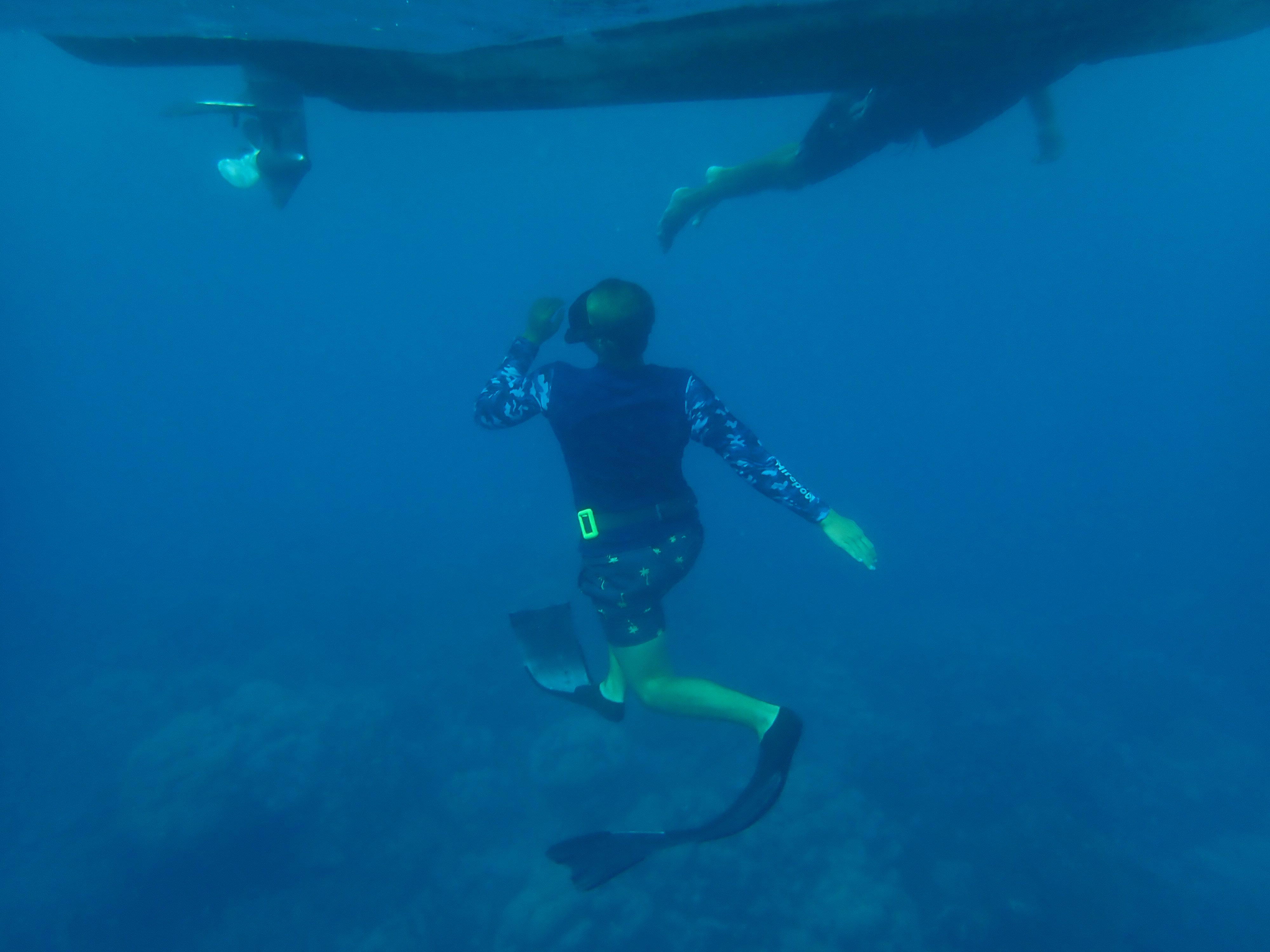
When I swim, kayak, or sail, I protect my face from the sun with Boudreaux’s Butt Paste Maximum Strength Diaper Rash Cream. It has 40% zinc content.
Diaper cream is a cheap and effective alternative to regular sunscreen. I do not need to reapply the cream throughout the day. In fact, I have to use a facecloth and shampoo or dish soap to remove it.
On shore, I wear a more conventional, 50+ SPF sunscreen on my face and any exposed body parts.
In the photo, I am wearing a COPOZZ full rash suit over top of my swimsuit. Again, this is for no-fuss overall sun protection.
Note: I don’t get paid for providing any of the links in this dictionary. I just really like the products.

dirty rice
Refers to curry. When Paul was two years old, he resisted eating his first meal of curry. He thought that white rice with curry looked dirty. Curry is now Paul’s favourite meal and he is a fantastic chef.
dog-legged ‘a‘
Refers to a handwritten ‘a’ with its downstroke pointing outwards — like a male dog might lift its leg against a tree. I prefer that my children write “straight-back a’s”.

doodad
Refers to something unnecessary, maybe frivolous, that costs money. For example:
While shopping, I might say, “I think I will buy these decorative book ends.”
Karen might respond, “Doodad. Just use one of our tin cans instead.”
We adopted the term “doodad” from the Cashflow Board Game, developed by Robert Kiyosaki, author of the best-selling book, “Rich Dad Poor Dad”. Questioning our purchases is more about being creative and resourceful than doing without.
engine clothes
Refers to stained clothing, suitable to clean an engine. For example:
“Put on your engine clothes. This job is going to be messy.”
Escher family hair cut
This refers to a buzz cut for the boys in our family. (Our last name is Escher.) Because we cut our own hair, and we are in the tropics, a ¼ inch buzz cut is the easiest cut and style for us to manage.
Creative departures from this style have led to some hair disasters including the Joan-of-Arc bowl cut, a failed mullet, and bangs cut so short, that they resembled a stiff, tufted paintbrush.

family car
Refers to our dinghy, also called a tender, or RIB (rigid inflatable boat) which we use to travel from SV Aphrodite to land or to another boat.

family meeting
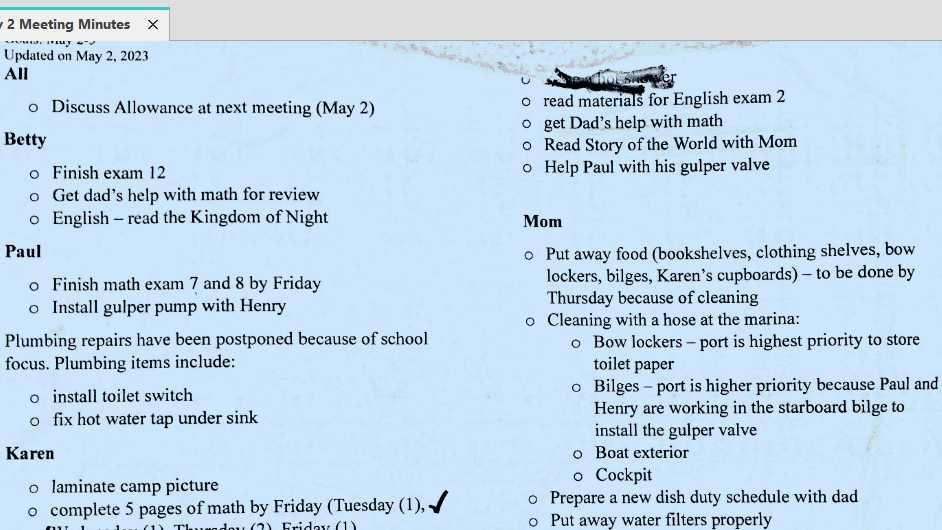
Refers to the twice-weekly family meetings we have arranged (at times) to track goals and progress. I type out meeting minutes and post them on a wall so people can cross off tasks as they are finished.
flipper flapper
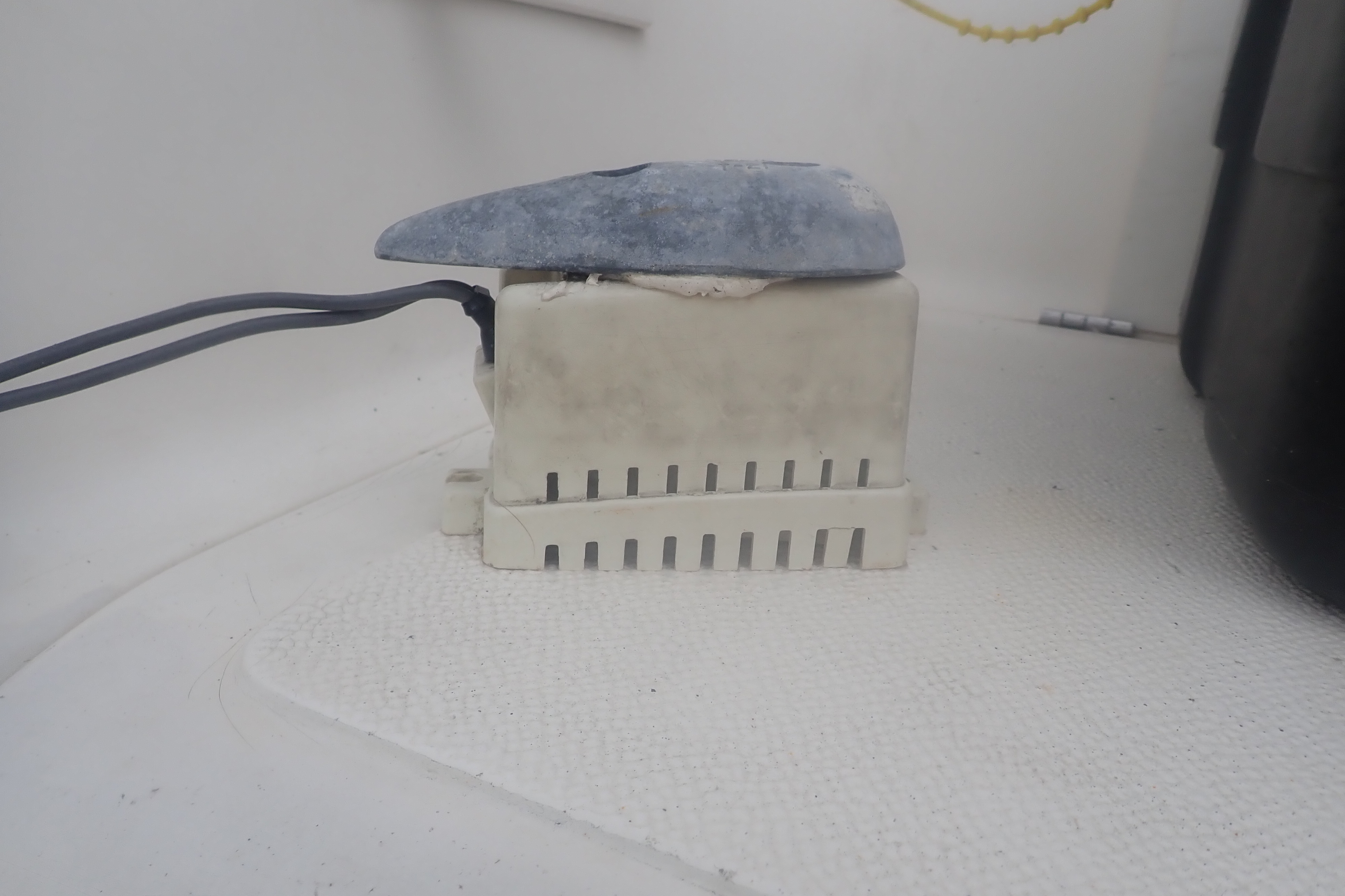
Refers to the Rule-A-Matic float switch as shown in the top photo. In the presence of water, a float flips ‘up’ and activates a pump. We use the “flipper flappers” to automatically activate our bilge pumps and to run our rainwater collection pumps.
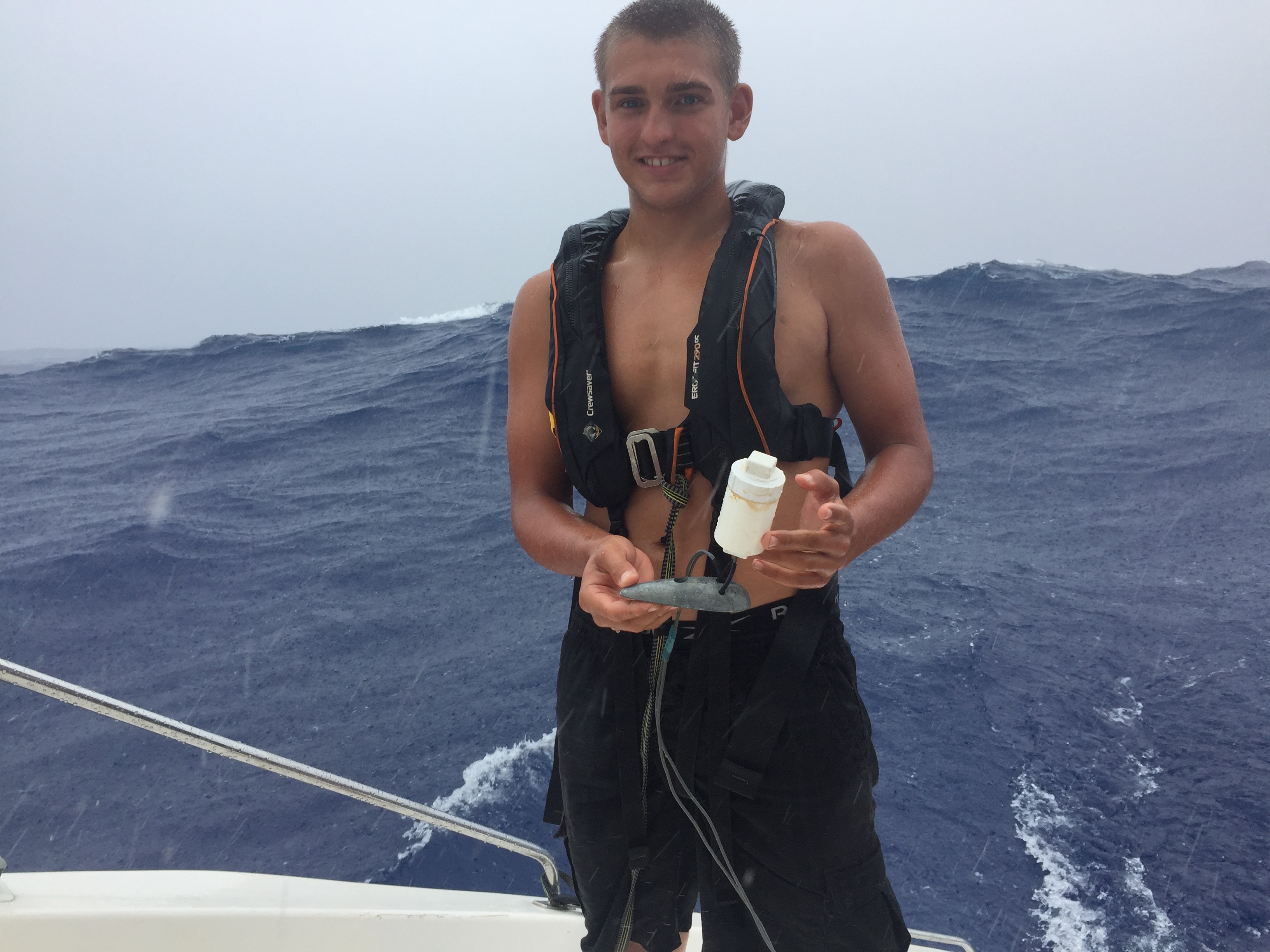
Rule-A-Matic float switches do not last, and require frequent replacement. After one of the rainwater flipper flappers failed, Rick built a switch from an old mercury switch. The middle photo shows Paul holding Rick’s fully-sealed, homemade float switch.
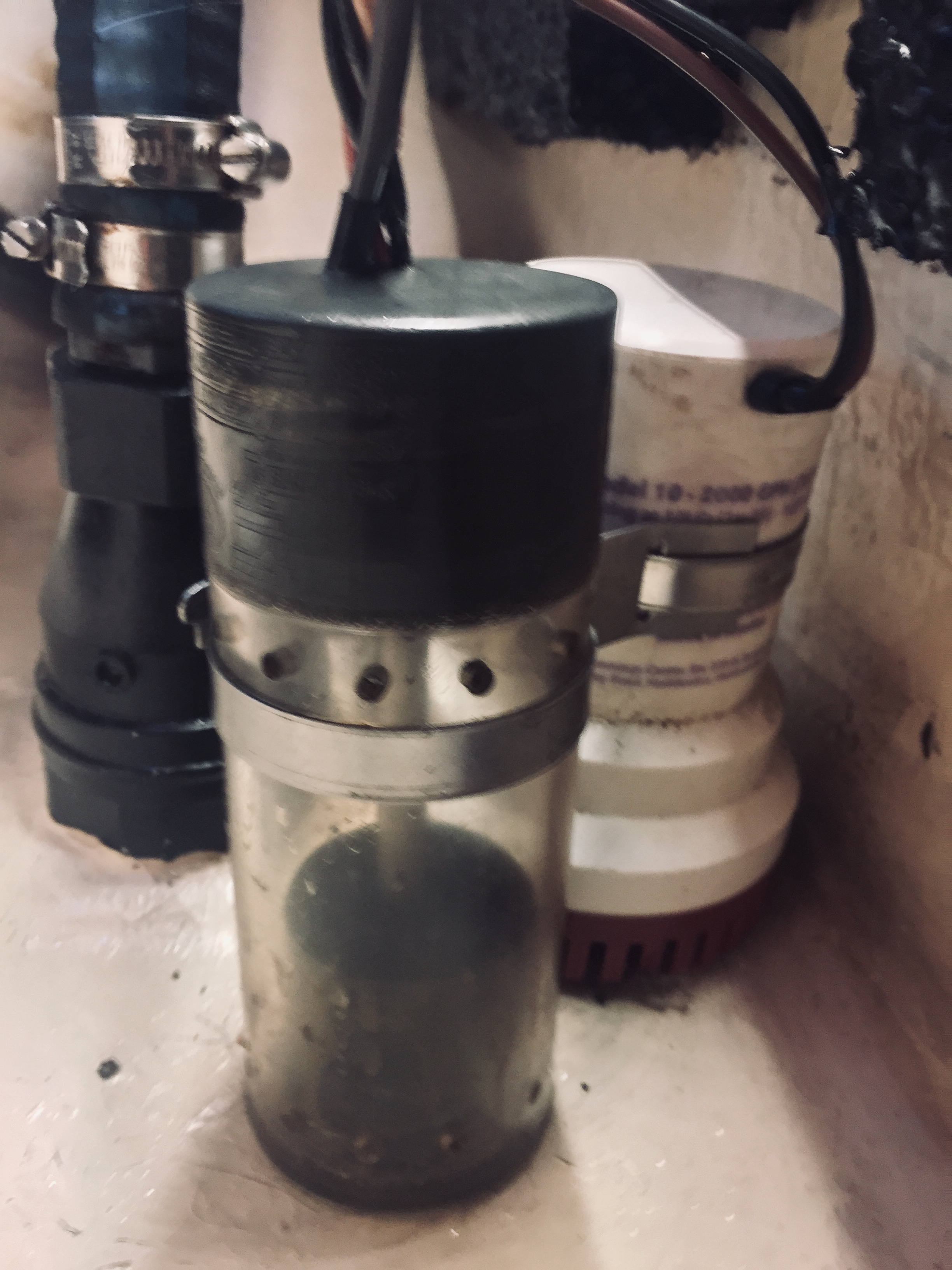
We have been buying Ultra Pumpswitches SRs for our bilges so we can get rid of Rule-A-Matic flipper crappers. The Ultra Pumpswitch SRs are nicely designed and built to be maintained, as opposed to replaced. The photo of the Ultra Pumpswitch SR was taken in our starboard engine compartment.
foods for passages
Refers to food, intended for passages, that no one believes will last that long. Foods for passages include: peanuts, cookies, and chocolate. The phrase “foods for passages” is said usually with an eyeroll because people on our boat (me) tend to eat the treats before a passage, leaving folks on nightshift with ramen soup as an alternative.
good water bottle
Refers to a Nalgene bottle, which is a bottle meant to last. We have had several crack and break. Nalgene offers a lifetime warranty, though we’ve never been anywhere where we can take advantage of that warranty.
Grayskull
This refers to our first washing machine, which was a Splendide 7100XC washer/dryer combo. The name “Grayskull” came from the opening sequence of the 1980s television show He-Man. In the show, Grayskull is a sword that holds god-like powers. Certainly, I felt “the power” when I began using a washing machine on a boat. For the first 3 years of living on a boat, we washed clothing by hand.
We replaced Grayskull with a Miele WWH660 washing machine. It greets me in German, and the parts are very robust. That said, Miele is a domestic machine. We voided the warranty straight away by putting it on our boat. However, when we had issues with our machine in New Zealand, the Executive Director of Miele, Markus Miele, personally intervened. Recht herzlichen Dank, Miele.

“Hatches!”
When it rains, someone will often yell, “Hatches!” and then we close the cockpit enclosure, and as many overhead hatches and portlights as possible, before it stops raining. When it rains at night, I wake people up, and ask them to close their hatches and portlights. My voice keeps pitch with the intensity of the rain. Sometimes I close overhead windows for people who are sleeping but it means I must clamber over them.
helper
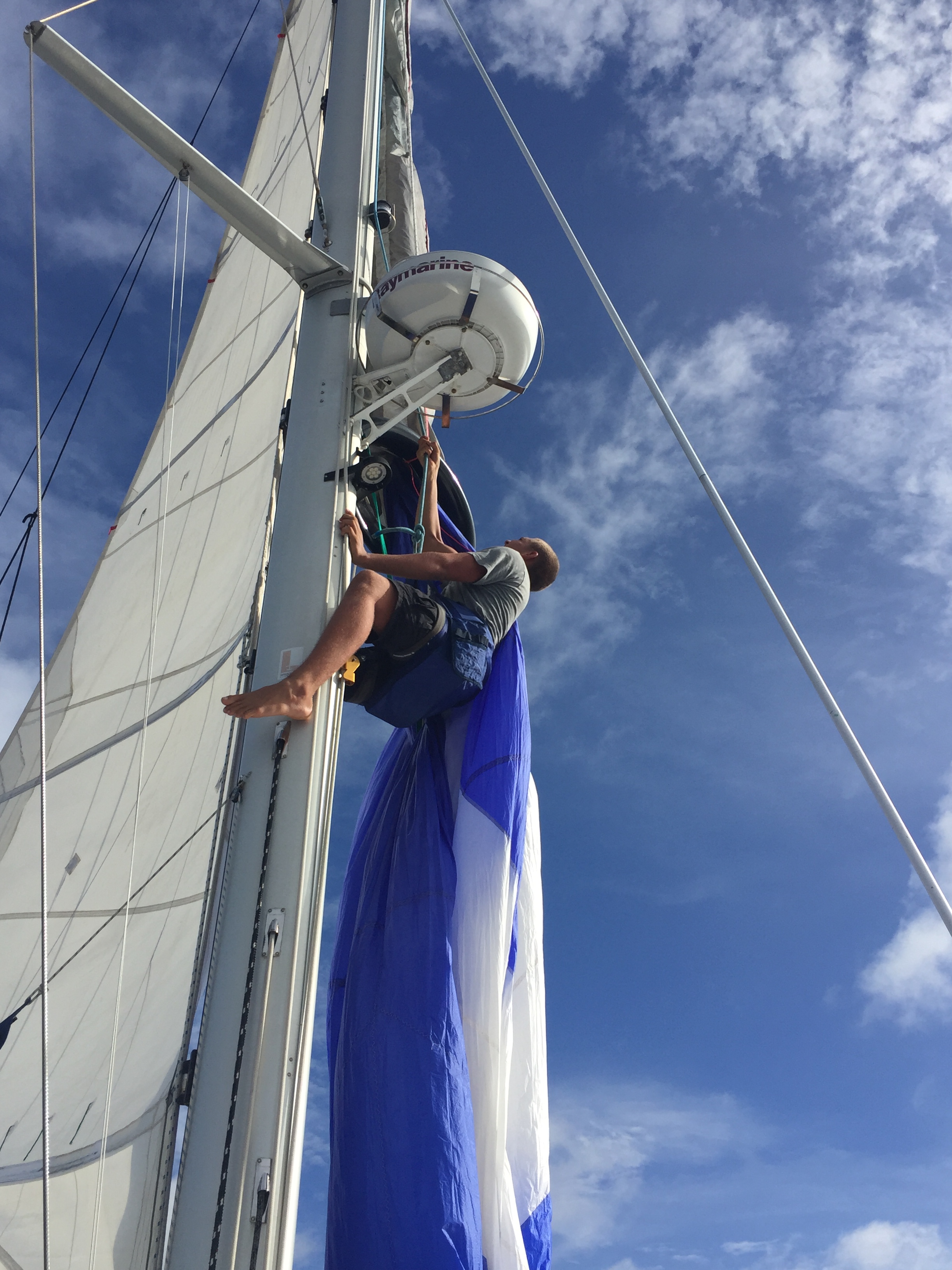
Refers to a person, usually as child, assigned to help with a specific boat job. In the early days of sailing, the “helper” supplied Rick with tools, rags, water and food. Over the years, the helpers have increased their portfolio of skills.
In 2024, the job of “helper” may involve going up the mast; using tools such as: a grinder, Fein multi-tool, electrical multimeters, a hot knife, heat gun, soldering iron; or using chemicals like specialized two-part glues, muriatic acid or acetone; and generally providing agility and fine-motor skills in tight areas, with instruction from Rick.
It’s a boat. It’s not Disney. We challenge our kids by assigning jobs and they seem to build grit and character.
Related term: Nimbleton.

Betty cleaning the hull 
Paul at the top of the mast in New Zealand. In the background, is the Auckland Harbour bridge. 
Henry, age 12 building a new battery 
Paul age 15, servicing our Yamaha 25 HP dinghy engine 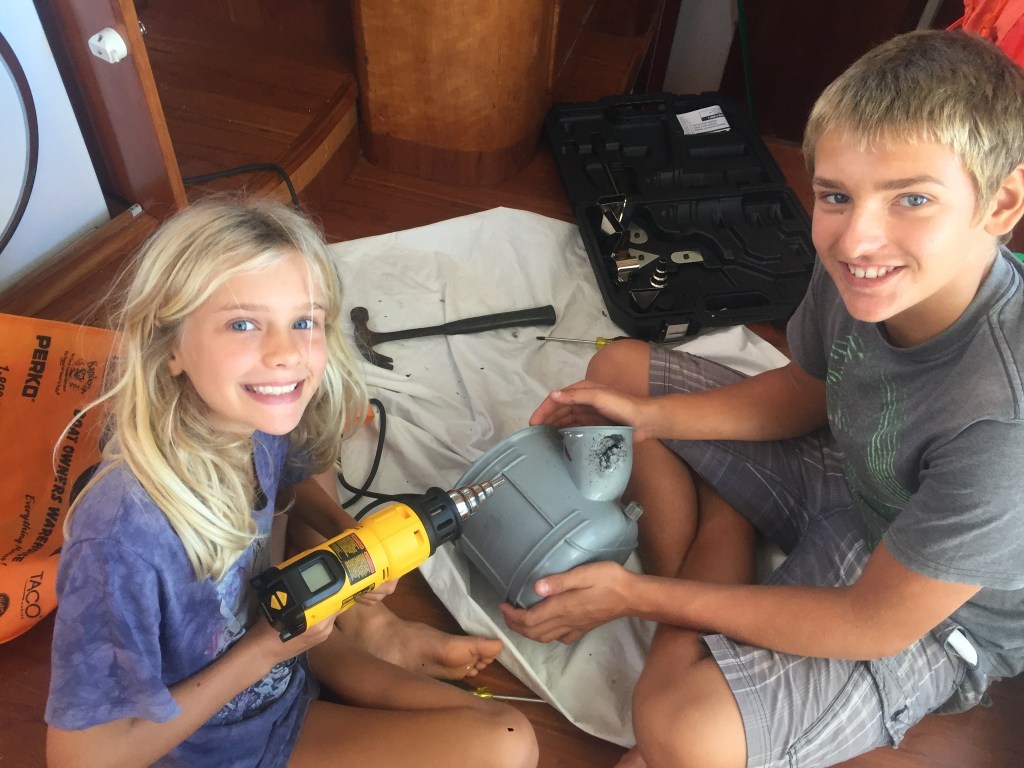
Karen and Paul fixing an engine exhaust on the way to Panama 2021. 
Karen, age 4, using a screwdriver
Hilson project
Refers to a job likely to explode into a series of unexpected side jobs. The term “Hilson” originates from the name of the street in Ottawa where we owned a 1950s walk-up apartment.
In the early days of ownership, Rick and I decided to remove some sticky, privacy film from a bathroom window. We thought it would be a short task.
Instead, we ended up breaking the window and discovered that the window frame had rotted, along with part of the bathtub wall. A 15-minute task ended up taking us several days once we bought materials.
We had to rebuild the rotted window frame and a portion of the wall, retile the new wall section, paint the wood, putty the glass, before finally installing a new window. And, all we had wanted to do was to remove some sticky privacy film.

Hobbleton
A term meant to add some levity while acknowledging an injured family member. For example, Rick was a “Hobbleton” when he had dengue fever. Paul was a “Hobbleton” in 2019 during a growth spurt, and after having his appendix removed in Grenada.
To explain the accompanying x-ray, Paul had Sever’s disease, which is an awful name for something that meant his heels were very sore. His Achilles tendons were not keeping up with the growth of his bones. As a result, Paul felt continuous pressure on the growth plates on his heels. This was aggravated when he walked. Paul literally had growing pains. The x-ray ruled out further issues such as bone spurs.
Antonym: Nimbleton.

hooves
Feet.
hot thoughts
Refers to a phrase said while taking someone’s temperature. As I use our Braun digital ear thermometer, I tell my kids (or husband), “Do not have any hot thoughts,” as though they might think themselves into a fever.


I believe I can fly
When Karen was about 6 years old, she fell into the bottom of our cockpit table. Through tears, she explained that she was attempting to fly from the helm and landed headfirst instead. Karen has a small scar near her hairline as a result of this incident.
inside fridge
The fridge in our galley. Our fridge is about the size of a bar fridge with 4 cu ft of interior space. It is stainless steel. This is different than the outside fridge, which is larger, and is in the cockpit. Our inside fridge was intentionally bought without a freezer compartment because we have freezers elsewhere on the boat. We have a deep freezer in the saloon.
Jason Gibson video
Refers to STEM videos we purchased for our children by Jason Gibson. We bought all 50+ of his video courses and he shipped them to us a hard drive in Martinique. We highly recommend his videos. He gives lessons from Grade 1 to university-level math. See: https://www.mathtutordvd.com/.
When the videos arrived we joked with the kids that they better like this guy because he’ll be with you for life. The videos span the range from basic counting, adding and subtracting, to advanced calculus and differential equations, to electrical circuit analysis and Java programming, and even how to use Excel, Word and graphing calculators.
job-jar job
Refers to a short, 15-minute task selected randomly out of a large ketchup bottle that I fashioned with a door like a bird feeder. The job jar contains about 70 different tasks (aka job-jar jobs), ranging from “dusting the guitar ledge” to “scrubbing the back transom, port side”.
The idea is that each kid completes a job before they start school.
When put into practice, everyone in our family can see that small improvements bring about big changes. Our boat looks better, and our kids feel a sense of pride and ownership.

kayak the garbage
Taking the garbage to shore by kayak. For example: “I’m going out to kayak the garbage.” In Grenada, I would sometimes stop at a friend’s boat to take their garbage as well.

knitter
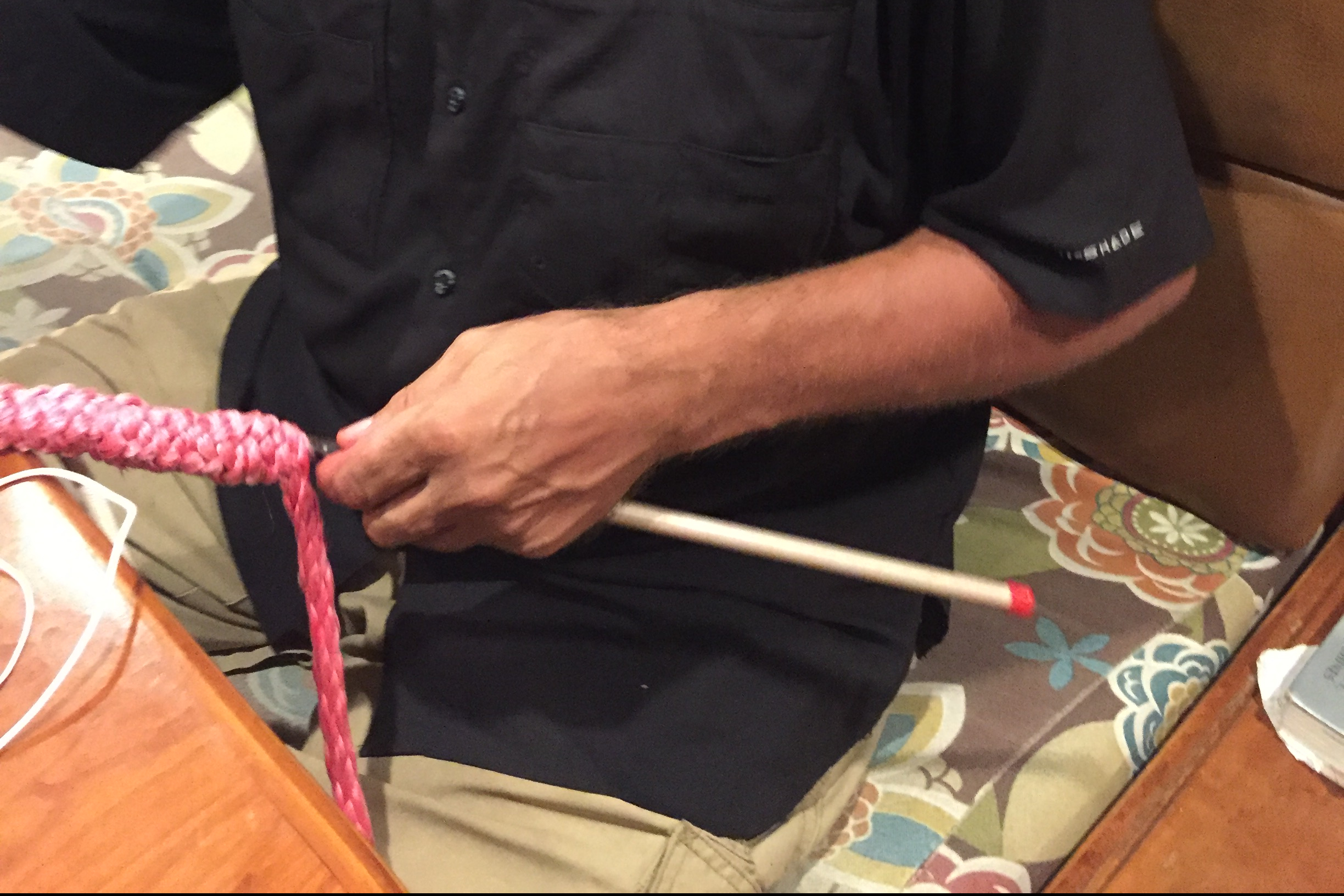
When a line is tangled, I often say, “Step aside, I am a knitter, I know what I am doing.”
Knitting is not all soft woolies and grandmas. Knitting is about planning, patience, and precision.

Terms L-R were written in Colonia, Yap, Micronesia
GPS: 9. 30′ .852N, 138 07′ .331 E
landards
A noun, invented by Karen, to describe people who live on land. For example, “Why do landards shower every day?”
life jackets
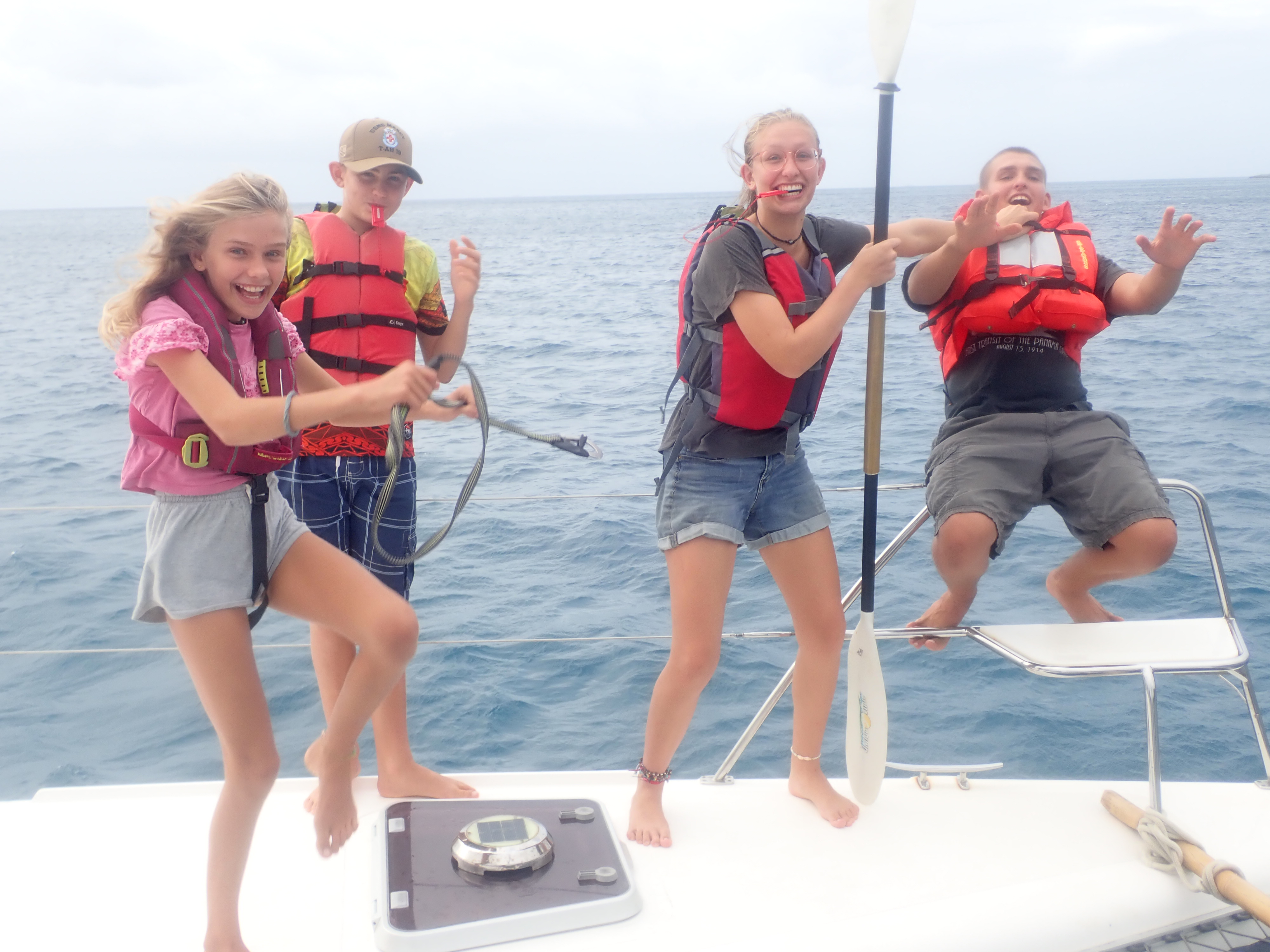
Depending on the context, the term “life jackets” refers to any of the 4 different types of life jackets that we use and own. My kids agreed to model each type of life jacket.
lizard chicken
A terrible and memorable chicken dinner that I made in Saint-Pierre, Martinique using an Instant Pot.
After being cooked, this chicken looked like a lizard and was put to sea. A chicken dinner was lost. Perhaps the chicken saved a few fish from the food chain that evening.

lock up
When we go to shore, we lock all doors and windows and shut off some power switches. If we think we might be back after dark, we bring flashlights and leave our anchor light on. We also remove valuables from the deck. Locking up our boat takes about 10 minutes.
At night, we lock up our dinghy with heavy chain and a padlock. Sometimes we raise the dinghy as well. We have started to lock our Yamaha gas tank because ours was stolen right off the back of our boat in Micronesia in January 2024.

long-sleeved shirt
Refers to a shirt used for sun protection, not warmth.

Luperon spoon
Refers to a large, pitted serving spoon that I bought as a sand toy in Luperon, Dominican Republic. It has been missing for several weeks. I suspect it went overboard.
math music
Kate Bush, The Kick Inside, album. Rick listened to it when he was studying math and space physics at the Florida Institute of Technology. He sometimes plays it for our kids when they are studying.

making water
We make water using a reverse osmosis machine. The machine extracts near-pure water and discharges salty brine overboard. We can make fresh drinking water in most locations unless the water is murky or oily.
Miss Scarlett
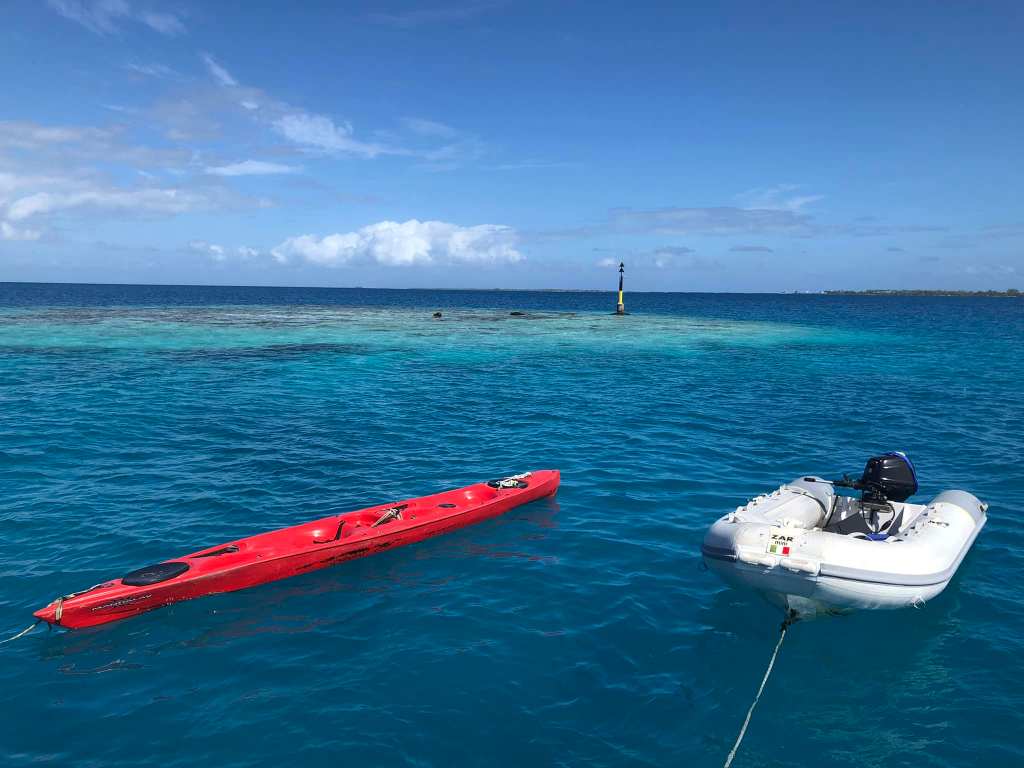
The name of our 17-foot double-seat kayak. Miss Scarlett has watertight holds and is excellent for taking snorkeling or transporting groceries. When the dinghy is in use, the kayak is like having a second car.
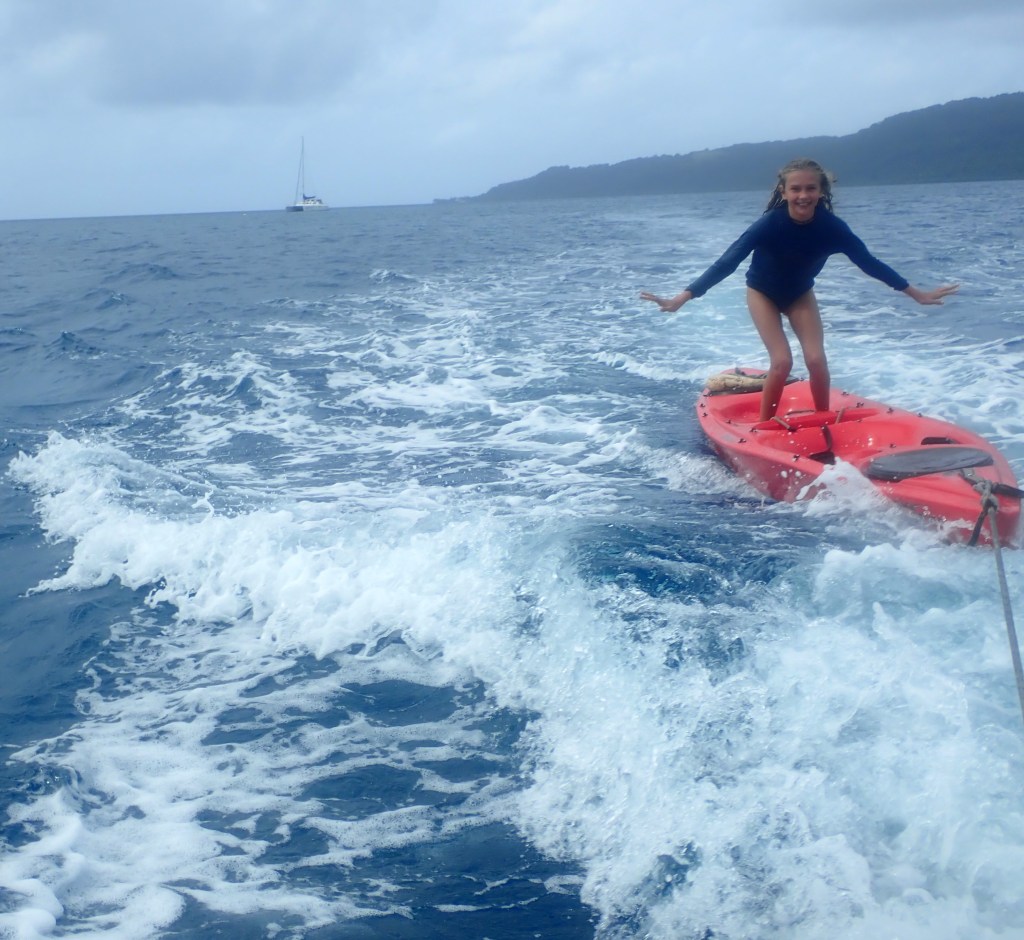
money
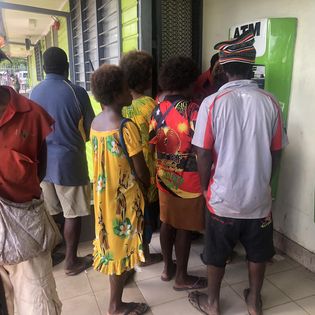
Money depends on where we are. We think of local currency in terms of Canadian or US dollars. We plan large purchases in advance because ATM machines may not be functioning or might have daily limits. We guard our bank cards because they are extremely difficult to replace in this part of the world.
Because we are so far away, we are unable to visit a local Canadian bank for a new card. It has been challenging to convince our bank to send us a new debit card but they do, eventually, after we explain our situation.
In the more remote islands in the Pacific, there is no need for money. We have traded for produce using: Advil and a knee brace (to the same person), clothing, pectin for jam making, rice, rum, reading glasses, shoes, dive fins, flip flops, fishhooks, and resins and fabric for fiberglass.
One boy asked for a cellphone in exchange for a bunch of fresh peanuts. I admired his chutzpah, but we did not have a phone to trade. In French Polynesia, we traded a good-quality sailing line for an entire truck bed of fruits and vegetables.
The people in the Pacific islands are just as eager to receive hard-to-find goods as we are to receive fresh food.


monster crawling
Running on all fours by hopping or crawling. Sometimes my children do this while putting their arms fully down their pant legs, giving the effect of having dinosaur or monster legs.
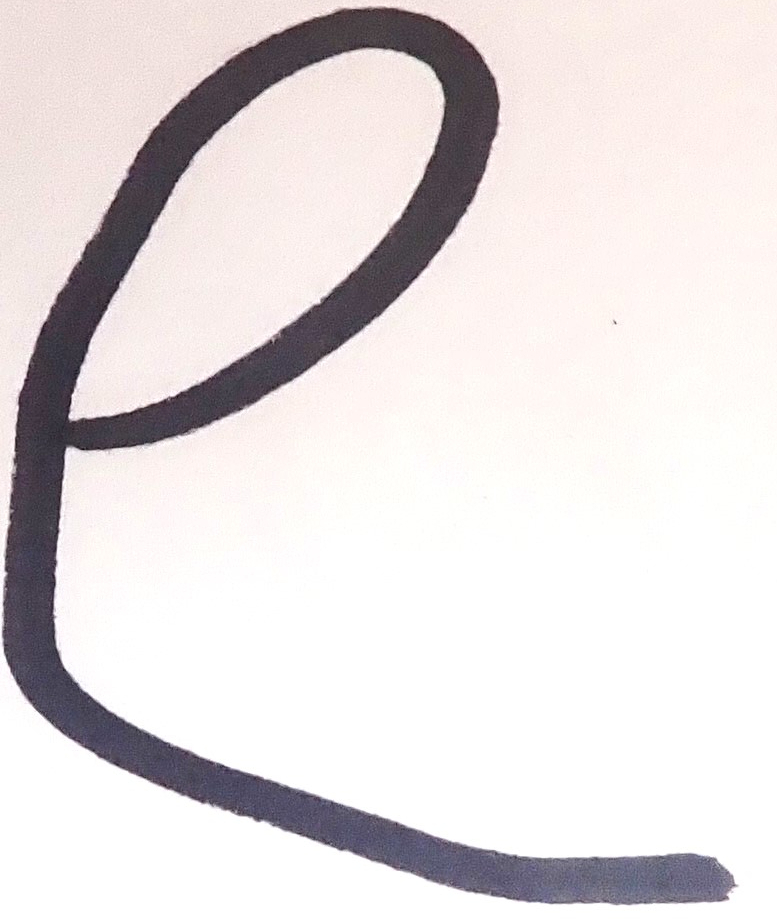
moose-nosed e
Refers to a handwritten ‘e’ that lacks a sharp point. Instead the ‘e’ is entirely curved. The terms comes from going to elementary school in Whitehorse, Yukon, where I first learned to print. Moose was a common term in my childhood. Further, my family ate moose meat because beef was prohibitively expensive.
Ned
The name I sometimes give to a protuberance that is bothering my children. If someone complains of a pimple, or an occipital bun (which is normal), I might suggest we call it “Ned” as it is something that we must learn to live with.
new shoes
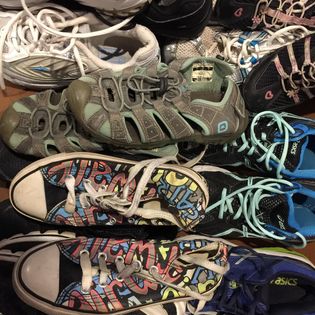
In developing countries, it is difficult to buy good quality shoes of any type. Shoes do not hold up well in a salty environment. We don’t often wear shoes around the boat.
To solve the problem, years ago, I bought boys and girls running shoes and sandals in every size, from about size 3-12 in Savannah, Georgia and Little Havana, Miami.
When my kids outgrow their shoes, it is an occasion. We open up a locker and access a storage area under our cockpit table. I pull out some shoes. My children try on a pair they like until we find a shoe that fits.
Nimbleton
Refers to a person with athletic ability. A Nimbleton might be asked to lock up the dinghy in rough weather or climb up the mast with safety gear. Paul deserves special mention; he is a fully certified Nimbleton and has gone on the deck many times in extremely rough weather to manage the sails and lines.
Antonym: Hobbleton
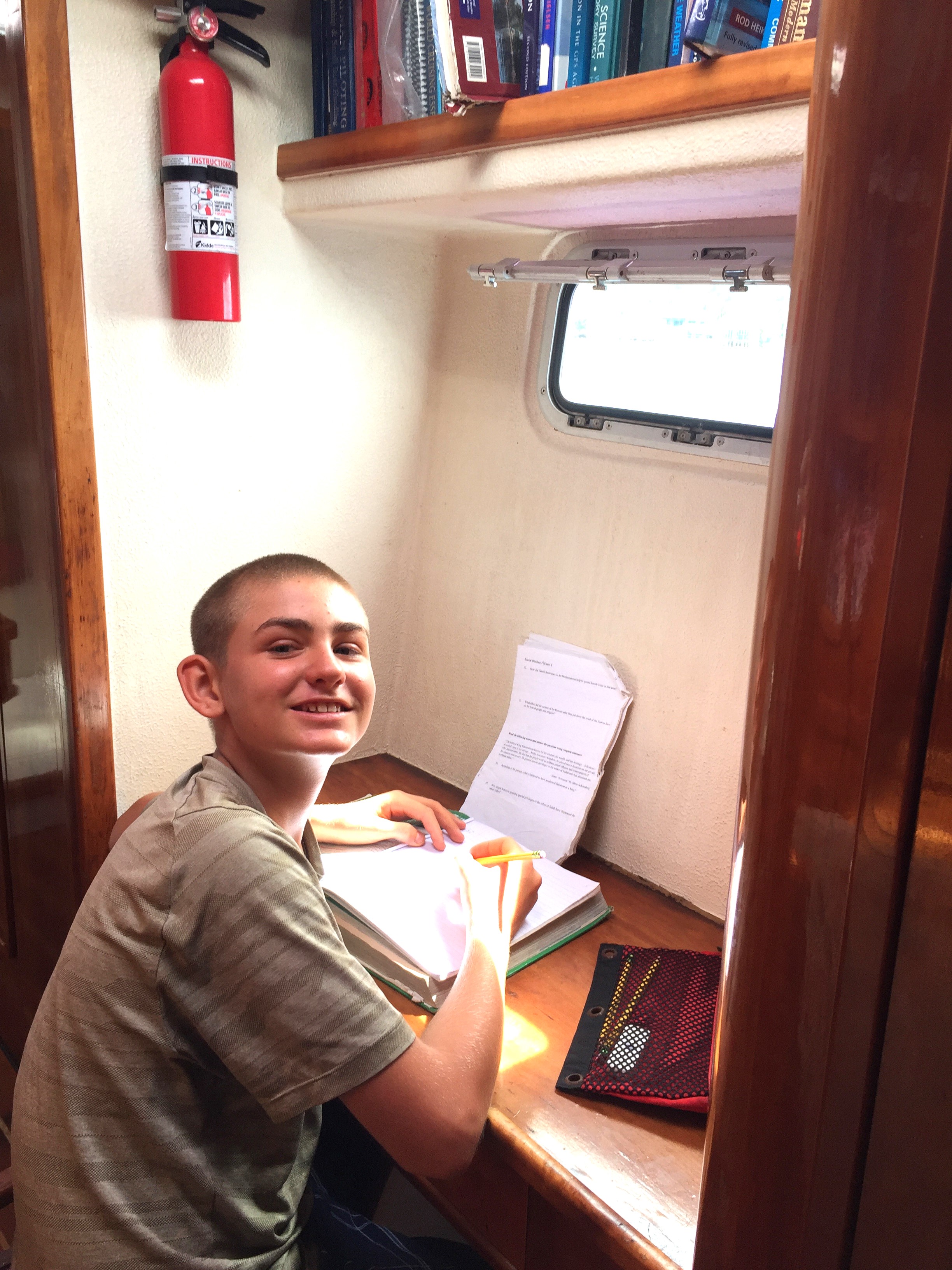
office
Our office is a desk with a bench, located on the starboard side.
on the hard
Refers to a situation when our boat is hauled out of the water and placed on stands. Being “on the hard” allows for boat repairs and painting.

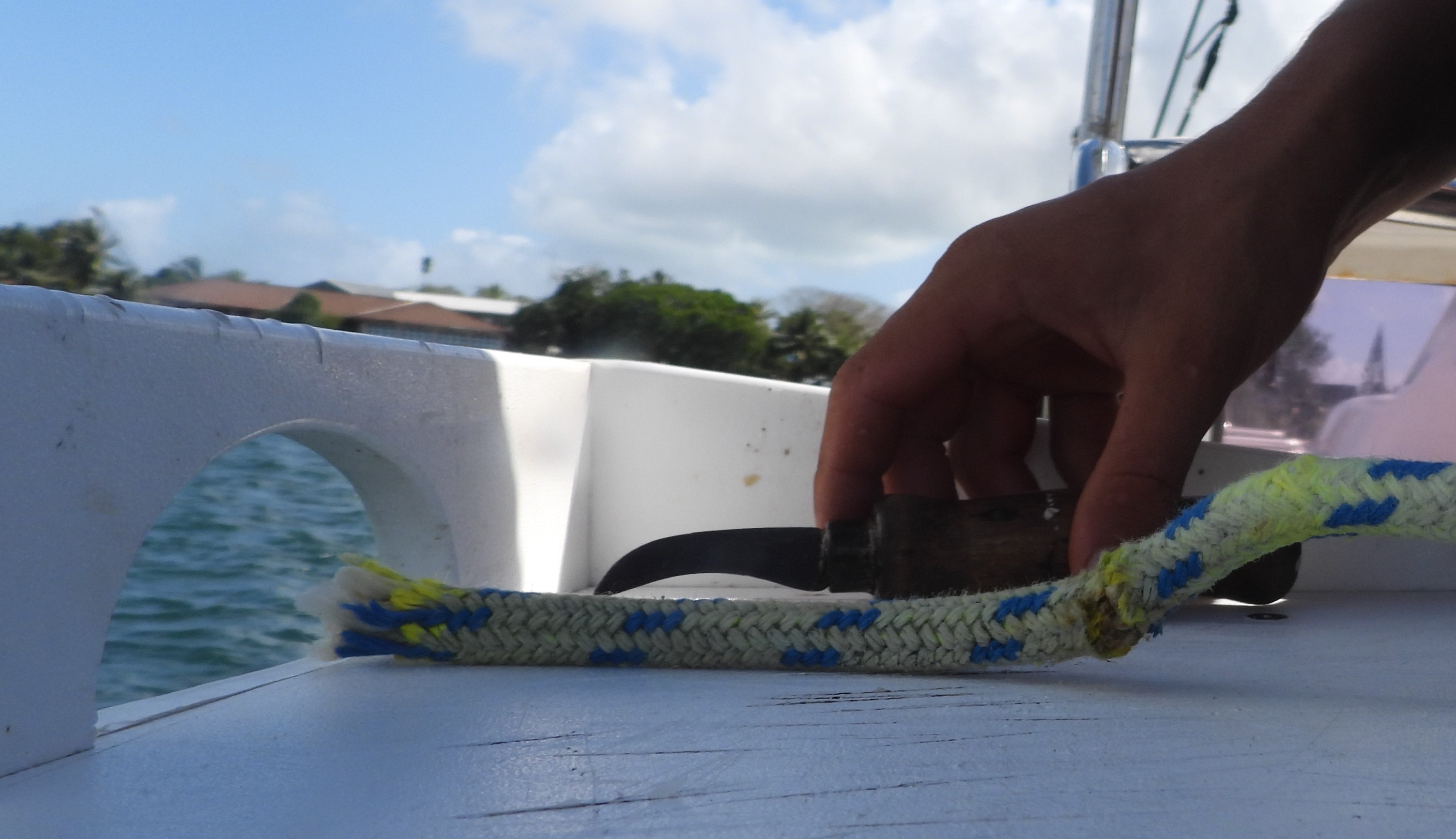
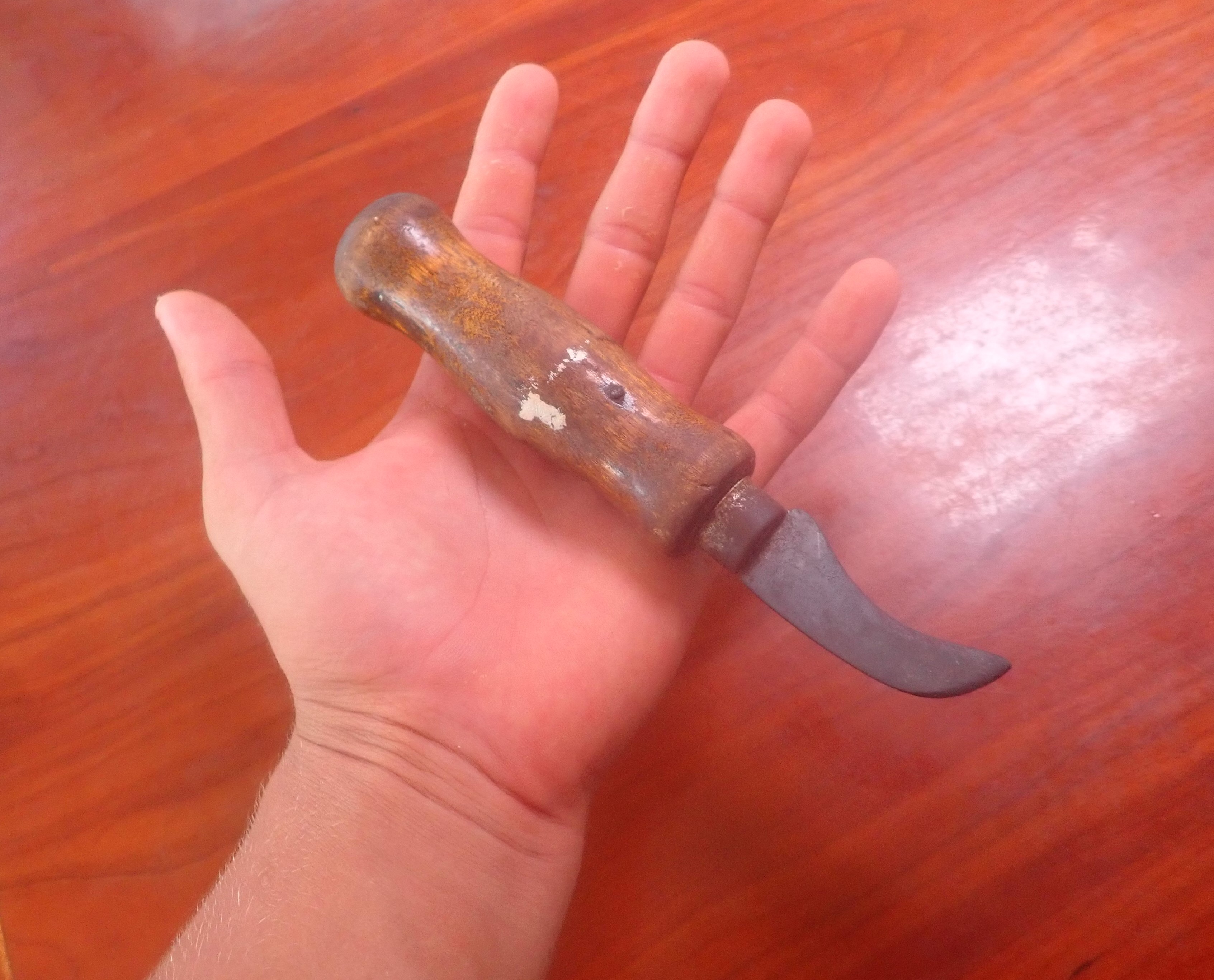
Opa’s knife
A good-quality, wood-handled carpet knife that belonged to Rick’s dad, Alfred. The knife is not very sharp, but it is very useful.
Also, it is something tangible that embodies Rick’s dad commitment to precision and hard work. Alfred founded and ran Centennial Floors in Calgary. Opa means Grandpa in German.

outside fridge
The outside fridge is a storage locker with a refrigeration unit inside. We use the outside fridge to store water bottles, beer, wine and produce.
papers
Refers to passports, receipts from Immigration and Customs, VISAs, entry and exit clearances, boat registration paperwork, crew list, and vaccination booklets. We need these documents to enter and exit every country.
We often require copies of our paperwork (in print and electronic format). In the pictures, I provide an email from Rick to a coastguard office in the Philippines, requesting permission and procedures to arrive in that country. It is sometimes very easy, and lately, very convoluted.


peeling cans
We label and remove the paper labels from our tin cans. We have heard that insects may like to nest under the labels. By “peeling the cans” we hope to avoid bug eggs getting into our cupboards.

Peter shorts
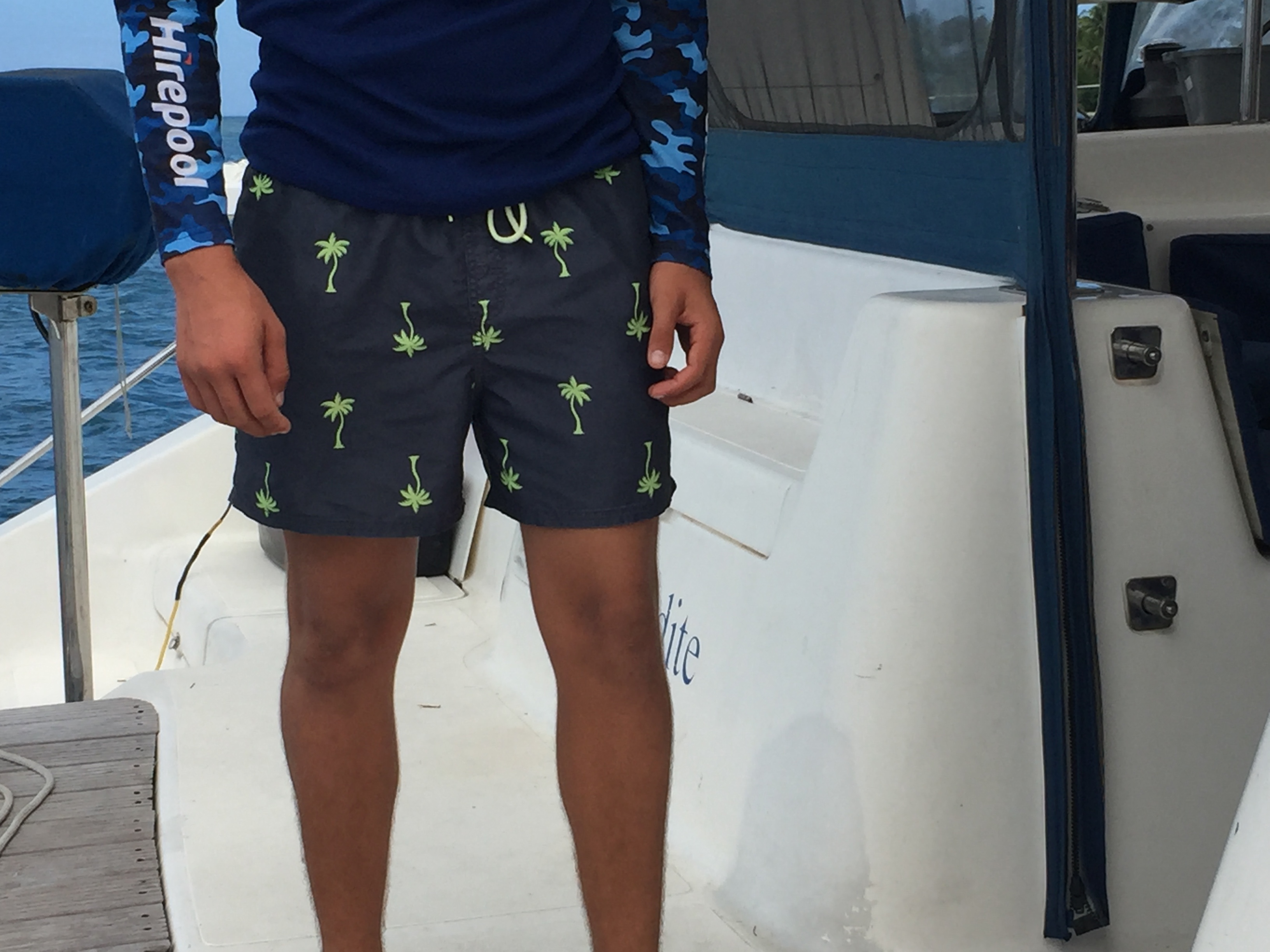
Refers to a style of boys’ shorts, popular in the “Keywords with Peter and Jane” series. Used in a sentence, Henry might say:
“I don’t want to wear those shorts. They are Peter shorts!”
Or, Paul might say:
“Peter shorts give me a better tan.”

pool noodles
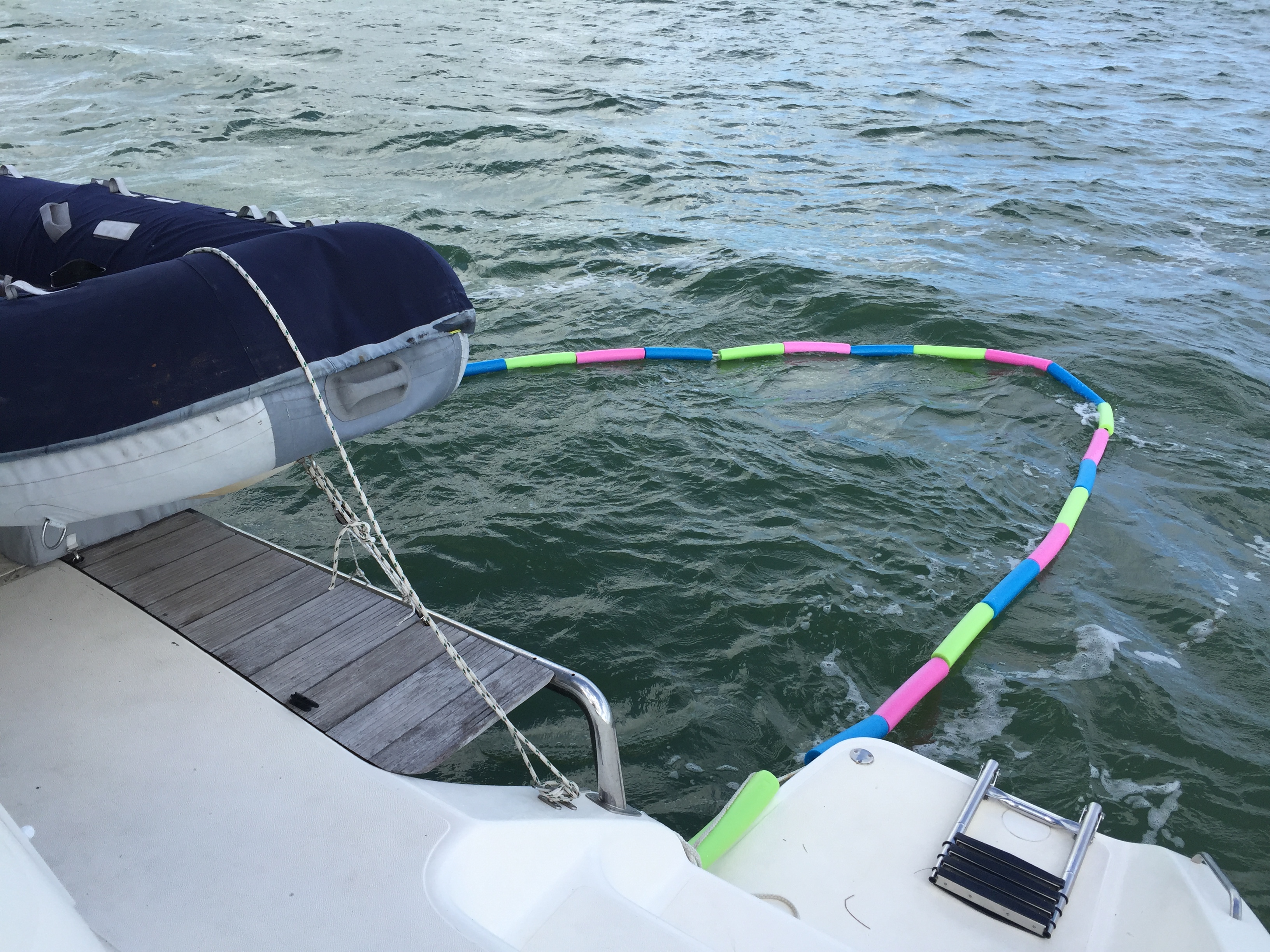
Refers to a swimming circle we originally made using pool noodles on a line. The row of floats helps other boaters to see us swimming in the water. The U-shape prevents us from getting dragged away from the hulls, even with a strong current. Other boaters sometimes hold onto the pool noodles while they are talking to us.
The original pool noodles did not stand up to constant use. In 2017, I wrote a blog post about our DIY swim enclosure. The original pool noodles were replaced with fishing floats that we bought in Grenada. But we continue to call them pool noodles.
put out your bingo wings
Another Canadian sailboat called, SV Party of Five originated this phrase but they called it, “putting out your bitch wings”. This phrase is probably more descriptive, given its intended purpose.
To “put out your bingo wings”, refers to the practice of standing on deck with arms akimbo to perhaps intimidate another boat from anchoring close by.

rainwater bins
We collect rainwater in two bins and filter it to put into our potable water tanks. Rick built us a system that collects, purifies, and directs water to our port or starboard tanks.
From a switch at the nav desk, we can turn the rain collection on or off. This is important because, during a heavy rain, our two 178 US gallon tanks can fill in as little as 45 minutes.
Without this we would have to run our generator (consuming 0.33 US gallons per hour of diesel) and reverse osmosis system (producing 25 US gallons per hour) for about 14 hours to collect the same amount of water (356 US gallons). That’s 4.7 US gallons of diesel saved or US$34.00 given the price of diesel in Chuuk Lagoon, FSM.

real milk
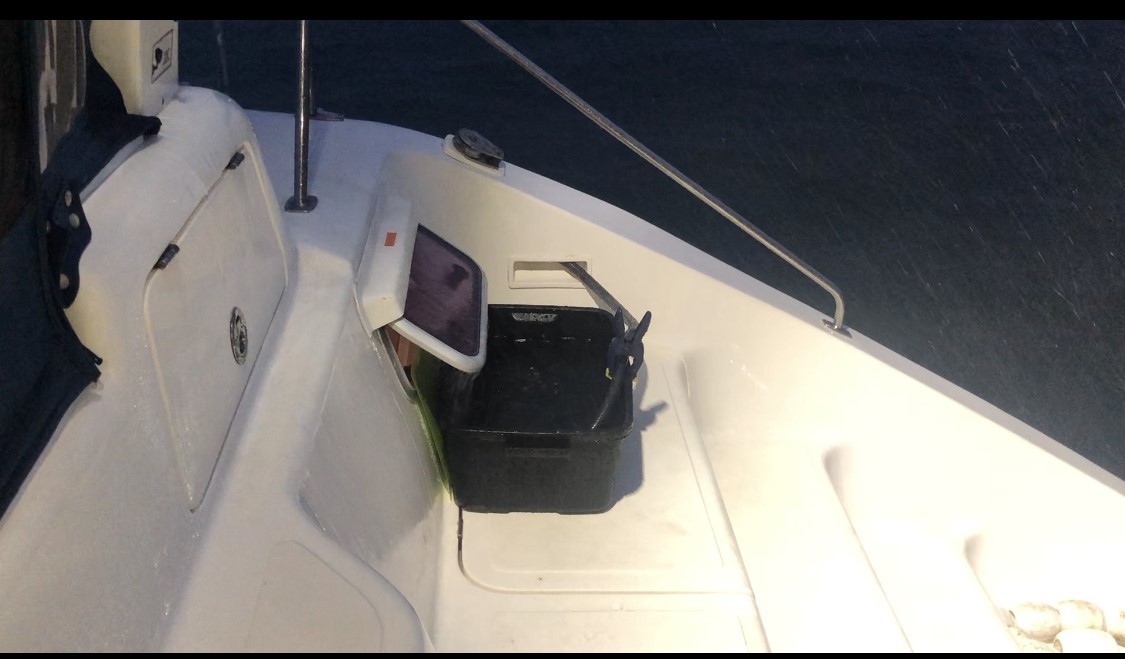
UHT milk sold in a box. This milk tends to be heavy and expensive. Our family buys powdered whole milk. We have not had fresh milk in years.
red light
We use red LED lights at night to preserve our night vision. It allows our eyes to adjust to seeing outside when it is dark.
red pasta
Pasta with tomato sauce.
R. Escher
A name I call my husband, when “Rick” is not enough.
Terms S-Z and numerics were written sailing from Colonia, Yap, Micronesia to Allen, Philippines.
GPS: 10 02′ .338 N, 134 54′ .364 E
sailboat cup
Refers to the only cup we have with a picture of a sailboat on it. It is plastic and double walled. If you are using this cup it is almost certain that there are dishes to be done. Everyone in our family seems to prefer using stainless steel cups, such as the bulbous cup.

school
Our kids tend to focus on one subject at a time: math, geography, science, history or English. Our days are full on. Short of bad weather or the boat sinking, schooling is our priority. When we ask our kids about “school” it refers to the work they are doing on a specific subject, not a full suite of subjects.
Click here for more details
Currently, Betty and Paul are working on an MIT Calculus program. This should put them in good stead for taking the AP Calculus test, which is desirable to North American universities for STEM subjects. In April, they will resume their studies with the American School of Correspondence.
At the same time, Betty will be balancing her time with SAT preparation. The SAT testing is in May 2024, and she will write the exam in Manila, in the Philippines. Betty recently spent 42 days on a medical mission with the French non-profit group, AidOcean.
At the moment, Karen is working on a series of biology exams. Henry is working on completing a history course.
scrub the waterline
Refers to the job of removing algae stains from our white hull using a scrubbing pad. Algae tends to grow where the water meets our boat (at the waterline). We use a green scrubby Scotch pad for this job, and never a metal scrub pad as it would be too abrasive on the gelcoat.

second green light
Refers to the green light above the stove that must be turned off after each use. The second green light activates a solenoid that brings propane to the stove, oven or barbecue. The term might be used as follows:
“The barbeque won’t light.”
“Did you turn on the second green light?”
shark:30
Refers to dusk, when we think sharks come out to eat. Example, “We will come to visit but we won’t swim off the back of your boat. By 6 o’clock it’ll be shark:30.” Once, in the Bahamas, I let Henry swim at 5:45 p.m. He jumped in the water and a large bull shark swam between our boat hulls. The shark swam very close to Henry.

Silvey
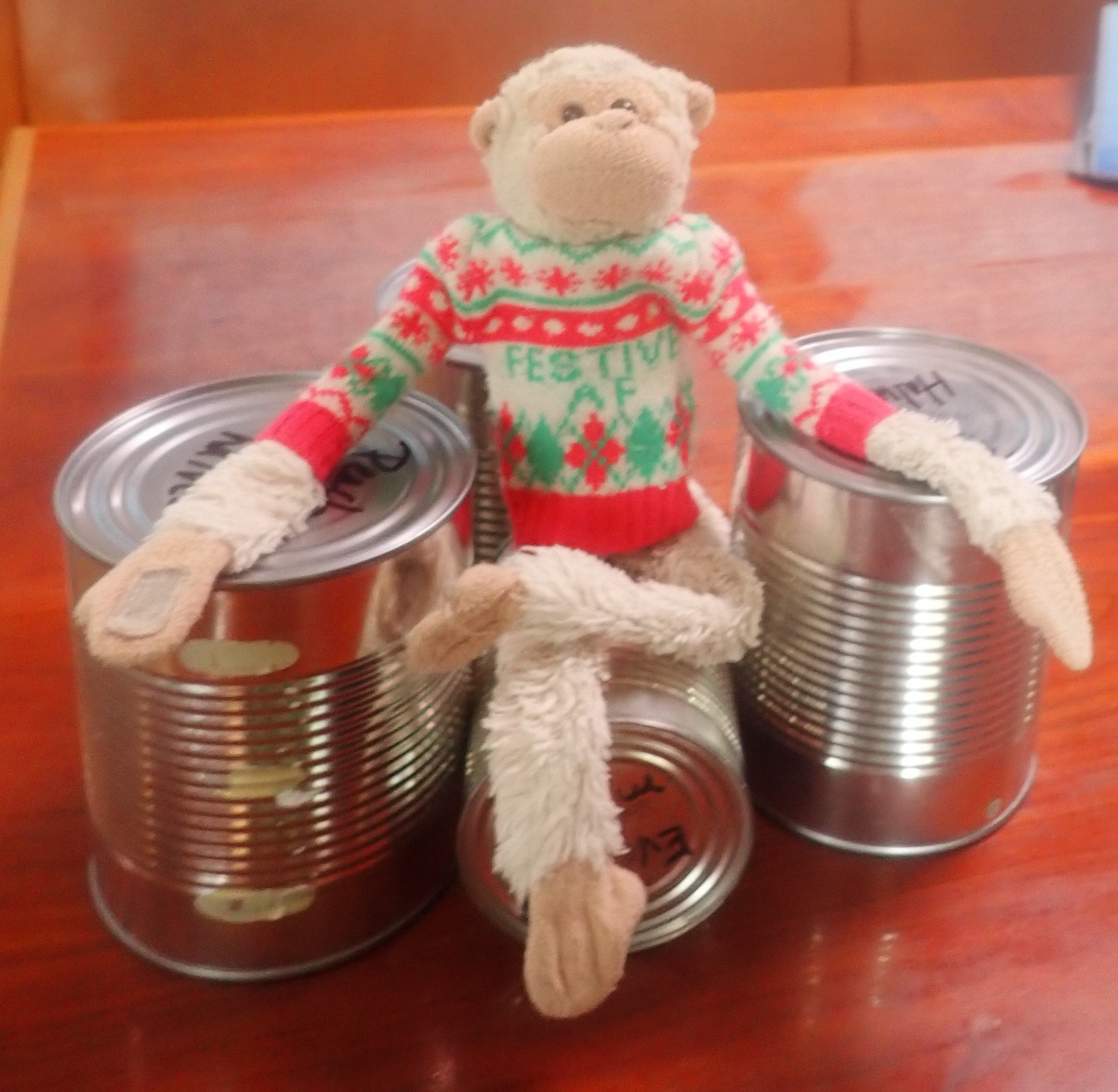
Silvey is a stuffed toy monkey who was liberated from a thrift store in Georgia, USA in 2019. He belongs to Henry. Silvey’s nickname is Oldie.
Silvey used to have a long and fuzzy hairdo. But, that changed when I washed him and put him in the dryer. Karen recently gave Henry a new eye.
In New Zealand, Auntie Caroline bought Silvey a festive sweater. I’m not sure she realized is was emblazoned with “Festive AF”. Henry has a knitted hood for Silvey, which allows him to be a monkey or a rabbit.
sleeping up top
Karen and I like to sleep on the trampolines at the front of our catamaran. Henry sleeps in a hammock.
If we ask, “Are you sleeping up top ?” we are referring to whether someone is going to sleep on the deck, which usually prompts a discussion about the probability of rain.
The benefit of sleeping up top is that it tends to be cooler than sleeping in a cabin. The stars are amazing. There are usually no bugs at all, but we sometimes see bats.
On the deck, I wake up at sunrise. In Kavieng, Papua New Guinea I frequently woke up to the sounds of dolphins expelling water from their blowholes.


tent
A large, cream-colored Sunbrella canvas cover that spans our entire front deck. The tent can only be erected when we are not sailing. It provides shade and cools the boat considerably. The tent funnels the wind into our hatches. It also allows us to open our hatches during a light drizzle.
The hold up
A memorable dancing pair in 2017 at the Children’s Carnival in Grenada. We were leaving the parade. It was very crowded. Their dancing stopped us in our tracks. There was nowhere else to go. Henry recalls, “Is that the dance where he held up her leg?” We stood as a family waiting, watching, observing until the dancers moved their heads forward and opened their eyes. There we were. It was a hold up.

The Tarzan
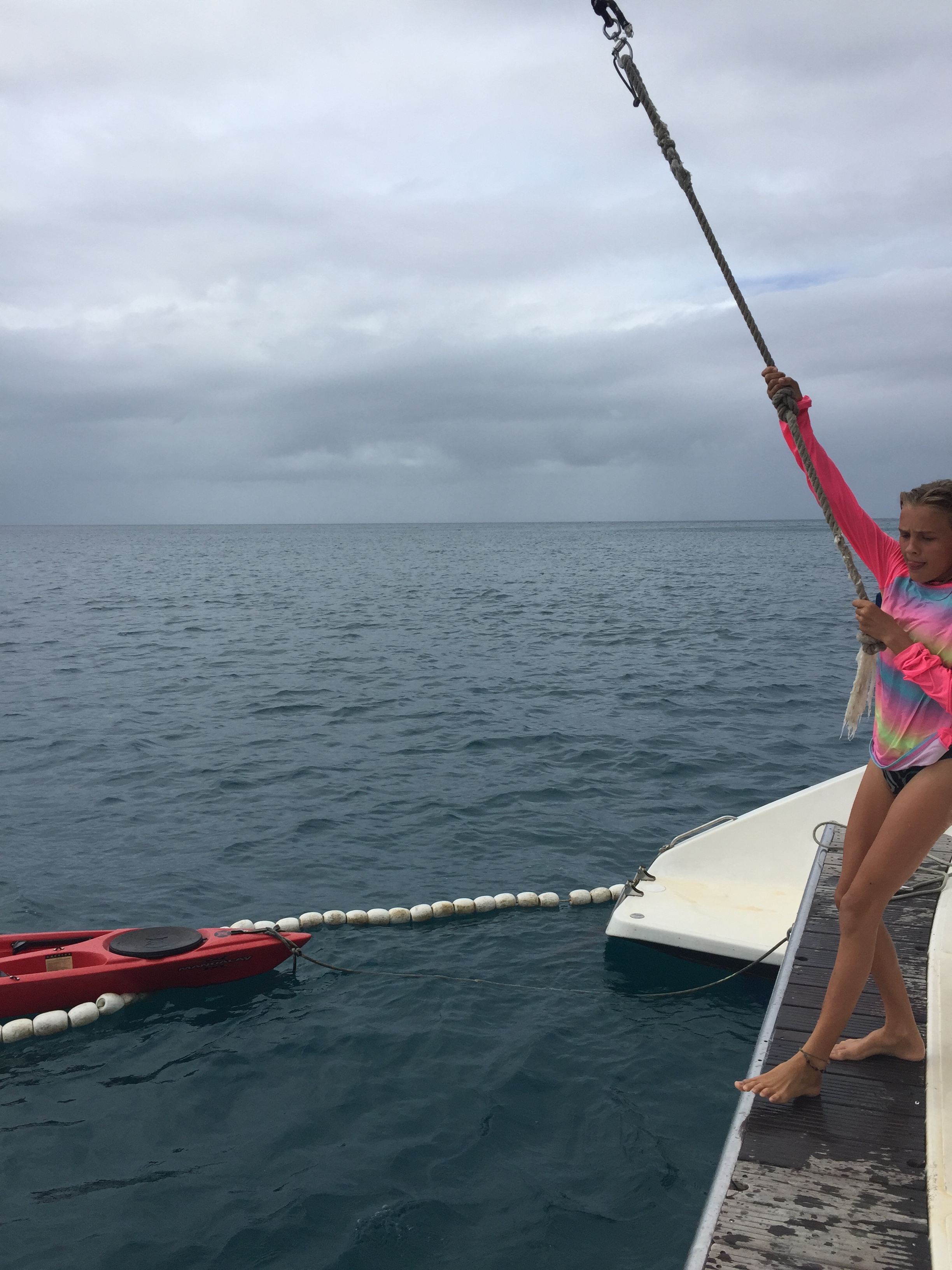
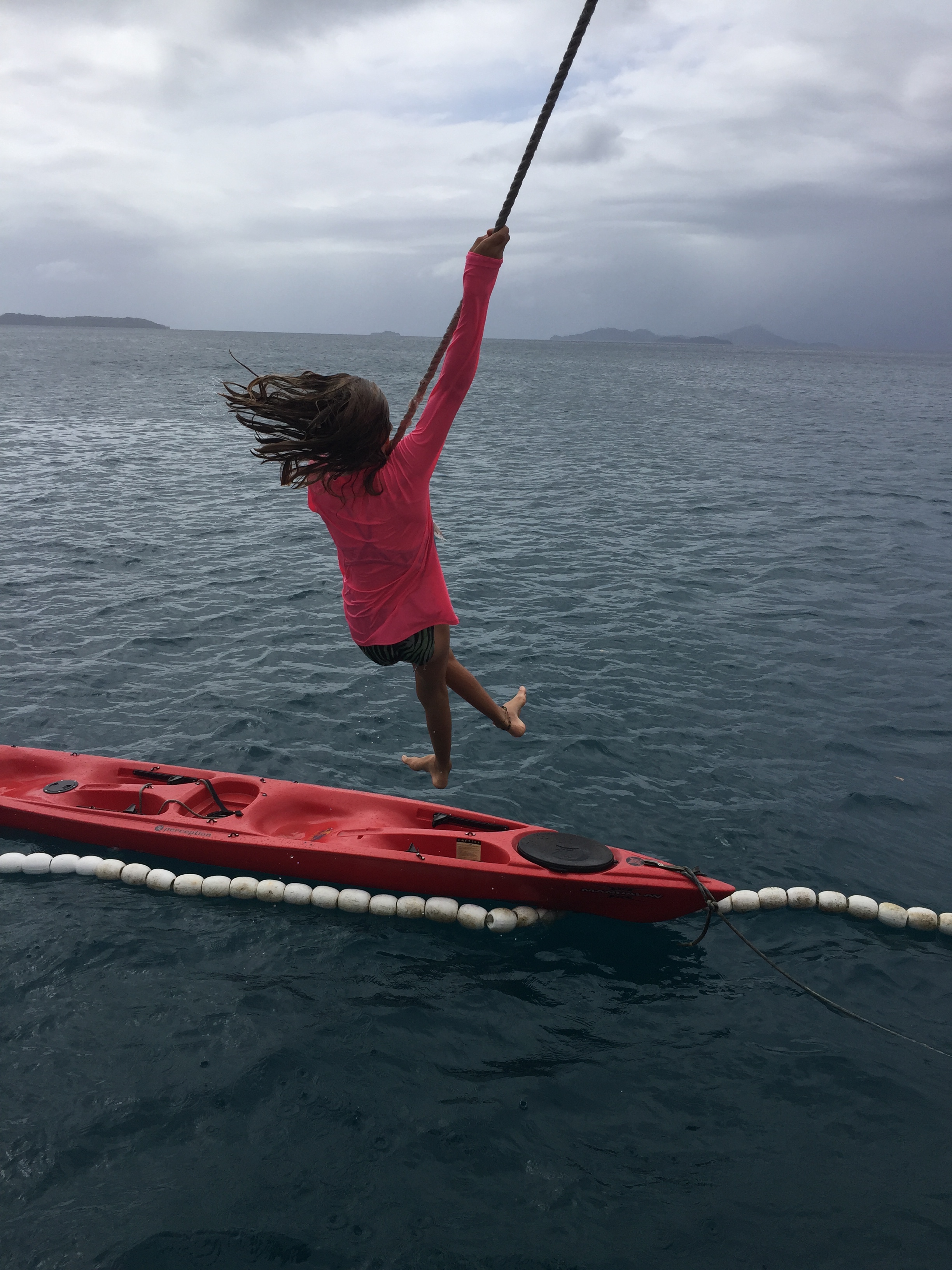
Refers to a rope that the kids use to swing into the water from the back of our boat. They perform various acrobatics including being upside down, spinning and diving from the rope. It used to be a challenge to go hand-over-hand to touch the top of the rope, but now they can do that with ease. Our first Tarzan rope was lost in Calvigny Cut, Grenada. We have replaced it with another Tarzan rope that we found on a shipwreck in Fakarava, French Polynesia.


The net
A morning call-in event hosted on the VHF radio, which is hosted in some anchorages. A volunteer net controller uses a script and follows a set format. Topics might include:
- emergency announcements,
- arrivals and departures,
- weather,
- local events (such as dominos on the beach, guitar lessons, yoga, boat school on the beach, or hikes),
- daily trivia question,
- treasures from the bilge (free items, and items for sale
- final thoughts, such as a joke or inspirational message.
Sometimes the nets can be very lively. During COVID, when we were anchored in St. Anne, Martinique, people would discuss how to get fresh water or fish. Sometimes, people get into heated discussions, and the net controller has to step in to manage the conversation. The Net lasts between 10-45 minutes, depending on the number of people who want to participate.
The communication between boats does not stop with The Net. In busy harbours there can be almost constant chatter throughout the day on the VHF radio. Nothing is private. Some people set up their radios to receive voice traffic, regardless of the channel. We often turned off our VHF radio, however, because the chatter would distract us from schoolwork.


“This cheese has gone bad“
A phrase I practiced to achieve a Kiwi accent.
tombstone door
Refers to an access door to a cupboard at the front of our boat. It is shaped more like a coffin than a tombstone. For example, when we need to find a new package of toilet paper we might say, “Have you looked behind the tombstone door?”
undoing the bow locker
The bow lockers are at the front of the boat. They have a wooden shelf that runs the length of the bow locker. On top of the shelf, we store items such as sails, lines, spare life jackets, and fenders. Below the shelf, we stow items we seldom need such as packages of toilet paper, warm blankets, warm clothing and our Christmas tree.
Undoing the bow locker means carrying everything out and then re-packing it.

wavers
People who wave to us from a boat when we wave to them. On land, this would be the friendly equivalent of a small hand wave to another driver while still holding the steering wheel. People who charter boats tend be non-wavers. We figure they probably see other people all the time and have nothing to lose by not waving.
During COVID, most people became nonwavers. In Martinique, we transitioned a non-waver. We waved at him, one family member at a time until the awkwardness reached a peak, and the gesture just blossomed.
wedding mushrooms
Refers to a recipe that family and friends made for our wedding called “Marinated Mushrooms”. The recipe appears in Molly Katzen’s “Moosewood Cookbook”. The basic ingredients are mushrooms, salt, pepper, thyme, garlic, olive oil, lemon juice and parsley.
wedding spoons
Hand-carved, wooden salad spoons made from Manzanita wood. They have sentimental value because they were given to us as a wedding present from my sister-in-law, Caroline.

weeviling
The act of inspecting individual pieces of pasta and removing weevils or evidence thereof. For more information, see “Weeviling: managing weevils on a sailboat in Micronesia.”
whipper head
Refers to our hand mixing/immersion blender or blender top. This blender gets a lot of action because we use it to froth milk for coffee, and to puree vegetable soups. For example: “Have you seen the whipper head?”
wiggle box
Refers to a cellphone, or iPad. For example: “Please get off your wiggle box. It is time for supper.”
yellow house
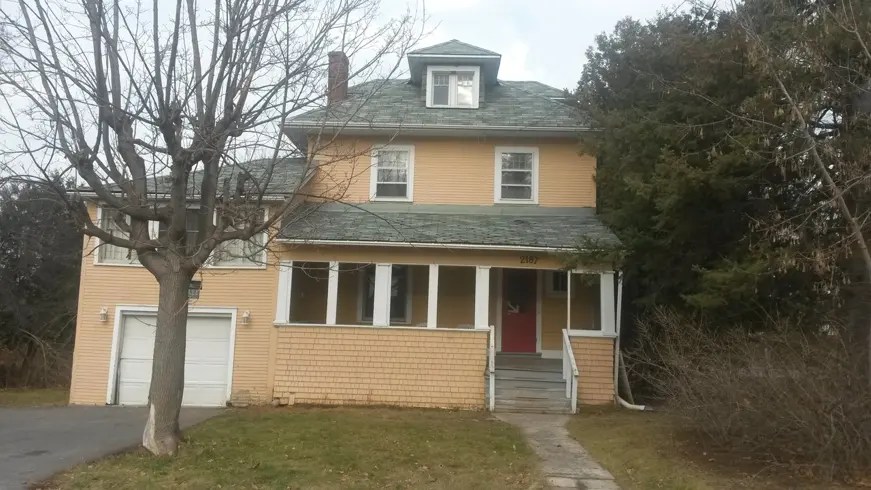
The yellow house was built in the 1940s in Ottawa’s cottage country before urban sprawl. It was a fantastic location, just 15 minutes from the parliament buildings. This is the first house that my husband and I owned together. It belonged to the Hayes family, who Rick had known for years.
Betty, Paul, Henry, and Karen lived in this house before moving to the big house. We have since sold the property.
yellow lady
Refers to a woman with a yellow hat that we kept seeing in Trinidad. The first time we saw her was on a bus. The bus driver had asked her to put her paring knife away. He had to repeat himself several times. Finally, she slowly unzipped her purse, straightened out her skirt, inspected the contents of her bag, and then she put the knife away.
Days later, we saw the yellow lady at the National Library in Port of Spain. I looked away for a moment and she had disappeared from sight. It was if she was a spectre. Spotting the yellow lady sparked great excitement.
Her hat was large and elegant, as though from a different time. We could literally take a bus for 2 hours to another part of Trinidad, and see her walking along the road. Her appearances became so random that she seemed otherworldly.

120
Refers to 120 volts. Our catamaran has both 120-volt and 240-volt plugs. As we are off grid, our wall socket plugs run off our battery bank. Wall sockets do not receive power unless we flip a switch. A 120-volt plug is the kind of plug you see in North America.

240
Refers to 240 volts. A 240-volt plug is the kind of plug you see in parts of the world, outside of North America.

1776
Betty and Karen enjoy the Hamilton musical. When Betty says, 1776, Karen responds with “New York City.” Betty and Karen like singing together.

 Becoming a Sailor