
In short
We spent six months in the Luperón hurricane hole, Dominican Republic, in 2016. We built a mooring for our 50-foot catamaran and sheltered from Hurricane Matthew, which brought gusts of about 40 knots and no damage. This long read covers common cruiser complaints (stray dogs, the dinghy dock, dirty water, check-in fees of $224 US), local kindness, lunch aboard with Bruce Van Sant, and the red tape of getting our despacho to leave.

This Long Reads unpacks the Luperón hurricane hole. We were there for six months. In that time, we built a mooring for our 50-ft catamaran and sheltered from Hurricane Matthew. Here’s our take on the town, the community and meeting the cruising legend, Bruce Van Sant.
In This Long Reads
Examining common cruiser complaints about Luperón, Dominican Republic
Originally published on June 9, 2016
Luperón has changed since this blog post was originally written. I understand that the dinghy dock has been updated. Yet the gritty feel of this friendly town likely remains.What follows is my take from our early sailing days. A decade and about 40 countries later, my outlook has broadened. But I bet Luperón still smells like fresh tomatoes and cilantro, and locals will greet you with interest and a smile.
He was sitting on a white plastic garden chair, on the sidewalk, and leaned forward slightly as I passed. He introduced himself as Joseph. “What do you think of my country?” he asked. His eyes glinted, and as he spoke, his fingers spread out as though to embrace the things he held dear in the Dominican Republic (DR).
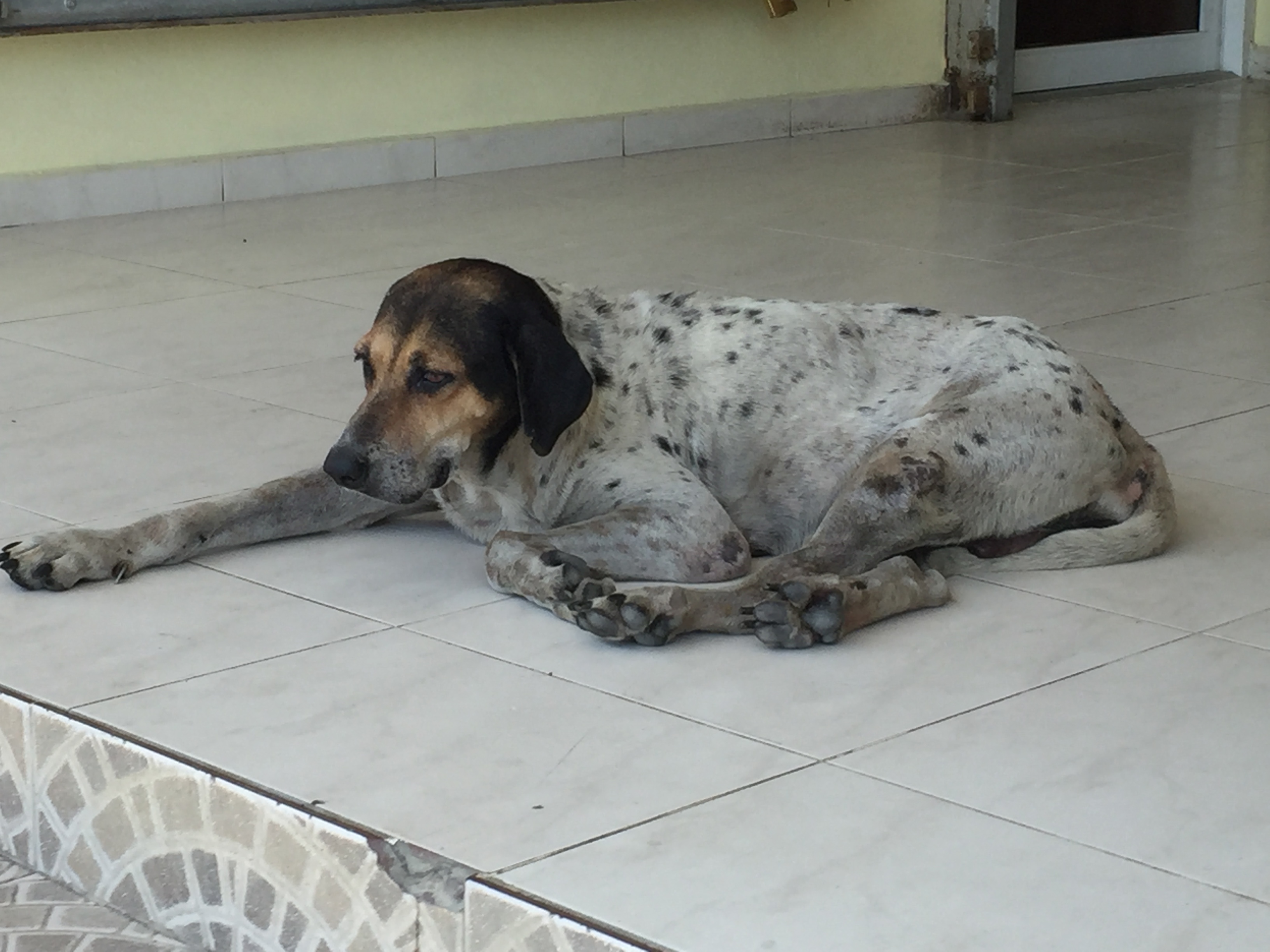
His English was well spoken. As I stopped to form an answer, a stray dog ran up to me and licked my shins. Its fur was yellow and looked short and tufted. Awkwardly, I struggled to meet Joseph’s gaze. He seemed oblivious to the stray dog beneath me and flashed a warm smile.
“The people are very friendly here,” I said. And they are. But while my response was genuine, it didn’t capture the ambiguity I feel when immersed in a foreign culture.
In case someone stumbles on this blog post looking for nuggets of information about Luperón, I will give you the scoop.
Please bear in mind, however, that we’ve been in Luperón for only a week, and I tend to notice subtleties. When it comes to embracing change, my disposition lies somewhere between hero and flat-out whiner. Inwardly, I tend to despair when restaurants run out of half and half cream.
As I have written previously, there are blogs and cruiser message boards that are full of negative comments about Luperón. Admittedly, there are some truths behind their stories.
Luperón has plenty of stray dogs, the dinghy dock is in need of repair, the water is dirty, and the government officials ask for fees that are a little suspect.
Below, I examine some common complaints about Luperón.
Stray Dogs and Cats
There are ample stray dogs and cats in Luperón. An animal care worker estimates that there are about 60 stray animals in town, though it doesn’t feel that way when we are walking around.
The strays tend to keep to their world-weary selves. The cats run off when approached. I ask my kids not to touch the dogs. But my daughter Betty enjoys spending time with a very social stray dog called Buttercup.
There is a non-profit organization that is addressing the health of the cats and dogs in Luperón. The organization is called Dogs and Cats of the Dominican Republic — Luperón. They spay and neuter animals and provide treatment as needed, such as tick removal. They also give the animals vaccinations.
Dilapidated Dinghy Dock
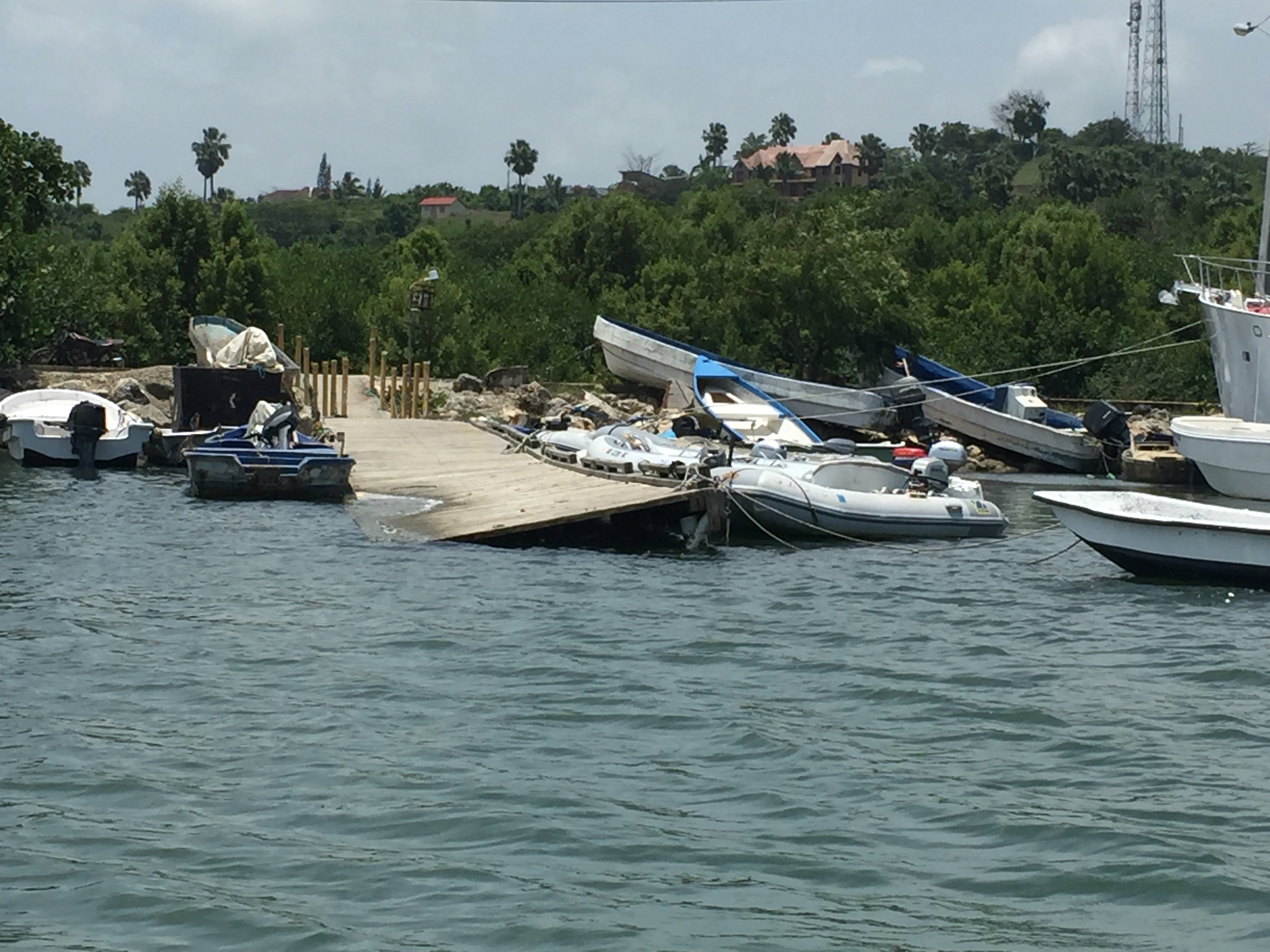
The condition of the government dinghy dock doesn’t bother me. It is tilted and sometimes partially obscured by the rising tide. If mobility is an issue, the dock would present a problem.
Dirty Harbour: Forget About Using a Watermaker
The water in the Luperón harbour looks like any pond in Ontario, Canada. But we are not in Canada. So to be safe, we would not swim or use our watermaker in the anchorage.
Originally, we thought we might leave the anchorage to make water occasionally. But that was before we realized that space is at a premium in the anchorage. The anchorage is smaller than I had imagined and it is quite crowded.
Here is a picture that shows our proximity to our neighbours.
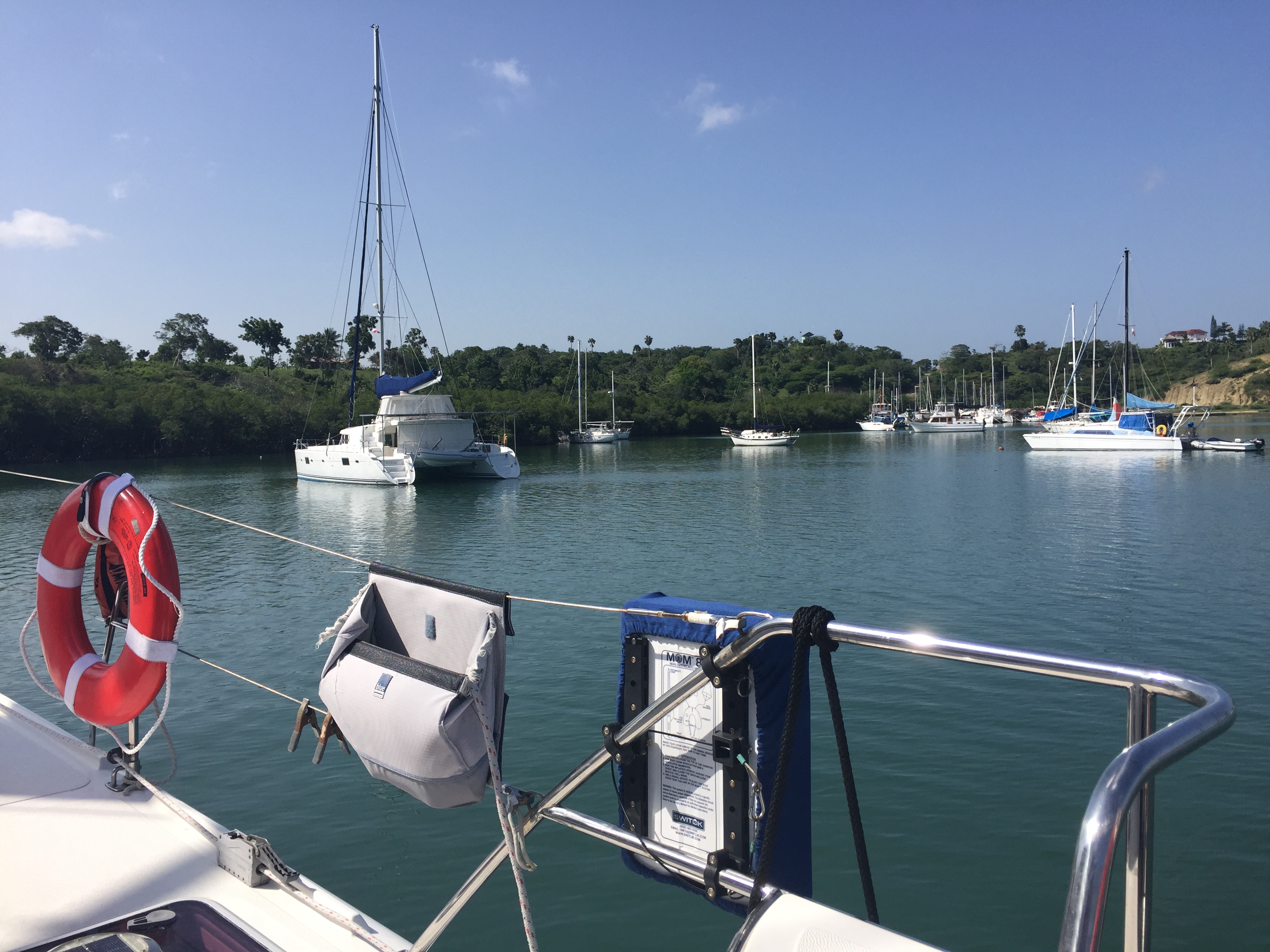
Some of the boats are anchored but uninhabited. Some boats are occupied by long-term residents. Fran, on SV Rebel Razor, has lived on her boat in the Luperón harbour for the past four years.
Incidentally, it costs about 45 pesos ($1 U.S.) to buy a 5-gallon container of water. Recently, we bought reverse-osmosis water from an enterprising man named Handy Andy. We paid Andy $40 to deliver 200 gallons of water.
With help from his employees, Andy delivered the water to our boat, poured the bottles, and took them away for recycling. Here is a picture of empty water bottles in Handy Andy’s service boat.
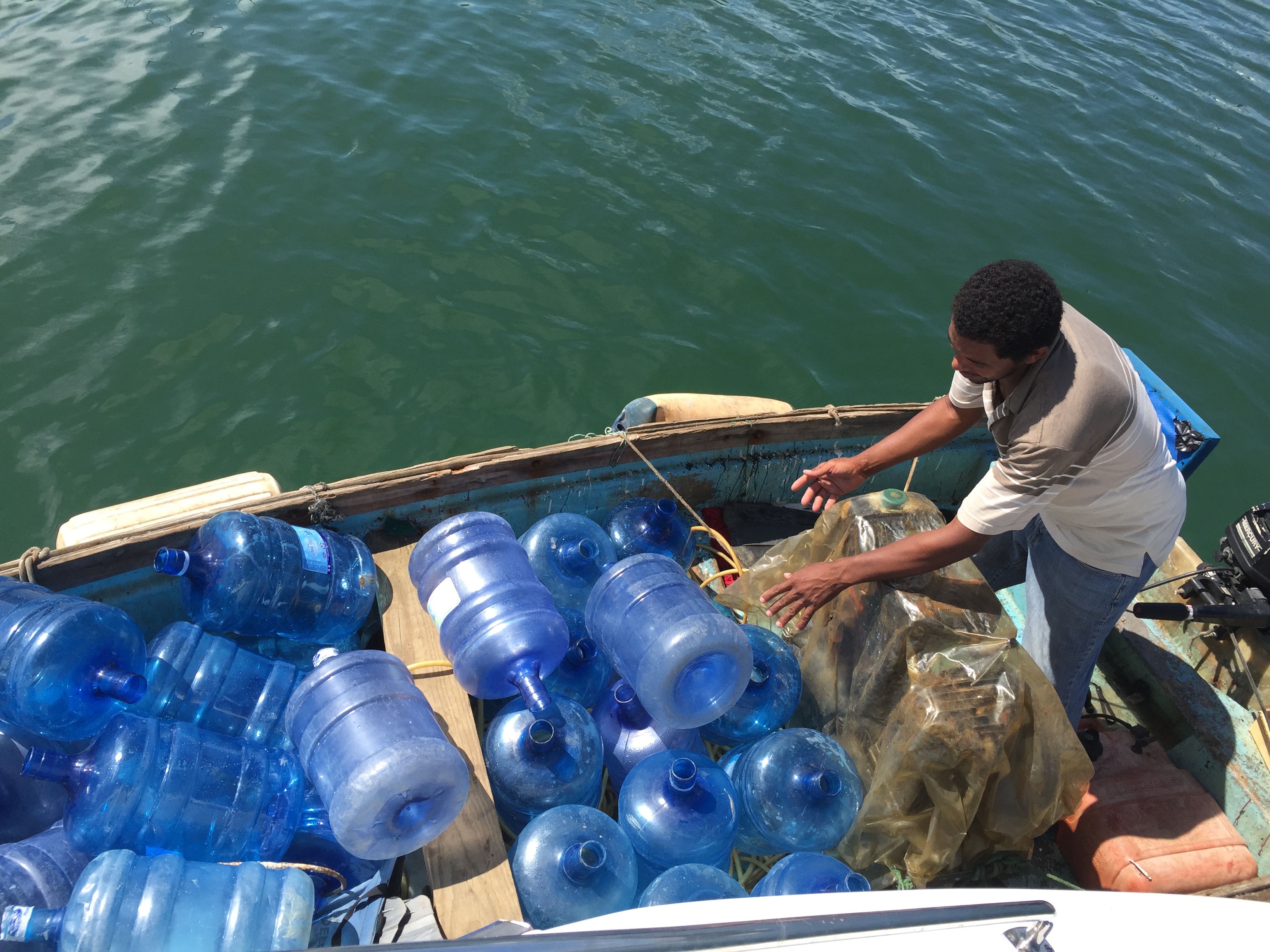
The bottles looked dusty and well-recycled. But the water quality was excellent. We used a water tester and measured 20 parts per million (ppm). Other cruisers have measured as low as 5 ppm.
Unauthorized Government Fees
The government buildings are not fancy. I’m not sure why this is sometimes raised as an issue by cruisers. Here is a picture of the customs buildings in Luperón.
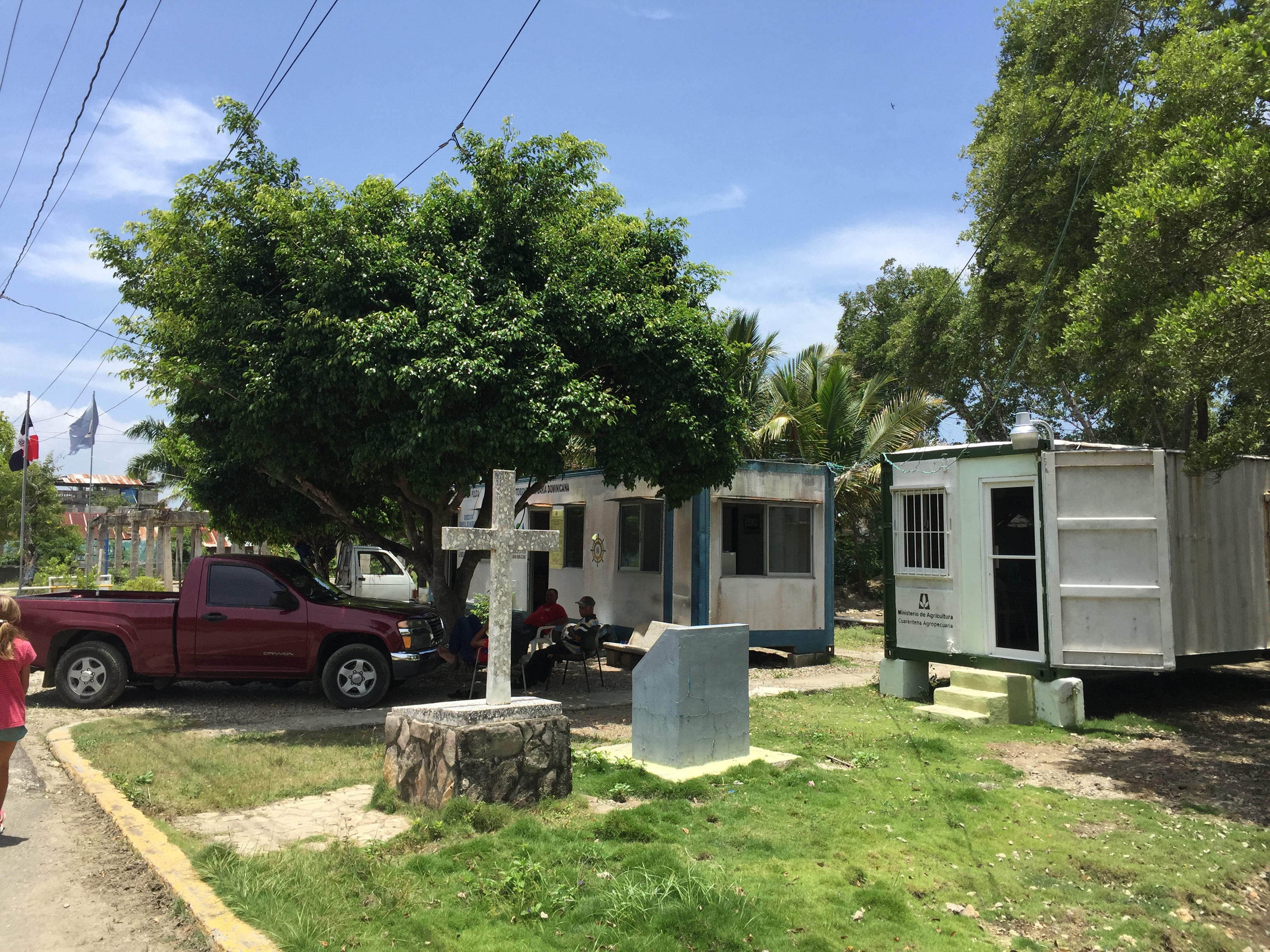
It cost our family of six $224 U.S. to check into the DR. As well, we are expected to pay $20/month during our stay, plus departure fees. To check in, my husband met with six different people, all representing different departments. These departments included: Immigration, Interior Ministry, Luperón Port Authority, Customs, Agriculture, and the Navy. Check-in took about an hour to complete.
We were not asked to make donations or pay bribes. But some of the fees — such as the tourist cards, which cost $10 per person — seem to apply to people coming from Canada or the U.S. only. Europeans and other nationalities were not asked to buy tourist cards.
I have had some culture shock in the DR. I will elaborate on some of the challenges in a separate post. Hopefully, before the shock wears off.
The short story is that we don’t speak Spanish. I was not prepared to see poverty amongst the children who play baseball with sticks, or who wear oversized sandals.
As well, there have been cultural surprises such as organised cockfighting. Tonight, there were organised cockfights in Luperón. Our kids ask lots of questions.
We opted out of the cockfighting event and played trivia with some other cruisers at a restaurant called “The Lazy Ass” instead. Tomorrow night, we’ll be playing baseball with Andy’s children.
Kindness Ashore: A Fisherman in Luperón
Originally published on June 24, 2016
A few days ago, our family was returning to our dinghy after spending some time in the town of Luperón. The kids ran ahead. Soon, our family was strung out along the road like random beads.
As we walked, we trailed behind a fisherman pushing a wheelbarrow. The wheelbarrow contained a homemade air compressor, fashioned out of an old beer keg. The man pushing the wheelbarrow walked slowly. He was covered in dust and drenched in sweat.
We continued to walk in the heat behind the man, but we arrived at the dinghy dock at the same time as he did. As I was about to pass him, he asked for help, in English. My husband, Rick, helped him to carry the air compressor down to to dinghy dock.
The man introduced himself. His name came and went in my mind. But his face burned a hole in my memory.
I ran into him again today. By chance, he appeared at the Luperón medical clinic.
I saw him out of the corner of my eye, as I struggled to communicate my health issue to the Spanish-speaking doctor. The doctor did his best. He even used a Spanish-English dictionary. Eventually, the doctor asked the fisherman if he could help translate.
Because I have grown up in Canada — a culture that values patient confidentiality — the process of revealing my medical concerns to another patient was rather awkward.
The doctor asked the fisherman to ask me about the nature of my problem. My situation was minor — especially compared to the fisherman who was being treated for a barracuda bite.
Yet, he, another male patient, and at least two nurses were happy to help and discuss the situation among themselves. They conferred in Spanish, and then the fisherman would ask me questions. Then, the rapid-fire Spanish would begin again. In the end, the doctor suggested I go to Puerto Plata to see a specialist.
Puerto Plata is an hour away by car. To my amazement, the fisherman offered to drive me. He wrote his full name on a piece of paper.
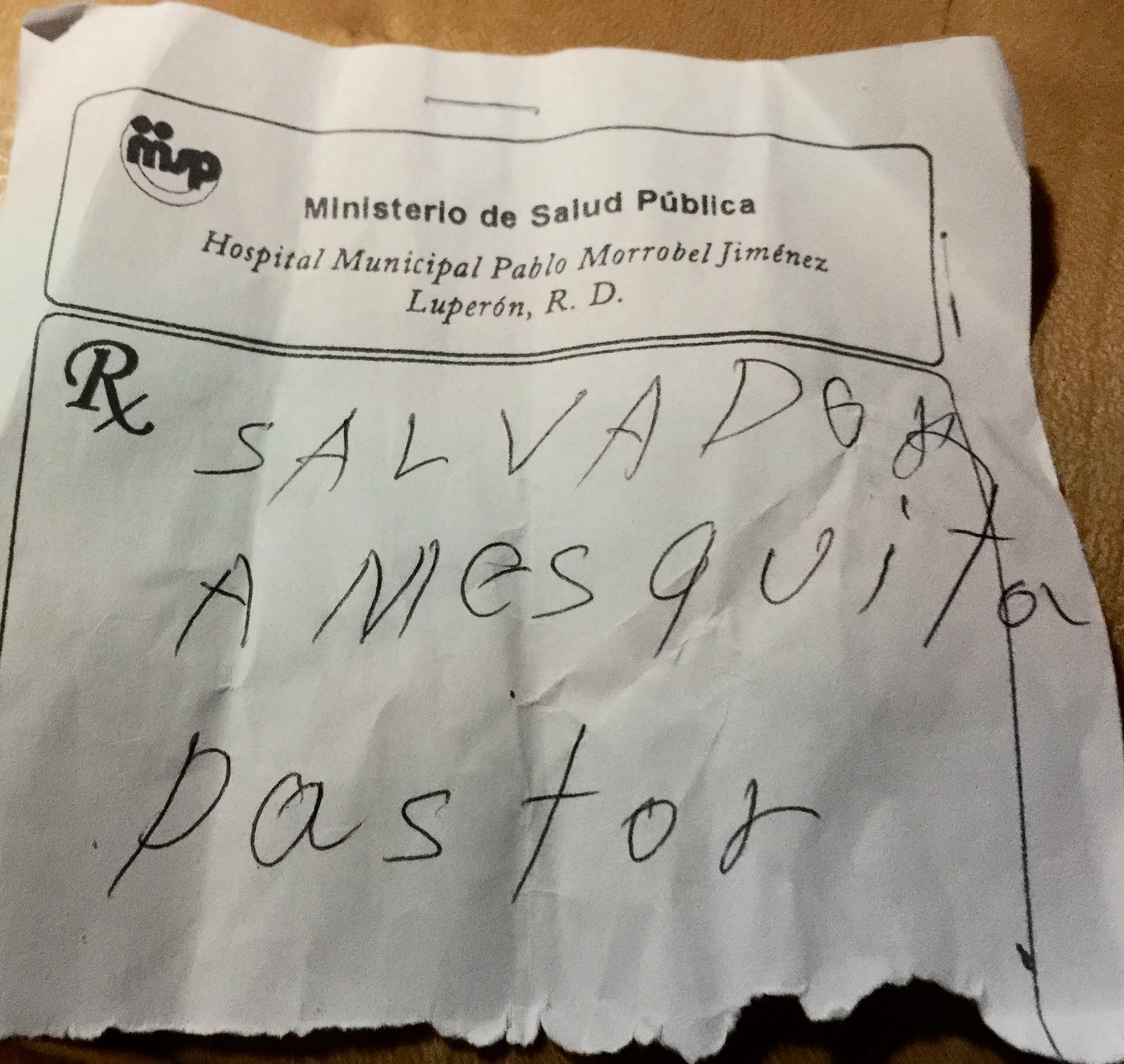
I was to meet Salvador at the dinghy dock at 6 a.m. He said he would call the specialist to arrange for me to be seen. The specialist was American — and definitely not free — but he did speak English.
When I returned to my boat, I contacted our travel doctor in Ottawa by email. He made some suggestions and didn’t think it was necessary for me to go to Puerto Plata. He said he was “happy to help out, together with Salvador.”
As luck would have it, Salvador reappeared near the dinghy dock this afternoon. I told him I no longer needed him to take me to Puerto Plata. He smiled and was happy to hear I had found a solution to my medical concerns.
Salvador Amesquita Pastor. I won’t forget his name again.
Beans! Beans! Beans! Abandoning Meat in the Dominican Republic
Originally published on July 12, 2016
We have been in Luperón, Dominican Republic, for six weeks. Of course, cultural differences still exist from what I’m used to in Canada. But I am no longer wringing my hands because the celery looks floppy. In fact, today, I bought a cabbage that was being ravaged by live caterpillars. I discarded the outer leaves. Everyone is happy.
This blog post highlights the cultural difference that has affected me most: meat.
I haven’t eaten meat or eggs since we arrived in the Dominican Republic. I can’t get past the fact that the meat here looks like the animal from whence it came.
Chickens without antibiotics are actually scrawny beasts. Egg yolks are slightly less perky, and there are no dates stamped on the eggshells.
I’m accustomed to eating highly processed items. The irony is that — assuming there is reliable refrigeration — the meat and eggs here are probably better for me than what I consume in Canada.
Lunch on Aphrodite with celebrity sailor and cruising guru: Bruce Van Sant
Originally published on August 11, 2016
In late March 2016, our friends Dave and Nathalie Houston hosted two of their friends on their boat Cheval in George Town, Bahamas. Their guests were travelling lightly from Colorado. But they agreed to bring us a much-anticipated book: Bruce Van Sant’s The Gentleman’s Guide for Passages South, 10th and final edition.
We had heard about the book before we arrived in the Bahamas. But in Shroud Cay, Bahamas, another cruiser suggested the book to us. The book was particularly relevant to our situation but it was hard to find in some of the remote areas where we were travelling. Among other things, The Gentleman’s Guide describes a method for sailing from the Bahamas to Luperón, Dominican Republic.
Needless to say, we received The Gentleman’s Guide with the zeal of a jeweller examining a precious gem. We studied the book for two months. We discussed his ideas with other cruisers who were also interested in his methodology and routing suggestions.
Even our kids enjoyed looking at the picture of Bruce Van Sant on the front cover of his book. They noticed his striking similarity to Indiana Jones.
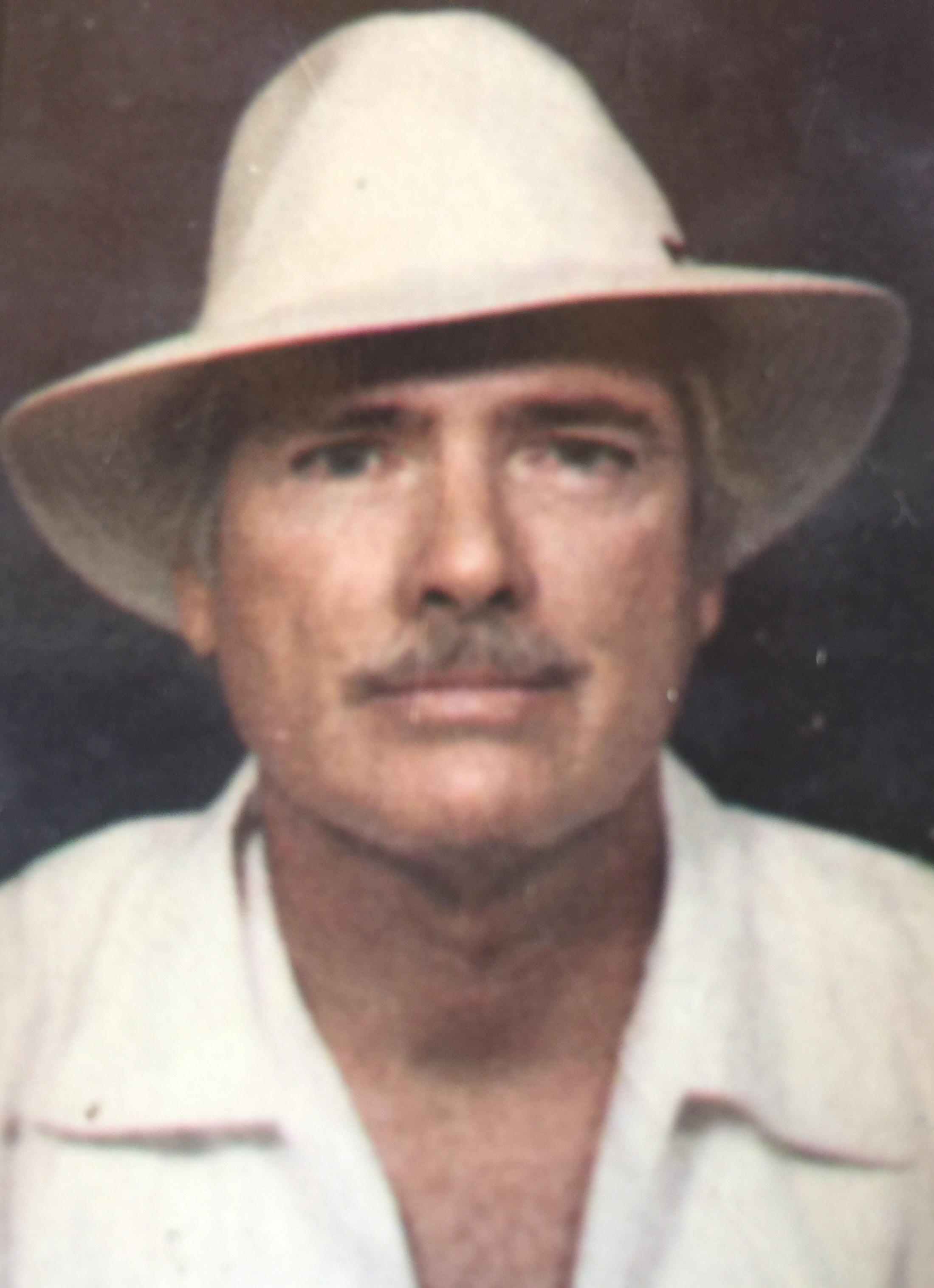

Bruce has four decades of sailing experience. He has earned the right to wear a fedora.
Bruce’s book provides a firm kick in the pants to cruisers like ourselves who thought of medical kits and provisioning without attending to basic sailing essentials like good charts (The Gentleman’s Guide, page 10).
Bruce’s wise words crept up on us like mold on a fungus. We were dumbfounded, in hindsight, that we had left Florida without buying charts or flags to sail south from the Bahamas, thinking instead we could pick them up as we went. So, in George Town, Bahamas, we acquired many of the charts we needed for the coming year. Rick bought Weatherfax software for our PC and began to gather weather data using SSB.
Bruce himself acknowledges that his book is “plain-spoken, straightforward skinny unsoftened by perhapses and maybes.” Because of his no-nonsense, rules-oriented approach, I mentally pegged him as the sort of person who is prone to verbal jousts. Yet, I wanted to get his thoughts on our mooring construction in Luperón. So, I sent him an email.
I was delighted when he wrote back. It seems that Bruce liked our mooring design. Here is an excerpt from his email to me:
While you’ve done a great job and overkilled it (if that’s indeed possible to overkill on a mooring), be aware that the danger in Luperón comes from the rampaging flotilla of unmoored boats dragging into you. They’ll fine tooth comb the bottom with their dragging anchors and make a fine mess of tackle-tangled boats which can wrap around your steady-moored boat and beat it to death from all sides.
Knowing that Bruce and his wife, Rosa, lived close to Luperón, I invited them to lunch on Aphrodite.
Bruce and Rosa accepted our invitation, prompting us to polish our cockpit to oblivion. (It’s not every day that we have a celebrity on our boat.) Bruce and Rosa agreed to meet us in Luperón, at the dinghy dock of the Puerto Blanco Marina.
Before boarding our dinghy, Bruce and Rosa suggested we have a drink at the marina restaurant. It was evident that they are well-loved in the Luperón area. Our table became a revolving door for traffic — as people stopped to greet Bruce and Rosa with a hug.
An hour later, our son Paul drove us by dinghy to our boat. Paul enjoyed Bruce’s company and leapt into this picture that I took in our cockpit.

Bruce later wrote:
Paul was the manliest 8-year-old I’ve ever met — and a fine helmsman too!
Over lunch we talked about Bruce’s book and his background in space physics. I was amazed to think that 18 months ago I struggled to understand basic sailing terms. Yet, here I was eating salsa and talking to Bruce about his book. For three months I had hoped to have a “Bruce sighting” here in Luperón. And now here he was on our boat.
Bruce signed our book before he left, and I drove him and Rosa back to the dinghy dock.

If you had seen me on the water, I would have appeared as a white light blasting across the waves, carrying Bruce and Rosa across the harbour in the dinghy.
Imagine, just 10 months ago I learned to drive our dinghy. It doesn’t seem that long ago when I drove our dinghy in circles. In one case, I connected a child’s head with a mangrove branch in a narrow channel.
Still we shot through the air on our way back to Puerto Blanco Marina. I could have burst — so pleased was I with the success of our lunch and my ability to drive the dinghy.
And then, my overzealous moment was over. As if synchronized on cue, Bruce and Rosa motioned for me to slow down as we entered the marina. They each told me in their kindly way that the waves would rock the boats. I was Icarus with waxen wings — and had perhaps flown too close to the sun.
Bruce and Rosa got out of the dinghy. We made plans to see them again at their house near Puerto Plata.
In June 2026, Bruce passed away. We are honoured to have met him and to have spent time at his home. He will be missed. Here is a link to the interview he did for CruiserTV when he was on our boat, SV Aphrodite, in Luperon.
The saga of Leo’s helm
Originally published on August 25, 2016
Yesterday, I visited an engine repair shop in Puerto Plata. But I could have been in any independently-run engine repair shop. With its familiar oily smell, shops like these provide a visual assault of black rubber belts and gaskets, along with colorful engine parts — most often red. Apart from speaking Spanish, the only obvious difference was the abundance of apprentices who appeared to be barely out of highschool.
For this trip, I was with two other cruisers — Leo and Fabio. They are both single-handers, which means that they sail solo on their own boats. And when they sail for long periods they must manage sleep as they sail. One single-hander in Luperón told me that the secret is to sleep in awkward positions so as not to sleep for too long. Clearly, having a functioning and dependable autopilot is essential.

For me, this trip to Puerto Plata was a rare day out without my children and an opportunity to visit a large grocery store. We ate lunch in a restaurant and I revelled in the sensation of having no responsibilities.
Leo, on the other hand, was worried. Although not prone to panic, the future of his sailing endeavor, in some ways, hinged on the success of our trip to Puerto Plata. I shall explain.
Leo was visiting Puerto Plata in hopes of fixing the steering on his boat. Leo said that the steering had always felt a little stiff, but he thought it was because he was sailing a heavier craft than he was accustomed to. His steering was so stiff that his autopilot was unable to steer the boat. That can be deadly for a single-hander. Since arriving in Luperón, the steering had seized completely.
Leo removed the seized part from his helm. It was the gear and shaft assembly holding the steering wheel. He brought the assembly with him to the machine shop. Leo was a bit worried that the shop might force it to the point of breakage. If any part of it broke, it would be very difficult to replace, not impossible, but close. Leo’s boat is thirty years old.
When we arrived at the shop, a man inspected the seized assembly.

In short order, another man sprayed it with an oily lubricant. That didn’t help. That was followed by putting the part in a vise while the owner of the shop brought out a blowtorch. He heated one end. Soon, the bushing was dripping black oil, which was the residue from the aforementioned oily lubricant.
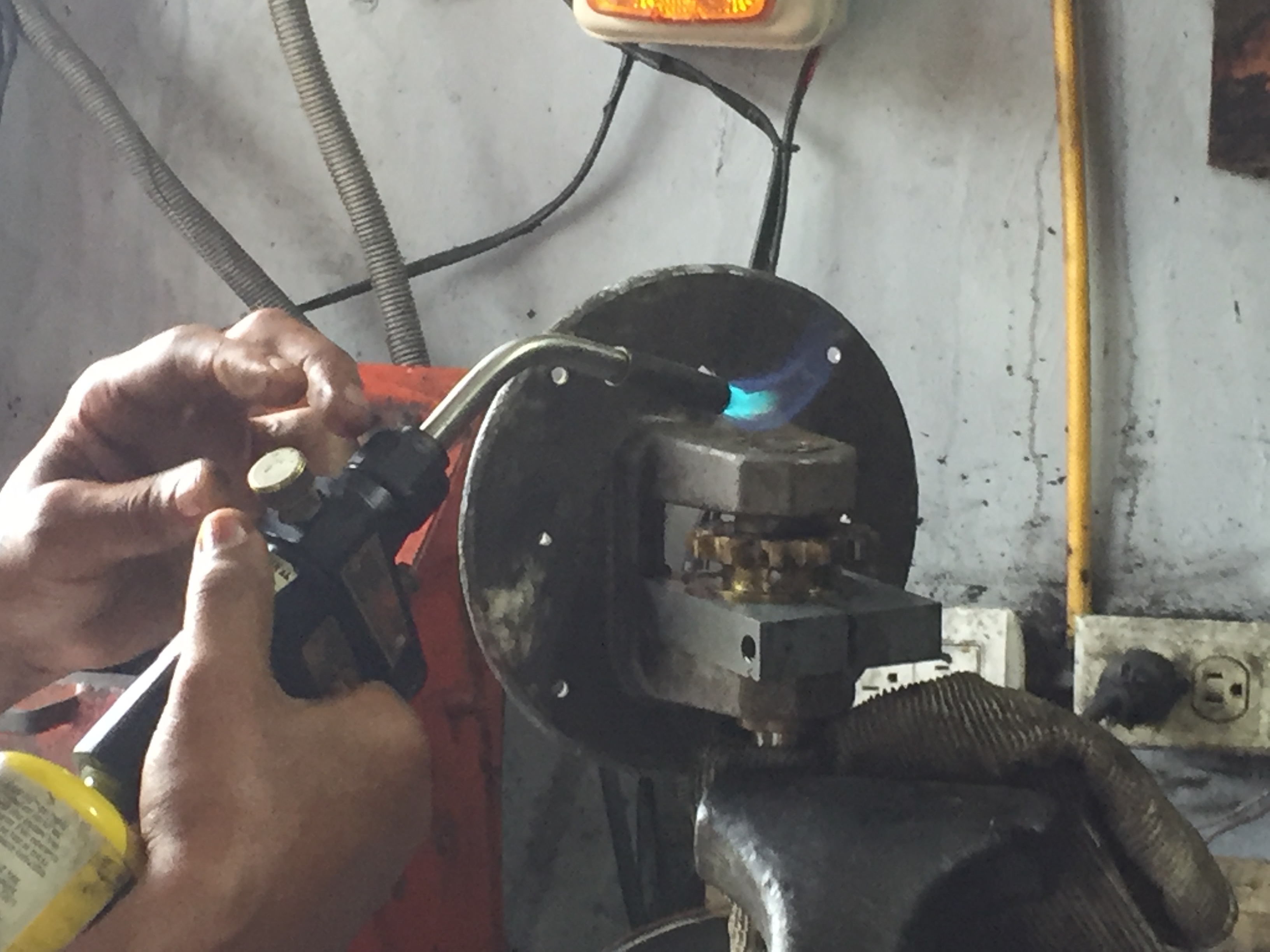
Following the blowtorch, the shaft began to move, albeit with force. The apprentices wrapped it in a cloth and took turns cranking on the part. After a few minutes, the owner took a product called Carb Clean from his store shelves. He sprayed the shaft and bushing, and within minutes the seized shaft was spinning like new.

I was amazed. I picked up a can of Carb Clean, inspected it, and put it back on the shelf. But the dusty-looking product haunted me. For 185 pesos, about $4 U.S., I could not go wrong.
Back at the boat, I gave the can of Carb Clean to my husband. He was familiar with the type of product and said that it was stronger than the product we already had onboard — at least that is what he told me. I am so pleased. I didn’t expect to feel this excited about buying engine cleaner.
We returned to Luperón in the late afternoon. The day trip was a success in more ways than one.

When Hurricane Matthew Passed 355 km from Luperón
On October 5, 2016 we remained on our boat in the Luperón harbour during Hurricane Matthew. Some sailors were nervous but we know of one boat owner who actually left for a short vacation during the storm.
Wind gusts reached about 40 knots. No boats sustained any damage.

Leaving the Luperón hurricane hole: a story of red tape
Originally published on September 3, 2016
We were in Luperón, Dominican Republic (DR) for six months. The departure process was confusing. At one point, we considered involving our embassy to help us leave. In the end we left thanks to the help of some local people who had connections and influence.
Would we need a survey?
Our first clue that leaving Luperón might be tricky occurred more than a month before our departure. The Navy comandante (pronounced Commandan-tay) was new and interpreted the rules about departure a little differently than his predecessor.
Another sailor was told that, before he could leave, he must go to Santo Domingo and get a marine survey to indicate that his boat was seaworthy. Santo Domingo is about a 4- or 5-hour drive from Luperón. The cost of a survey was a worry.
Our friend managed to leave Luperón without incident. The remaining cruisers rejoiced. We all thought that leaving Luperón would be straightforward.
More Confusion Unfurled
Then another cruiser wanted to go for a day sail. He was denied permission. And as the bad news spread across the harbour, other cruisers worried.
One cruising boat was headed for Haiti. These sailors were watching the weather and wanted to understand and comply with the proper procedures to ensure that they could leave on the day that they had planned.
To be clear, with sailing, weather is extremely important. It’s not as though cruisers might make an early start because they are early-morning go-getters. Well, some might. In general, the weather dictates when it is best to sail. This is why the departure process in the DR was so infuriating. How could people sail safely when hours mattered and Luperón seemed to be on island time?
The trouble was that it was not possible to pre-arrange a departure. The involvement from the Luperón comandante occurs on the day of departure only. I’ve seen boats sit in the harbour all day waiting for the comandante to arrive with their official permission slip of departure — a despacho document. Meanwhile, they have lost a full day of sailing, which might impact their safety at sea.
The Luperón Cruisers Association held a meeting to discuss a solution.
Local Leadership Steps In
A local woman offered to help with the departure paperwork and talk to the comandante. But, leaving nothing to chance, the Haiti-bound cruisers solicited the help of another person as well, who was also thought to have clout with the comandante.
Departure Process
When all was said and done, as many as seven boats were planning to leave Luperón at about the same time. One cruiser told me he was getting his paperwork done early. He wanted to make sure his departure was not postponed because of the volume of boats leaving the harbour. It was all he could do, really.
Everyone was at the mercy of the system and watched to see how it would unfold in the arena of the anchorage. All eyes were on the departing boats.
With the Haiti-bound boat, the Luperón comandante arrived as promised.
Later, in the afternoon, the comandante arrived in a cruiser’s dinghy with the necessary departure papers. But, the cruiser was too forthcoming. After telling the comandante that he would be leaving the following evening, the despacho was retracted.
The next day — on the day of our departure — I was off the boat with our kids when the comandante arrived. The comandante was suitably placated with raisins and coffee.
When it was over, the comandante took some raisins to go. We had our despacho. We were good to go to Puerto Rico and beyond.
I already miss the Luperón hurricane hole, but I don’t miss the bureaucracy. Many thanks to the people who helped us leave when the weather was favourable.
Related posts: