
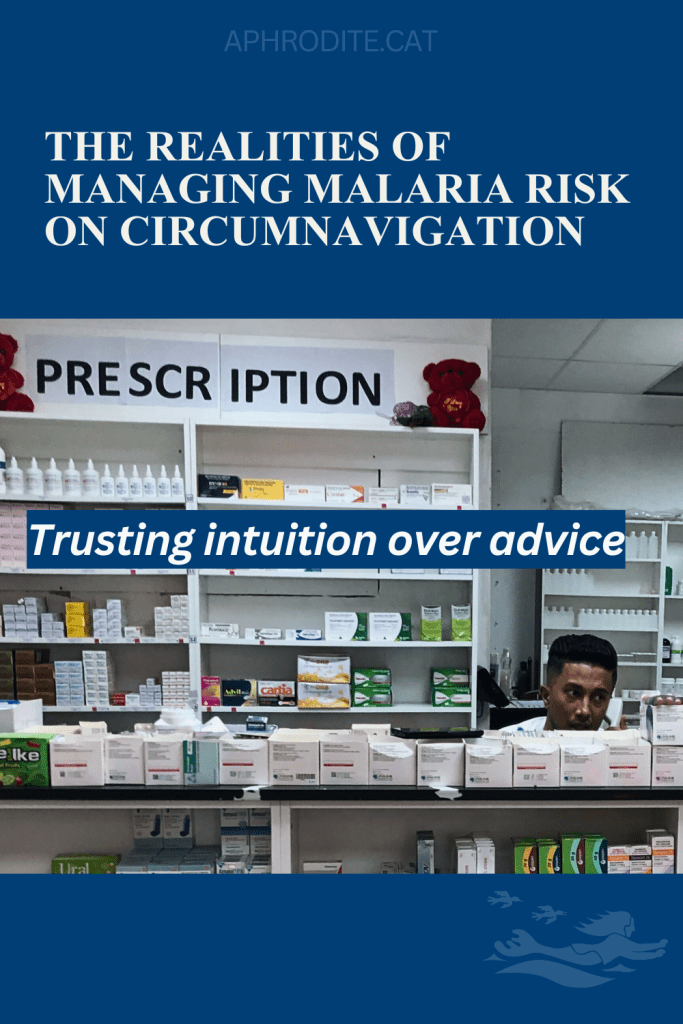
Pharmacy in Labasa, 2023
A bottle of 200 anti-malarial pills sat on the table before me. Something didn’t feel right.
Just a day before I had stood in front of a small woman in neat, navy pinstripe. “I hate to ask you again, but are you sure this medicine is on my list?” I looked at the bottle of pills she had given to me, and again showed her my short-list of effective medications for Vanuatu.
“Yes.” Her eyes darted to her feet. “It’s a derivative of mefloquine.”
“Okay,” I said, a little uneasy with her reply, although I had asked her twice. “What if I catch malaria? Do I alter the dose?”
“Yes, it’s all on the web.”
Can I trust the pharmacist?
For the first time in 8 years, I really miss the security of medical care in Canada. Here, in Fiji, the anti-malarial medicines are limited. The village doctor was available but my appointment was unusual.
An unusual doctor’s visit in Savusavu
Without getting too specific, I went to the doctor to discuss anti-malarial medication for Vanuatu. Instead, the doctor talked at length about being Muslim in Fiji: the mosques, and the schisms. Then, the shootings in Christchurch: “It was a Friday when they knew people would be at prayer.” He spoke with such conviction, and the situation being so tragic, I found myself struggling with my lower lip.
He opened the door, and quickly checked the heartbeat of another patient. When the man left the room, the doctor continued, “Jesus is mentioned more times in the Quran than Mohammed.” In short order, the conversation became dark and began to enter the world of politics. I think he may have just wanted to show his more human side as we developed our patient-doctor relationship.
When the conversation began to fizzle, the doctor shifted in his seat and directed me to the CDC website. He suggested that I use this site to determine, on a country-by-country basis, whether the mosquitos in that area were resistant to any anti-malarial drugs. From there, I could determine the type of anti-malarial drug to suit my needs. The doctor gave me his business card. I was not charged for the visit.
Trusting my intuition
I really should have called the doctor when I had misgivings at the pharmacy in Labasa. He would have identified that hydroxychloroquine was not in the same family as mefloquine as the pharmacist had suggested. Hydroxychloroquine would have been useless in Vanuatu where malaria parasites have developed a resistance to chloroquine.
Hotline: German pharmacist and friend
As it stood, I was looking at the pill bottle, and pulling out my hair trying to make sense of this mistake. Finally, I reached out to pharmacist and friend, Martin Fischer, who works at Adler-Apotheke Kettwig in Germany. Martin confirmed that the medicine that I’d purchased was inappropriate for malaria in the countries we are visiting. He also gave me some information that I didn’t know: “Keep in mind, that chemoprophylaxis does not prevent the infection, it only weakens the symptoms!”
Malaria avoidance strategies
To avoid malaria, we now own bed nets, mosquito coils and bug repellant. I am looking at ways to use netting on our windows and to seal our cockpit enclosure. We do not plan to purchase malaria test kits. Rick says the screams would be a dead giveaway. He would know as he once heard the screams of malaria patients when he visited Quito, Ecuador.
Buying the right malaria medication in Fiji
I reached out again to the pharmacy in Labasa. They kindly asked me to return my pills to my local branch in Savusavu. I was relieved as this saved me another 2-hour bus trip to Labasa. In Savusavu, pharmacist Ajinesh Chand exchanged the original, weekly medication for 1,100 doxycycline pills to be taken daily. To gather such a large supply, Ajinesh had to arrange for the medicine to come by bus from the shop in Labasa. I returned to his shop in the afternoon, after the bus had arrived, to pick up my supply of medication. I appreciated his help very much.

One of the side effects of doxycycline is photosensitivity. We have stocked up on SPF 50 and plan to use it.
Malarone: unavailable in Fiji
Malarone would have been my first choice. It is what Rick was taking when he used to travel to India and elsewhere for work. I feel some lingering reassurance, nearing patriotism, that Malarone would have been a better choice as it was what our Canadian travel doctor recommended when we were in Canada. Malarone does not seem to be available in Fiji, despite making a dozen or more phone calls.
For anyone interested, the Malarone medication is available in New Zealand and Malaysia.
Pin it
If you enjoyed this story, you can save it to your own Pinterest board using the image below. Thanks for reading and following our journey.
 Becoming a Sailor
What a wonderful writer you are, so descriptive. I’m enjoying reading along with you on your travels. I have so many questions. How is school going? Is Betty graduating this year? I totally missed the crossing from Central America to New Zealand. When did that happen and how long were you in NZ? Did you hire the more experienced sailor to accompany you?
LikeLike
Oh my. I prefer Malarone too! But doxy is so much easier to find around the world, and cheaper, if you don’t mind the metallic taste and the occasional nightmare.
I’d have been concerned if someone suggested actual mefloquine, however, as there are more and more reports of some very bad side effects.
Can you get some netting that is empregnated with DDT? My parents use that in Angola, and it’s been very helpful for the hospital where they work.
Looking forward to the days when the malaria vaccine trials are complete and the whole world can get access to something less annoying than prophylaxis!
LikeLike