
A fish hook injury at sea was not on my mind as I settled in for an early night. Yet, within minutes I heard a commotion. I sprang out of bed to see what was going on. Hands were gesturing. Rick was with our kids in the cockpit. And then Paul turned around to reveal a fish hook hanging from his face.
He is lucky he still has an eye.
As the boys tell it, just before bed, Henry rocked in a hammock in our cockpit, and a fishing rod fell from its overhead storage holder. Paul was talking to Henry at the time. We had asked the boys to remove the fish hook earlier in the day. Unfortunately, we didn’t follow up to see that it had been done. A fish hook entered Paul’s skin just below his left eye.
Fish hook injury at sea — photos
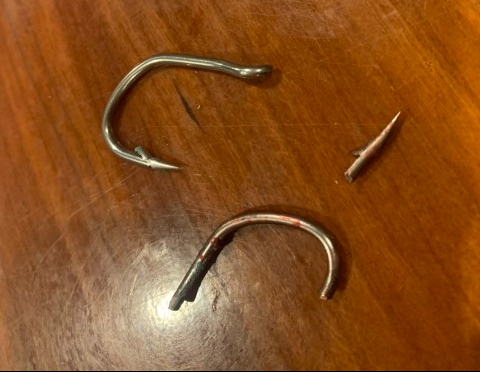
It was a large, barbed double hook.

We were in Munda, Solomon Islands. It was dark, and we were anchored out in the harbour. The harbour is reached by traversing two reefs.
With no hope of finding a medical professional, we were faced with removing the hook ourselves. We texted a friend who is an emergency room doctor, Dr. Pamela Petersen. She is an American who now lives in Denmark. We met her when she was sailing with her family in the Bahamas.
Meanwhile, Rick cut off the exposed side of the fish hook using 18-inch bolt cutters. He also used the cutters to remove the curve of the double fish hook. Because he was concerned about causing nerve damage, he wanted the remaining embedded piece of fish hook to be as straight as possible. He had to be careful as he was using the cutters very close to Paul’s eye.


To treat a fish hook injury, Dr. Petersen suggested we could either:
- push the barb through his cheek, cut it off, and then back out the remaining hook, or,
- we could use a scalpel.
She felt that nerve damage was unlikely because the hook would be traveling the same way that it had entered.
Paul’s pain was managed with tramadol and tooth-numbing gel, which was blue and applied liberally to his cheek. Paul lay on a yoga mat with his head propped up on a pillow. Rick was planning to remove the fish hook by pushing it through his skin. He used a black marker to draw on Paul’s skin where he thought the pointy barb might exit.
Henry’s job was to steady the bolt cutters. My job was to hold Paul’s hands.
We dabbed at the hook with alcohol to keep the area clean. At first, Paul’s cheek was very stretchy and resisted being pierced. I’ve since learned that this is what medical professionals refer to as “tenting.”
At one point, we lost our nerve. Then, I discovered that there was a small hospital called the Helena Goldie Hospital on shore. After several attempts, I reached the hospital, and someone answered with, “Who this?”
I tried to explain my situation. There was a language barrier. Then my cell phone ran out of minutes. They called me back, asked me to call them instead, and then hung up. We tried several methods to reach the hospital, but we gave up. Our failed phone calls were delaying the hook removal.
The hook had to be removed to avoid infection. So, we took it upon ourselves to proceed.
Henry held gauze over Paul’s eye. Rick guided the fish hook with vice grips and used a large washer to push against Paul’s cheek. Holding the washer in place, Rick pushed the barb through Paul’s cheek. The piercing took about two minutes.
Then the barb was removed using bolt cutters. Finally, the longer end of the fish hook was pulled upward and out of Paul’s skin. This part of the fish hook came out very easily.

Paul slept well and is now taking oral antibiotics to minimize the risk of infection. We have since removed the overhead fishing rods. Paul feels no pain, and his wound looks so tidy that I wouldn’t be surprised if it heals without a scar.

Update: Paul’s scar healed so nicely that an eye doctor in Malaysia had trouble finding the scar. He seemed impressed with our family effort and agreed that Paul was lucky not to lose his eye. I’m glad the fish hook injury is behind us and all that is left is a story to tell.
Pin it
If you enjoyed this story, you can save it to your own Pinterest board using one or all of the images below. Thanks for reading and following our journey.


Related posts
Good for you all to have worked together to deal with this emergency. Have a good recovery Paul. Marthe xx
OMG! So terrifying. I was in the edge of my seat, sphincter muscles fully engaged (tmi?). It was a brilliant idea to use a washer to hold the skin in place. He will make a full recovery thanks to the fast action of his family. Now Paul can truthfully say he knows how a fish feels, lol. I am sending hugs, love and healing vibes.
Mom
Wow Paul!! I’m glad everything turned out ok.